
By continuing, you agree to LoansJagat's Credit Report Terms of Use, Terms and Conditions, Privacy Policy, and authorize contact via Call, SMS, Email, or WhatsApp
Disclaimer: The information published on LoansJagat is intended for general informational and educational purposes only and should not be considered financial, legal, or investment advice. Interest rates, loan terms, statistics, and other data may change over time and may vary by lender or source. Please verify the latest information and consult a qualified financial advisor or the respective Bank/NBFC before making any financial decisions.
Subscribe Now
About the author

LoansJagat Team
‘Simplify Finance for Everyone.’ This is the common goal of our team, as we try to explain any topic with relatable examples. From personal to business finance, managing EMIs to becoming debt-free, we do extensive research on each and every parameter, so you don’t have to. Scroll up and have a look at what 15+ years of experience in the BFSI sector looks like.
Related News
Simplify All Your Loans Into One Affordable EMI

Customers Served

Debt Consolidated

1200+ Reviews

Locations in India
Club all Loans & Credit Card Bills into Single EMI

Quick Apply Loan
Consolidate your debts into one easy EMI.

Takes less than 2 minutes. No paperwork.

10 Lakhs+
Trusted Customers

2000 Cr+
Loans Disbursed

4.7/5
Google Reviews

50+
Banks & NBFCs Offers
Other services mentioned in this article
Key Insights
Read More - Indian Banks Are Beating Western Lenders
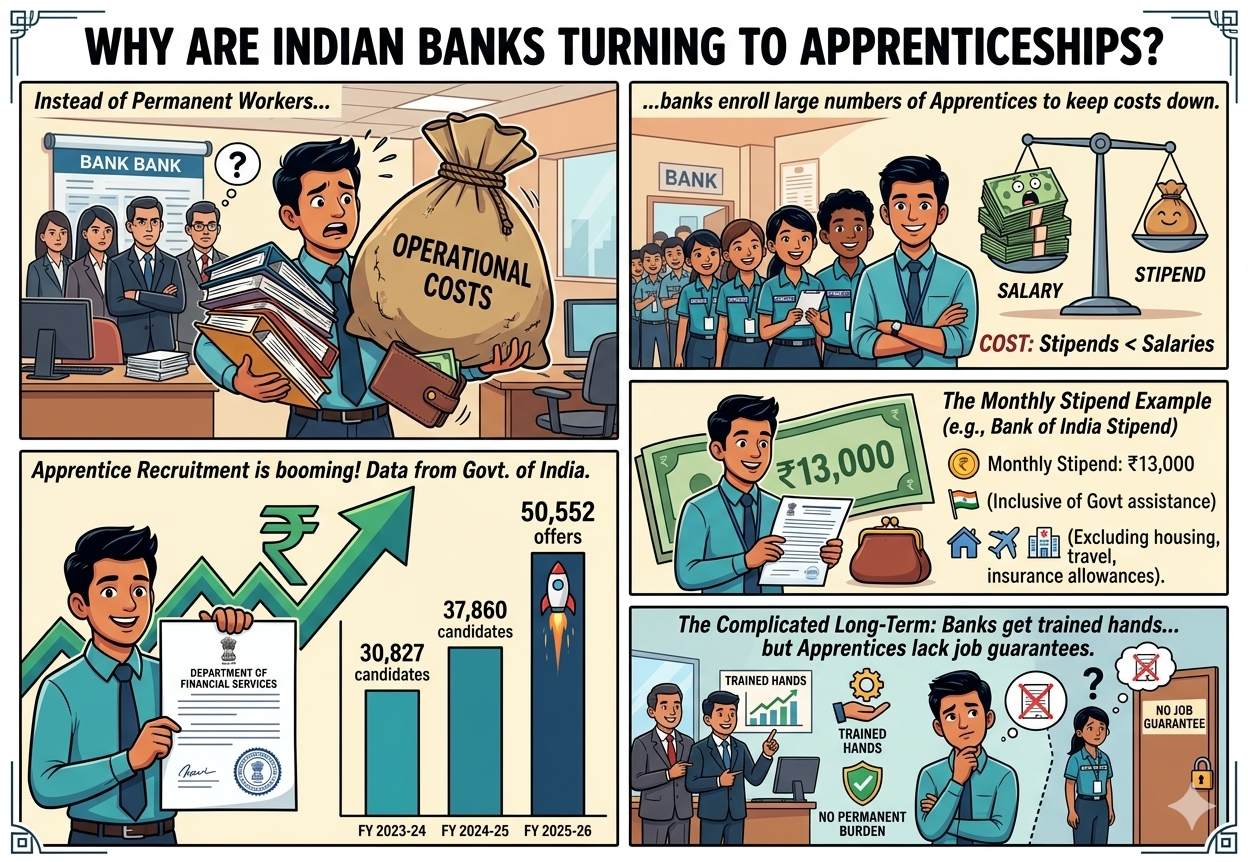
Public sector banks in India have found a new way of recruiting employees. Instead of hiring permanent workers, the leading banks are enrolling large numbers of apprentices to keep their operational costs down.
The Department of Financial Services, Ministry of Finance, has reported that there was a selection and issuance of offer letters to 50,552 candidates for the recruitment of apprentices in FY 2025-26.
The same figure stood at 37,860 candidates in FY 2024-25 and 30,827 candidates in FY 2023-24.
The short-term advantage is stipends cost far less than salaries.
For example, the Bank of India offers a stipend of ₹13,000 per month, inclusive of government assistance, to apprentices, excluding the provision of housing, travelling, and insurance allowances.
However, the long-term implication might be more complicated, with banks receiving the advantages of being able to engage trained hands without the burden of employing permanent staff, while apprentices are unable to receive any job guarantees.
A deeper dive into apprentice hiring by banks gives an insight into the systematic approach behind it. The table below shows key details:
It can be observed that Union Bank of India is increasing the number of apprentice positions significantly as compared to previous recruitment rounds. This indicates that the short-term workforce training model provides banks an opportunity to scale up.
What remains a consistent factor of all these recruitments is that they do not provide apprentices with any job guarantees.
This trend has implications not only for the banking industry in India but for millions of youth graduates who can now join one of the leading banks through the apprentice programme.
For example, Indian Bank’s apprentice programme is open to candidates of all academic backgrounds and offers opportunities to experience the banking field according to the Apprentices Act, 1961. This makes it easier for graduates to apply for these roles.
The positive impact is twofold. First of all, the Finance Ministry expects this move to result in improved quality of service delivery, enhance banking services reach in underserved regions, and promote financial inclusion.
The branches of public sector banks in rural and semi-urban India are expected to see tangible benefits from this initiative.
*T&C Apply
It appears that banks are making a strategic decision, rather than a simple cost-saving move from the analysis standpoint.
As mentioned by the Ministry of Finance, workforce expansion in a calculated way is critical for proper human resource management and ensures optimal staffing and operational efficiency.
Also Read - Banks Face the Hardest Hit to Capital?
Experts note that there is a rapid expansion of the Indian banking sector across geography, online platforms, and credit products. Apprentice recruitment allows banks to scale up without increasing the burden of salary bills.
The Finance Ministry has declared its intention to ensure that public sector banks receive the required amount of skilled and future-ready human resources for further financial inclusion and economic development.
India’s banks are growing. Apprenticeship hiring appears to be an effective tool for this. It remains to be seen whether the banks are going to turn this tool into sustainable competitive advantage.
Will the increase in apprentice hiring affect IBPS Clerk vacancies in the future?
There may be some decrease in normal IBPS Clerk hiring due to apprentices being less costly and flexible in employment terms. But, the vacancies would not go away totally because banks require staff members for ongoing processes.
Why do banks hire apprentices instead of making permanent hires?
Banks would rather hire apprentices as this helps in reducing salary expenditure and offers flexibility in employing manpower. Permanent hiring would mean higher expenses on salaries in the long term.









.png&w=3840&q=75)



