
By continuing, you agree to LoansJagat's Credit Report Terms of Use, Terms and Conditions, Privacy Policy, and authorize contact via Call, SMS, Email, or WhatsApp
Disclaimer: The information published on LoansJagat is intended for general informational and educational purposes only and should not be considered financial, legal, or investment advice. Interest rates, loan terms, statistics, and other data may change over time and may vary by lender or source. Please verify the latest information and consult a qualified financial advisor or the respective Bank/NBFC before making any financial decisions.
Subscribe Now
About the author

LoansJagat Team
‘Simplify Finance for Everyone.’ This is the common goal of our team, as we try to explain any topic with relatable examples. From personal to business finance, managing EMIs to becoming debt-free, we do extensive research on each and every parameter, so you don’t have to. Scroll up and have a look at what 15+ years of experience in the BFSI sector looks like.
Related News
Simplify All Your Loans Into One Affordable EMI

Customers Served

Debt Consolidated

1200+ Reviews

Locations in India
Club all Loans & Credit Card Bills into Single EMI

Quick Apply Loan
Consolidate your debts into one easy EMI.

Takes less than 2 minutes. No paperwork.

10 Lakhs+
Trusted Customers

2000 Cr+
Loans Disbursed

4.7/5
Google Reviews

50+
Banks & NBFCs Offers
Other services mentioned in this article
Key Insights
RBI Throws a Lifeline to Keep India’s Banking System Alive Through a $5 Billion Swap Auction
The Reserve Bank of India announces that it plans to hold a USD/INR swap auction of $5 billion dollars to inject lasting liquidity in the banking system.
Banks will sell their US dollars to the RBI in return for rupees under this swap arrangement. After three years, the RBI will give back the dollars to the banks and get rupees from them.
The auction period will start from 10:30 am to 11:30 am. The near leg settlement date will be set on May 29, 2026, while the far leg maturity date will fall on May 29, 2029.
The rupee had been trading at levels just above 96.96 against the US dollar due to rising oil prices, the impact of the West Asian conflict on geopolitics, and significant outflows of foreign money from India[‘s stock market.
This swap is projected to inject about ₹42,000 crores to ₹43,000 crores of liquidity in the banking system. This helps in relieving the cash crisis that has been building up within the banks for a couple of months now.
However, the fragility of the rupee still continues to be an issue. Every time a dollar gets sold off to defend the rupee, a rupee gets withdrawn from the system in terms of liquidity.
Here are the Reserve Bank’s USD/INR swaps in the last few months.
The earlier auctions were significantly oversubscribed with banks offering more dollar denominations than what RBI offered in each of the auctions.
These figures indicate that there had been a severe lack of liquidity within the banks for a couple of months now.
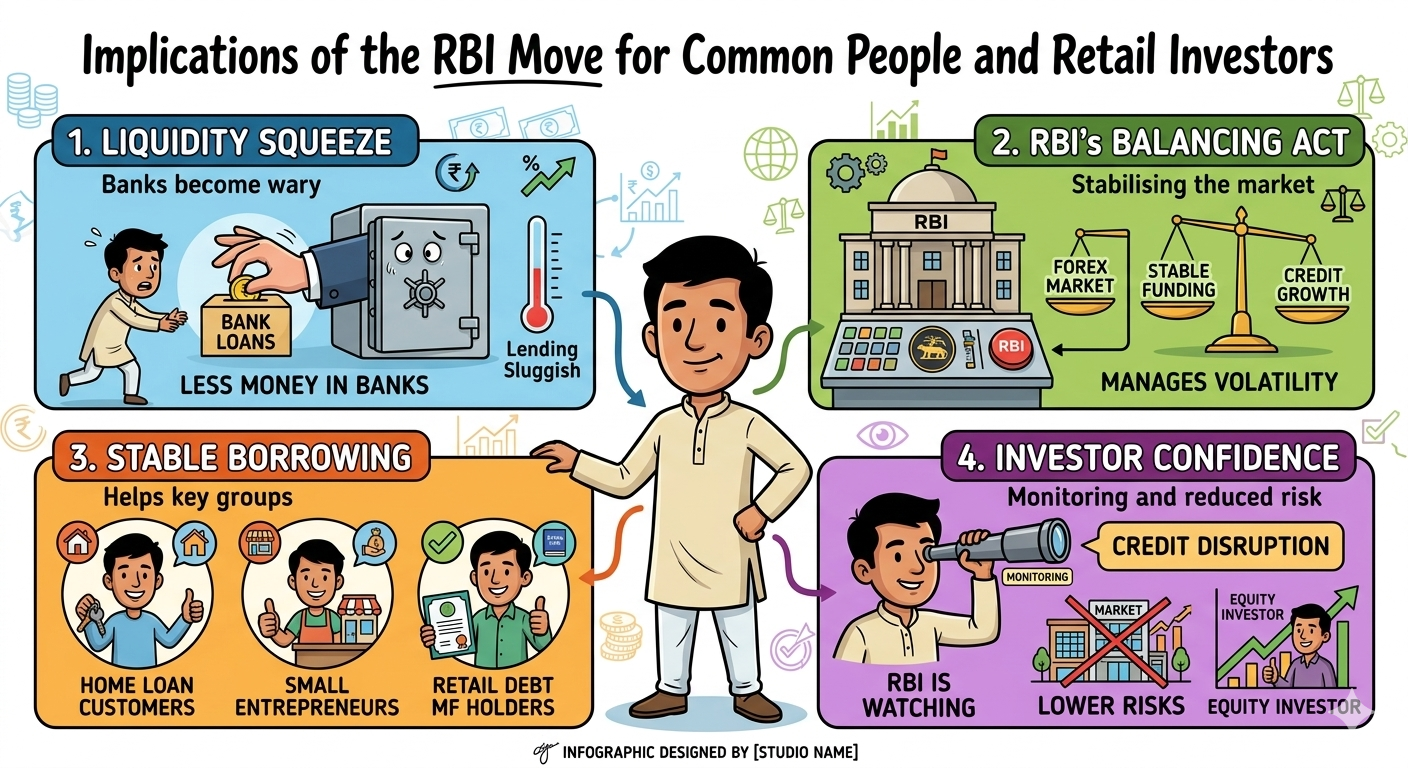
Banks become wary of lending activities whenever the liquidity within the banks is squeezed. The disbursal of loans becomes sluggish, short-term interest rates begin to rise, and availability of credit becomes difficult.
Such operations assist in stabilising the funding environment, promoting credit growth, and managing the volatility of the forex market. This helps home loan customers, small entrepreneurs, and retail debt mutual fund holders in terms of stability in borrowing conditions.
The good news here for the investors and market participants is that it indicates the RBI is constantly monitoring and working towards stabilising the markets.
Such liquidity operations can be utilised by the central banks for impacting liquidity conditions without changing the interest rates. Such a situation helps in reducing credit disruption risks in the financial market for equity investors.
*T&C Apply
Participants from the market and analysts believe that the move may help address the liquidity pressures while providing banks with funding security for medium-term purposes.
Market participants are expected to carefully monitor the upcoming liquidity operation as it can impact money markets, banking conditions, and general financial sentiments due to RBI operations.
Many of the analysts consider the decision of using three years tenor for a purposeful reason, which is to offer lasting relief rather than temporary one.
Since February 2025, the Reserve Bank of India has invested over $38 billion in protecting the Indian currency. Such a large-scale intervention by the central bank cannot be sustained forever without any consequences.
What lies ahead is a combination of forex swaps, open market operations, and effective rate management on part of the central bank.
This May 26 auction is not simply about providing liquidity but is instead a central bank operating within a challenging situation. The central bank is trying to balance defending the currency along with maintaining credit requirements within its jurisdiction.
Will RBI’s $5 billion liquidity infusion lower home loans and personal loans in India?
An infusion of liquidity by RBI will ease the ability of banks to access funding, making short-term interest payments less costly. Even though loan rates won't be lowered instantly, it will aid in stabilizing interest rates and improving credit access to loan applicants.
Why is RBI intervening in the forex markets and infusing liquidity to banks?
RBI is intervening to avoid the depreciation of its currency due to capital outflows from foreign investors, high oil prices, and economic instability around the world. On the other hand, it is infusing liquidity to maintain adequate liquidity in banks' accounts.









.png&w=3840&q=75)



