By continuing, you agree to LoansJagat's Credit Report Terms of Use, Terms and Conditions, Privacy Policy, and authorize contact via Call, SMS, Email, or WhatsApp
Disclaimer: The information published on LoansJagat is intended for general informational and educational purposes only and should not be considered financial, legal, or investment advice. Interest rates, loan terms, statistics, and other data may change over time and may vary by lender or source. Please verify the latest information and consult a qualified financial advisor or the respective Bank/NBFC before making any financial decisions.
Subscribe Now
About the author

LoansJagat Team
‘Simplify Finance for Everyone.’ This is the common goal of our team, as we try to explain any topic with relatable examples. From personal to business finance, managing EMIs to becoming debt-free, we do extensive research on each and every parameter, so you don’t have to. Scroll up and have a look at what 15+ years of experience in the BFSI sector looks like.
Related News
Simplify All Your Loans Into One Affordable EMI

Customers Served

Debt Consolidated

1200+ Reviews

Locations in India
Club all Loans & Credit Card Bills into Single EMI

Quick Apply Loan
Consolidate your debts into one easy EMI.

Takes less than 2 minutes. No paperwork.

10 Lakhs+
Trusted Customers

2000 Cr+
Loans Disbursed

4.7/5
Google Reviews

50+
Banks & NBFCs Offers
Other services mentioned in this article
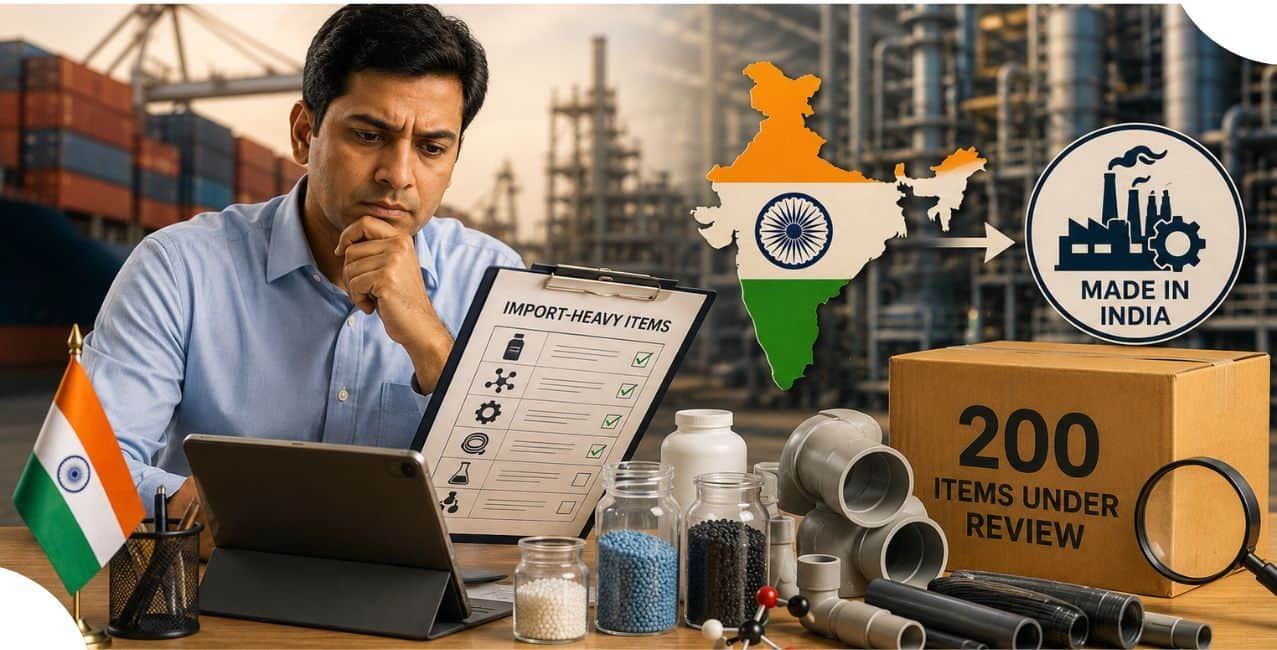
India is checking local production options for 200+ petrochemical items as West Asia tensions squeeze imports, prices and factory supply lines.
Key Takeaways
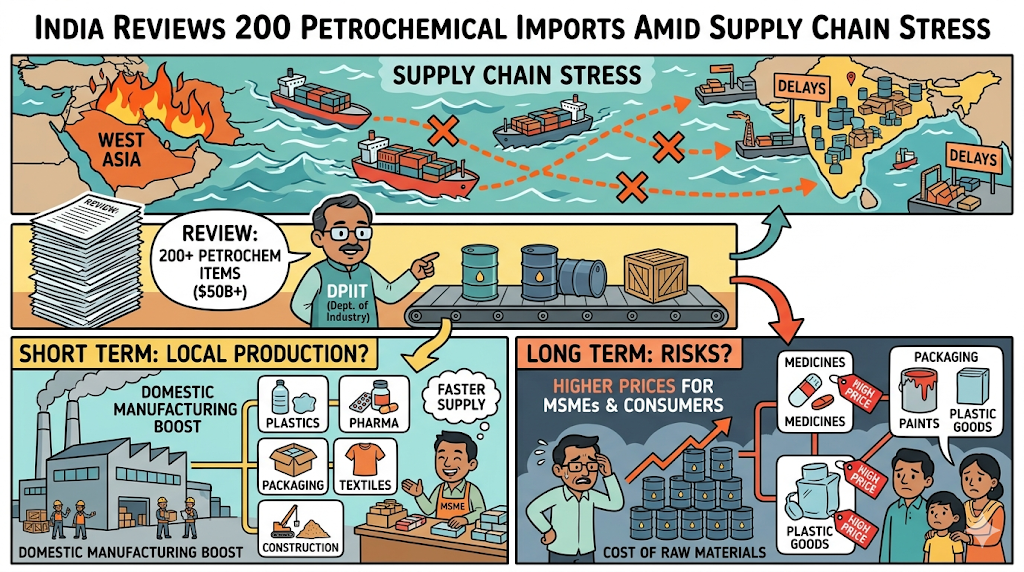
India’s petrochemical supply chain is facing fresh pressure after the West Asia conflict hit global movement of key raw materials. The Department for Promotion of Industry and Internal Trade has asked industry to examine if local production is possible for over 200 petrochemical items, according to an Indian Express report published on May 22, 2026. These items together account for annual imports of over $50 billion.
In the short term, this can help companies reduce delays in plastics, pharma, packaging, textiles and construction inputs. In the long term, it may push India towards stronger domestic chemical manufacturing. The risk is also visible. If raw materials stay costly, MSMEs and consumers may face higher prices for medicines, packaging, paints and plastic goods.
Here are the key numbers behind India’s petrochemical supply pressure. The data shows why the government is checking local production options, after import disruption, duty relief measures and high LPG dependence exposed pressure points across plastics, chemicals and pharma supply chains.
These figures show why the government has moved beyond temporary import relief and started asking companies which products can be manufactured locally.
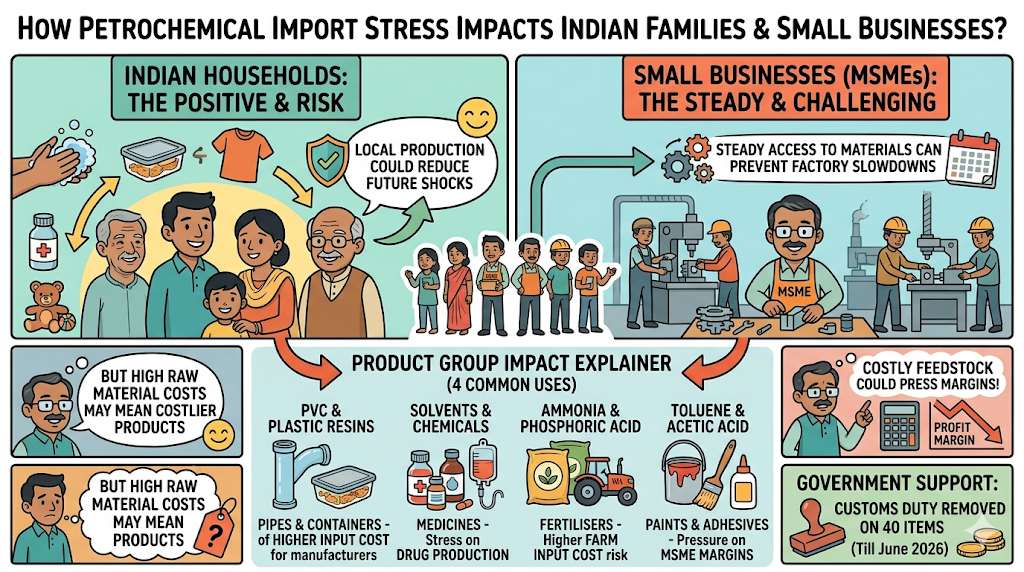
The impact is not only on big petrochemical firms. Petrochemicals go into pipes, food packaging, syrups, drug inputs, textiles, paints, auto parts and medical products. The Indian Express report named items such as PVC, LDPE, LLDPE, polypropylene, polystyrene, ABS, phosphoric acid, ammonia, acetic acid and toluene.
For households, the positive side is that local production can protect supply and reduce future import shocks. For small businesses, steady raw material access can prevent sudden factory slowdowns. However, if feedstock costs stay high, products may still become costlier even after domestic production improves.
*T&C Apply
A LoansJagat explainer also recorded that India removed customs duty on 40 petrochemical products till June 2026 to reduce costs and support industries during global supply disruption.
The government has already taken a few steps. PIB said on April 2, 2026 that full customs duty exemption was given on critical petrochemical products till June 30, 2026 due to West Asia-linked supply disruption. NewsOnAir also reported the same relief as a temporary step for domestic industry.
Another PIB update on April 18, 2026 said 1000 MT per day from the LPG pool was arranged for pharma and chemical sector companies. It also said around 3200 MT of propylene had been sold since April 9, 2026. Commerce Minister Piyush Goyal later asked industry leaders on May 18, 2026 to track imports and identify goods that can be made in India.
The practical solution is product-wise planning. India may need assured feedstock, quicker approvals, technology tie-ups and targeted incentives. A blanket duty hike alone may not help if local factories do not have scale, raw material or technology.
India’s 200-item petrochemical review is a direct response to import stress and rising supply risk. The next step is execution: local production must be affordable, reliable and fast enough for Indian industry.
Can Reliance’s petrochemical expansion cut India’s PVC import dependence?
Reliance’s bigger push into petrochemicals can help India reduce PVC imports, but it will not happen overnight. The Reddit post says India uses around 4.7–4.8 MMTPA of PVC and imports more than 3 MMTPA.
Reliance is planning around 1.5 MMTPA integrated PVC capacity, which can support pipes, packaging, textiles and FMCG companies. If the plants start on time and run well, local buyers may get better supply and fewer import shocks. Still, raw material cost, global prices and project delays can affect the actual benefit for Indian manufacturers.
Where do petrochemical products show up in everyday life?
Petrochemicals are part of many everyday products, even when people do not notice them. Plastic bags, food packets, water bottles, pipes, paint boxes, buckets and toys often use materials like polyethylene, polypropylene and PVC. Clothes made from polyester or nylon also come from petrochemical raw materials.
They are used in detergents, cosmetics, medicines, rubber tyres, adhesives, cables and fertilisers too. Hospitals use them in syringes, gloves and medical packaging. Cars, phones and home appliances also need such materials. So petrochemicals are not only for industries. They reach homes, farms, hospitals and shops.









.png&w=3840&q=75)



