
_(2)_(1).png&w=3840&q=65)
By continuing, you agree to LoansJagat's Credit Report Terms of Use, Terms and Conditions, Privacy Policy, and authorize contact via Call, SMS, Email, or WhatsApp
Disclaimer: The information published on LoansJagat is intended for general informational and educational purposes only and should not be considered financial, legal, or investment advice. Interest rates, loan terms, statistics, and other data may change over time and may vary by lender or source. Please verify the latest information and consult a qualified financial advisor or the respective Bank/NBFC before making any financial decisions.
Subscribe Now
About the author

Arshathul Afia
Arshathul Afia is a journalism graduate and fintech content writer with 4+ years of experience in digital publishing and research-led writing. She has written 200+ articles covering personal finance, lending, banking, digital payments, credit, insurance, and major financial developments in India. At LoansJagat, she focuses on simplifying complex fintech news, RBI updates, loan-related changes, policy developments, and industry trends for everyday readers. Her journalism background helps her approach stories with research, context, and clarity, while her SEO experience ensures content remains discoverable and relevant. She aims to make financial news easier to understand, practical, and useful for readers across India.
Related News
Simplify All Your Loans Into One Affordable EMI

Customers Served

Debt Consolidated

1200+ Reviews

Locations in India
Club all Loans & Credit Card Bills into Single EMI

Quick Apply Loan
Consolidate your debts into one easy EMI.

Takes less than 2 minutes. No paperwork.

10 Lakhs+
Trusted Customers

2000 Cr+
Loans Disbursed

4.7/5
Google Reviews

50+
Banks & NBFCs Offers
Other services mentioned in this article
Taxpayers who missed the AY 2026-27 ITR deadline still have a chance to file, the window stays open till 31 December 2026. But it is not a free pass. Late fee, interest and refund delays could catch up with quite a few filers along the way.
The window for filing belated income tax returns for AY 2026-27 is now open, and it comes as a relief to taxpayers who could not meet their original due date. As per the Income Tax Department, belated returns can be filed on or before 31 December 2026, or before the assessment gets completed, whichever happens earlier.
A wide range of filers across India fall under this, salaried persons, pensioners, freelancers, and individual taxpayers who for one reason or another missed the earlier deadline.
The short-term hit is direct. A late fee, interest on unpaid tax and refund delay can follow. The long-term issue is more painful for some taxpayers because delayed filing can affect loan documents, visa paperwork, income proof and future tax records. For people with losses, the cost can go beyond ₹5,000 because certain loss benefits may not survive late filing.
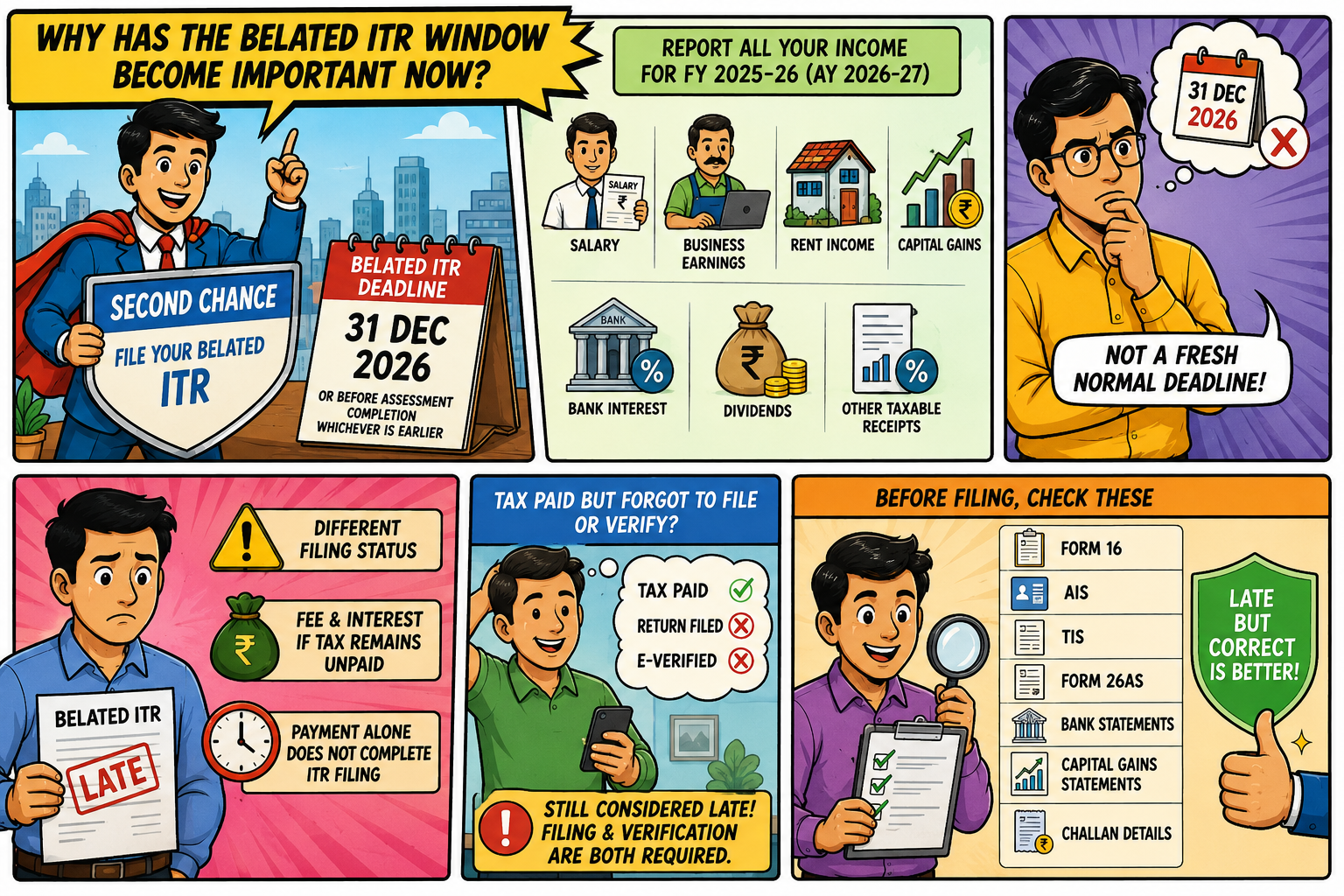
The belated return route gives taxpayers a second chance after the regular deadline.This falls under Section 139(4). Taxpayers can use this route to report all kinds of income, salary, business earnings, rent, capital gains, bank interest, dividends, and other taxable receipts for FY 2025-26, which gets assessed in AY 2026-27.
Still, taxpayers should not treat 31 December 2026 like a fresh normal deadline. A belated ITR carries a different filing status. It can also bring fee and interest if tax remains unpaid. Someone who has already paid tax but forgot to submit or verify the return can still face late filing consequences because payment alone does not complete ITR filing.
Before filing, taxpayers should check Form 16, AIS, TIS, Form 26AS, bank statements, capital gains statements and challan details. A late but correct return is better than a rushed return with wrong income entries.
Taxpayers who missed the original AY 2026-27 ITR deadline still have a legal filing route, but the late window comes with limits. The main points are the final belated return date, the Section 234F fee, the earlier CBDT extension for AY 2025-26, and the filing section taxpayers must use while submitting the return.
The table gives the basic compliance position, but the taxpayer’s personal cost will depend on income level, tax already paid, refund claim and the type of income reported. A salaried employee with full TDS may face a smaller burden than a trader or freelancer who still has unpaid tax.
The safer route is to file early in the belated window. Waiting till the last week of December can create avoidable pressure if the AIS has errors, the bank account is not validated, a challan is not reflecting, or the taxpayer picks the wrong ITR form.
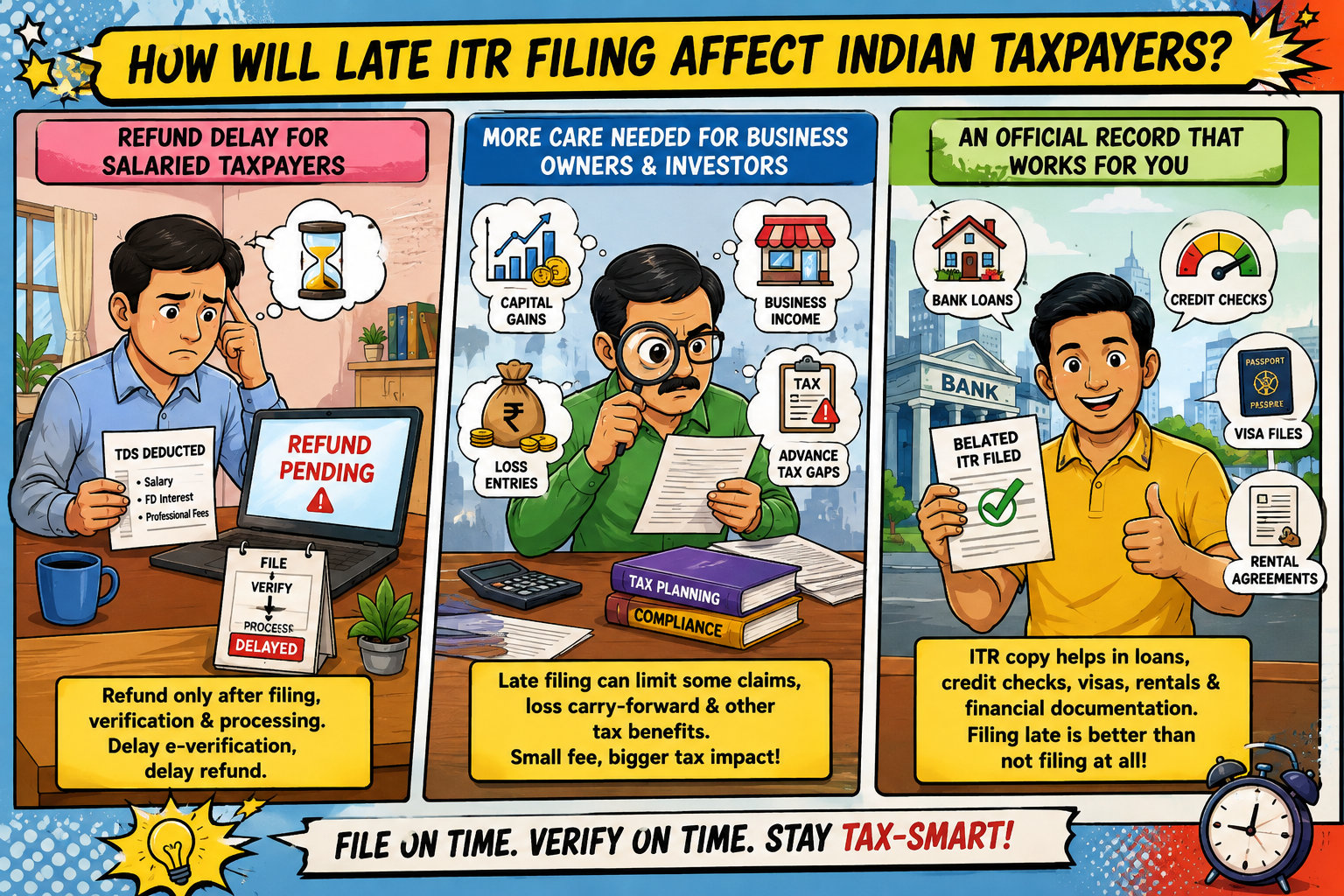
For many salaried taxpayers, the biggest issue will be refund delay. A person who has excess TDS from salary, fixed deposit interest or professional payments cannot receive the refund until the return is filed, verified and processed. If e-verification is also delayed, the refund clock gets pushed further.
Small business owners, consultants, stock market investors and property sellers need to be more careful. They may have capital gains, business income, loss entries or advance tax gaps. Late filing can reduce room for some claims, especially where loss carry-forward rules apply. The late fee may look small next to the tax impact.
There is one useful side. A belated return still creates an official income record. That helps when taxpayers need ITR copies for bank loans, credit checks, visa files, rental agreements or financial documentation. A missed due date is bad. Leaving the return unfiled is worse.
Tax professionals generally advise 3 steps: match records, pay dues, and verify the return. The taxpayer should not simply copy Form 16 figures and submit. AIS may show savings account interest, dividend income, securities transactions, property details or TDS entries that do not appear in Form 16.
A LoansJagat explainer on Section 139(4) describes the belated return route as a second chance for taxpayers who miss the original deadline. In borrower terms, this becomes important because many lenders ask for the latest ITR while checking income stability. A late-filed return may still support a loan file, but an unfiled return can slow the application or invite more questions.
The solution is not complicated. Users must log in to the e-filing platform. They must select AY 2026-27, the proper ITR form, the option for submitting a delayed return under Section 139(4), the payment of all outstanding taxes and fees, and lastly, the completion of e-verification. The acknowledgement should be saved after submission.
The previous major filing update came from the Ministry of Finance through PIB Delhi on 27 May 2025. CBDT extended the due date for ITRs originally due on 31 July 2025 to 15 September 2025 for AY 2025-26. The reason given was extensive changes in ITR forms, system readiness, utility rollout and integration testing.
That extension still affects taxpayer expectations. Many people remember the extra time given last year and wait for a similar move when the filing season becomes crowded. But tax deadlines change only through official orders. Forwarded messages, social media posts and last week's speculation do not change the filing rule.
For AY 2026-27, anyone who has already missed the applicable due date should go ahead with the belated return route, unless there is a formal update stating otherwise. Sitting around and hoping for relief without any official order in hand can turn what was a small delay into a last-minute December scramble.
Taxpayers should watch 4 things: refund status, AIS accuracy, e-verification completion and pending tax demand. If a return is filed late but not verified, the filing process remains incomplete. If the bank account is not validated, refund credit can get held up.
Tax consultants will likely see more cases involving AIS mismatch, wrong ITR form selection and missed interest income. Employers and deductors also have a role because incorrect TDS entries can delay filing for employees. Banks, lenders and financial platforms may continue asking for the latest ITR when borrowers apply for home loans, personal loans or business credit.
The department’s own FAQs give taxpayers enough direction on the final date and late fee. The real challenge is execution. A taxpayer who files carefully in August or September may avoid the year-end rush. A taxpayer who waits till 31 December 2026 may not get enough time to fix portal or document errors.
The AY 2026-27 belated ITR filing window protects taxpayers from complete non-filing, but it comes with a price. The late fee can go up to ₹5,000, interest may apply where tax is unpaid, and refund processing can move slower.
Taxpayers should file before the December rush. They should match AIS, TIS and Form 26AS, pay pending tax, select Section 139(4), verify the return and keep the acknowledgement. A late return can still repair the tax record. Further delay only makes the year harder.
31 December 2026. That's the cutoff, unless your assessment wraps up before that, in which case the window shuts earlier. Most people won't hit that second scenario, but it exists.
Depends on your income. Earning up to ₹5,00,000? You're looking at ₹1,000 under Section 234F. Cross that mark and it jumps to ₹5,000. Not a huge amount in the grand scheme, but annoying nonetheless, especially if you're filing late because of something outside your control.
Yes. Nobody loses their refund just because they filed after the original date. But here's the thing, filing is only step one. You still need to e-verify, and the department still needs to process it. Skip or delay the e-verification part and your refund just sits there, waiting.
No. Taxpayers should follow official dates and file belated returns if the due date has passed.
Some losses may not be carried forward after late filing. Taxpayers should check before submitting.









.png&w=3840&q=75)


