
By continuing, you agree to LoansJagat's Credit Report Terms of Use, Terms and Conditions, Privacy Policy, and authorize contact via Call, SMS, Email, or WhatsApp
Disclaimer: The information published on LoansJagat is intended for general informational and educational purposes only and should not be considered financial, legal, or investment advice. Interest rates, loan terms, statistics, and other data may change over time and may vary by lender or source. Please verify the latest information and consult a qualified financial advisor or the respective Bank/NBFC before making any financial decisions.
Subscribe Now
About the author

LoansJagat Team
‘Simplify Finance for Everyone.’ This is the common goal of our team, as we try to explain any topic with relatable examples. From personal to business finance, managing EMIs to becoming debt-free, we do extensive research on each and every parameter, so you don’t have to. Scroll up and have a look at what 15+ years of experience in the BFSI sector looks like.
Related Blog Post
Simplify All Your Loans Into One Affordable EMI

Customers Served

Debt Consolidated

1200+ Reviews

Locations in India
Club all Loans & Credit Card Bills into Single EMI

Quick Apply Loan
Consolidate your debts into one easy EMI.

Takes less than 2 minutes. No paperwork.

10 Lakhs+
Trusted Customers

2000 Cr+
Loans Disbursed

4.7/5
Google Reviews

50+
Banks & NBFCs Offers
Other services mentioned in this article
Large infrastructure borrowers are gaining lender preference as Ocorian flags corporates and funds, while India’s project pipeline points to tighter, sponsor-led financing ahead.
Key Takeaways
Large corporations, including utilities and energy companies, have become the most common borrowers in infrastructure lending, according to the Ocorian Nordic Trustee Infrastructure Lending Survey Report 2026, published on 21 May 2026. The research covered 200 senior decision-makers across Europe’s infrastructure debt market. It found that 42% named large corporates as the most common borrowers, while 37% named private infrastructure funds.
The short-term proposition is more direct. Stronger borrowers could be provided with capital more quickly. Smaller developers might have to meet increasingly stricter assurance and repayment checks. With time, this could drive infrastructure lending to more backed projects and could potentially slow the financing of smaller projects, with lenders focusing on larger, more established firms.

Infrastructure lending is not drying up. Lenders are choosing borrowers with stronger balance sheets, better contracts and more capital support from sponsors. Ocorian’s report also shows rising attention around private credit, hybrid capital and risk-sharing structures.
The table shows why the borrower profile has changed. Lenders are not only checking sector demand. They are checking who carries the risk, who controls the asset and who can support the project if cash flows weaken.
Ocorian’s research has put large corporates and private infrastructure funds at the front of borrower demand in European infrastructure lending. The survey was conducted between 18 March and 25 March 2026. Its official report was published on 21 May 2026, while borrower-specific coverage came out on 7 July 2026.
The main story is about lender selectivity. Infrastructure needs long-term debt, but lenders now want stronger sponsors and cleaner repayment routes. Large utilities, energy companies and fund-backed platforms fit that requirement better than smaller project developers in many cases. That is why they are showing up more often as common borrowers.
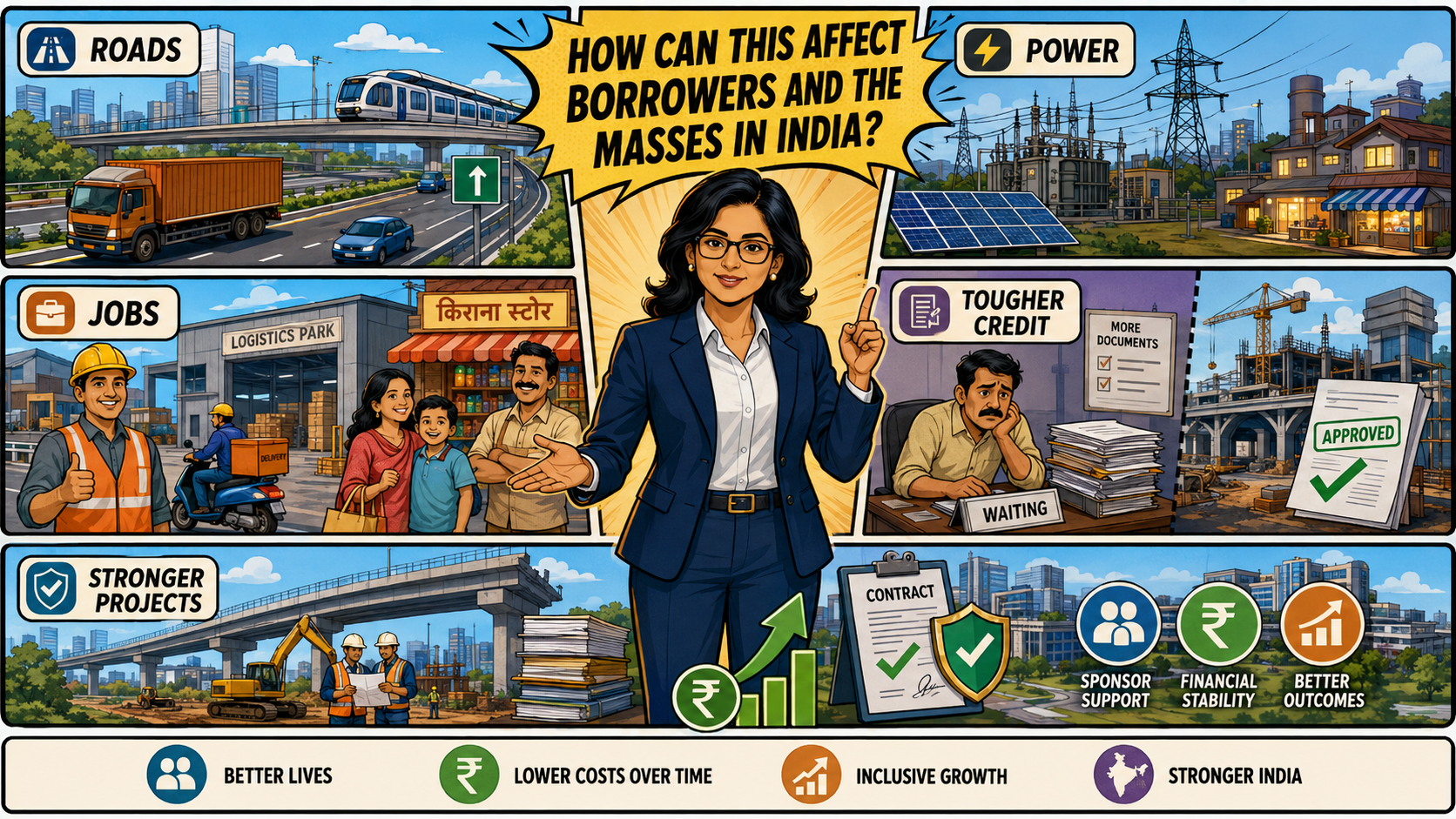
Indian households may not follow European infrastructure debt reports, but the impact can travel through funding costs and project models. Better-funded infrastructure companies can build power assets, roads, data centres, logistics parks and transmission projects faster. That can help local jobs, city services and business movement over time.
There is also a risk for smaller players. If lenders prefer large borrowers, small contractors and regional developers may face higher equity demands or slower approvals. A small transport operator, a local supplier or a property-linked business can feel the delay when a road, warehouse zone or industrial corridor is held back by financing pressure. Borrowers comparing loan products through LoansJagat also operate in this wider credit cycle, where lender caution can influence approval behaviour and pricing.
India has been building a wider public infrastructure base at the same time. A PIB release dated 18 March 2026 said public capital expenditure rose from ₹2 lakh crore in FY2014-15 to ₹12.2 lakh crore in the FY2026-27 budget estimate. The same update referred to the Infrastructure Risk Guarantee Fund and institutions such as NIIF and NaBFID as part of India’s long-term infrastructure financing route.
That government support can help draw private capital, but lenders will still ask hard questions. Is the project ready? Are approvals in place? Is revenue visible? Is the sponsor strong enough? These questions decide whether money comes in at a fair cost or stays away until the project becomes safer.
*T&C Apply
The earlier Indian development came through the National Infrastructure Pipeline. The India Investment Grid describes NIP as a whole-of-government project pipeline created to improve project preparation and attract infrastructure investment. The platform lists 8,716 projects with a total project cost of USD 2,238.8 billion.
The Union Budget 2026-27 also pushed infrastructure funding through public capex, risk guarantees, new waterways, and freight-linked plans. These steps show that India wants private capital to enter long-life assets, but not through loose project design. Better preparation is becoming the price of funding.
Private infrastructure funds are gaining lender attention because they usually bring committed capital, sector knowledge and professional asset management. They also build portfolios across energy, transport, social infrastructure, data centres and logistics assets, which can make lenders more comfortable than a single-project borrower with limited support.
This does not mean every fund gets easy funding. Lenders still check asset quality, debt load, concession terms, cash flow history and exit risk. A fund-backed borrower may look stronger on paper, but weak contracts or delayed approvals can still raise borrowing costs. In India, this is relevant for InvITs, infrastructure platforms and project-level special purpose vehicles that depend on long-term investor trust.
Another change is the rise of layered capital. A project may use senior debt, mezzanine debt, sponsor equity and preferred equity instead of one plain loan. That gives borrowers more routes to raise money, but it also makes documentation and risk sharing more detailed. For smaller Indian developers, this may create pressure to partner with larger sponsors or funds before approaching lenders.
Cato Holmsen, Global Head of Capital Markets at Ocorian and CEO of Nordic Trustee, said the research points to a conservative lending market where investors value structures that protect cash flows, allocate risk tightly and guard against downside pressure. That is the lender’s view in plain words. Money is available, but weak structuring will not get easy approval.
The solution for borrowers is not only cheaper debt. They need stronger contracts, realistic revenue estimates, sponsor capital, cleaner security documents and better execution planning. For India, the public sector can reduce early-stage risk through guarantees and prepared project pipelines. Private borrowers still have to show that the project can repay debt without depending only on optimism.
The fresh borrower takeaway is simple. Infrastructure lending is moving from "Who needs money?" to "Who can carry risk?" That shift can affect companies far beyond Europe. Indian developers bidding for roads, renewable energy assets, logistics parks or urban projects may need to show more equity participation and stronger project governance before lenders get comfortable.
For retail and small business borrowers, this may sound distant, but it is linked. Public infrastructure affects transport cost, land value, business movement and local credit demand. When infrastructure projects move on time, nearby businesses often plan better. When funding slows, smaller firms wait. That waiting period can affect working capital, business loans and hiring decisions.
Ocorian’s 2026 research shows that large corporates and private infrastructure funds are becoming the preferred borrower groups in infrastructure lending. The reason is not hard to see. Lenders want stronger sponsors, visible cash flows and better risk sharing.
For India, the timing is important. Public capex, the National Infrastructure Pipeline, and risk-support tools are already trying to attract long-term capital. The next test will be project quality. Announcements can open the door, but execution will decide who gets funded and who waits.
What did Ocorian find in its 2026 infrastructure lending research?
Ocorian found that 42% of senior market participants named large corporates as the most common infrastructure borrowers.
Who were the next major borrowers after large corporations?
Private infrastructure funds followed closely, with 37% of respondents naming them as common infrastructure borrowers.
Why are stronger borrowers preferred by lenders?
Lenders prefer borrowers with strength and stronger fundamentals because they have better cash flows, larger sponsors, and stronger capacity for repayment.
Why do big borrowers borrow money even when their market value is huge?
Big borrowers have cash flow issues because valuation does not mean cash and borrowing debt does not dilute ownership during highly strategic and expansionary plans.
Why do infrastructure debt funds have higher preferences than banks?
Infrastructure debt funds have higher preferences because, compared to banks, they offer longer-term and more flexible capital and they also face limitations in terms of lending and exposure.









.png&w=3840&q=75)



