
By continuing, you agree to LoansJagat's Credit Report Terms of Use, Terms and Conditions, Privacy Policy, and authorize contact via Call, SMS, Email, or WhatsApp
Disclaimer: The information published on LoansJagat is intended for general informational and educational purposes only and should not be considered financial, legal, or investment advice. Interest rates, loan terms, statistics, and other data may change over time and may vary by lender or source. Please verify the latest information and consult a qualified financial advisor or the respective Bank/NBFC before making any financial decisions.
Subscribe Now
About the author

Arshathul Afia
Arshathul Afia is a journalism graduate and fintech content writer with 4+ years of experience in digital publishing and research-led writing. She has written 200+ articles covering personal finance, lending, banking, digital payments, credit, insurance, and major financial developments in India. At LoansJagat, she focuses on simplifying complex fintech news, RBI updates, loan-related changes, policy developments, and industry trends for everyday readers. Her journalism background helps her approach stories with research, context, and clarity, while her SEO experience ensures content remains discoverable and relevant. She aims to make financial news easier to understand, practical, and useful for readers across India.
Related News
Simplify All Your Loans Into One Affordable EMI

Customers Served

Debt Consolidated

1200+ Reviews

Locations in India
Club all Loans & Credit Card Bills into Single EMI

Quick Apply Loan
Consolidate your debts into one easy EMI.

Takes less than 2 minutes. No paperwork.

10 Lakhs+
Trusted Customers

2000 Cr+
Loans Disbursed

4.7/5
Google Reviews

50+
Banks & NBFCs Offers
Other services mentioned in this article
UCO Bank’s 7.35% electric car loan keeps a ₹5 lakh five-year EMI near ₹9,983, though only borrowers with top credit scores qualify under July rules.
Key Takeaways
As part of its vehicle loan pricing update, UCO Bank has introduced a 7.35% rate for people buying electric vehicles this time. At those rates, the EMI is estimated at ₹9,983 for a loan of ₹5 lakh with a tenure of 60 months. The offer is available in India, subject to income checks, repayment capacity and the bank’s approval rules.
The headline can help a buyer plan a lower monthly instalment, but it can also create the wrong expectation. A petrol, diesel, CNG or hybrid car buyer in the same credit band starts at 7.45%. Someone with a lower score may receive 7.65%, 8% or more. Processing fees, GST, insurance and documentation charges come later, often after the buyer has focused only on the EMI.
₹5 Lakh Car Loan At 7.35%
Loan amount: ₹5,00,000
Tenure: 5 years
Monthly EMI: About ₹9,983
Total interest: About ₹99,002
Total repayment: About ₹5,99,002
At 8.70%, the EMI rises to nearly ₹10,307. Over 60 months, the higher-rate loan costs around ₹19,400 more.
The calculation follows the monthly reducing-balance method. Processing fees, GST, insurance and registration-linked expenses are outside this estimate.
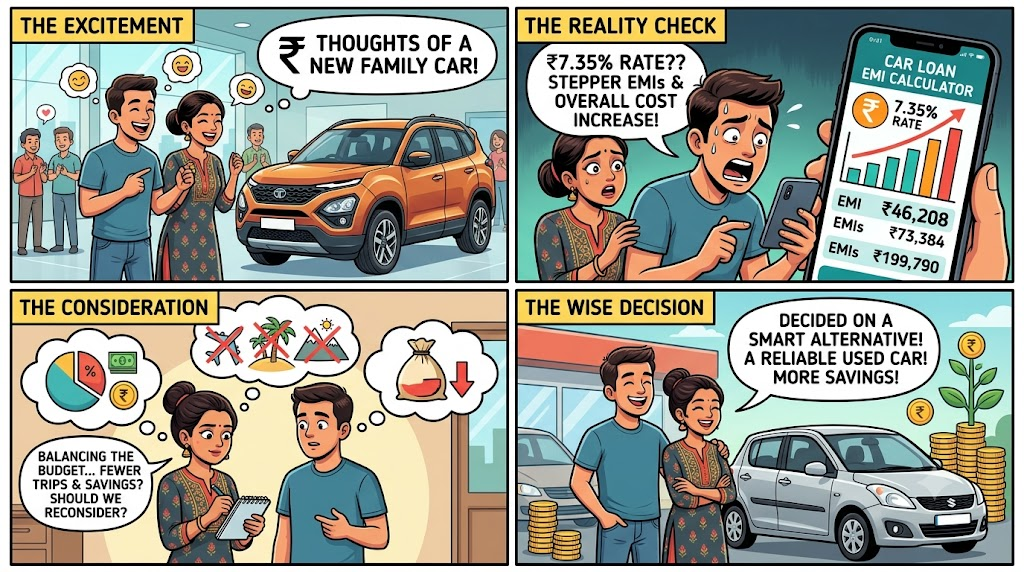
For a family with a monthly take-home income of ₹65,000, a ₹9,983 EMI may look manageable beside rent, school fees and regular household spending. Raise the EMI to ₹10,800 or ₹11,000, and the room left for fuel, servicing and annual insurance starts shrinking. The difference is not dramatic in 1 month. Across 5 years, it becomes easier to spot.
Electric vehicle buyers receive the lowest published rate under UCO Bank’s current structure. A borrower with a score of 825 or above gets 7.35% for an electric car, while the same borrower pays 7.45% for another eligible vehicle. The monthly gap remains small, yet the electric car buyer pays less interest through the tenure.
Direct bank offers could also give buyers more bargaining power at the showroom. Dealership finance is quick, and that speed has value when a vehicle is ready for delivery. The problem starts when insurance, accessories or a higher-rate loan enter the package without a proper cost comparison.
A buyer may book a ₹9 lakh car after calculating the loan at 7.35%. The bank then approves 8.30% because the applicant already has a personal loan and uses a large part of the credit card limit. The booking amount has been paid by then. Changing the lender becomes harder, and cancelling the purchase may carry a deduction.
An in-principle offer before booking reduces that risk. It also gives the buyer a firm EMI range instead of a number taken from an advertisement.
The sanction letter contains the figure that counts. “Rates from 7.35%” only states the lowest entry point. It does not confirm the applicant’s final pricing.
UCO Bank divides applicants by credit score and vehicle category. An electric car buyer with a score between 800 and 824 is listed at 7.55%. A non-electric buyer in the same band starts at 7.65%. Drop into another score band, and the rate rises again.
Income records carry equal weight. A high credit score may show timely repayments, but the bank still checks salary, business receipts, current EMIs and recent loan enquiries. Someone earning ₹80,000 a month with ₹35,000 already going towards debt may receive a lower sanction than expected.
Processing charges deserve a separate line in the calculation. UCO Bank lists a fee of 0.50% of the sanctioned amount, capped at ₹5,000, plus GST. Documentation expenses are additional. A borrower who compares only interest rates may miss several thousand rupees at the start of the loan.
Tenure can hide cost as well. A 7-year plan lowers the monthly instalment, which looks helpful on the application screen. The borrower then pays interest for 24 extra months. By that stage, the car may need tyres, a battery replacement or expensive repairs, while the loan continues.
A written quotation should show the approved rate, EMI, fee, total repayment, down payment and early closure terms. Three quotations are usually enough to expose large differences.
The table below uses a ₹5 lakh loan repaid over 5 years. Each EMI is calculated from the lowest displayed rate. The approved offer can move higher after the bank reviews the borrower’s profile.
The lowest EMI in the table will not suit every borrower. An SBI salary-account customer may receive quicker processing or more suitable repayment terms. Canara Bank may offer a fee concession. Another lender could approve a larger share of the on-road price.
Canara Bank’s disclosed range stretches from 7.45% to 15%, with a mean contracted rate of 9.09%. That distance between the floor and the average gives buyers a better reading of actual pricing. Very few applicants should build a purchase plan around the lowest number until the bank issues a quotation.
SBI lists rates from 8.70% to 9.85% on its July 1, 2026, page. The bank fixes the rate at disbursement for the full tenure. A borrower who receives 8.70% knows the EMI will not change later because of a rate reset.
At ₹5 lakh, the gap between 7.35% and 8.70% is about ₹324 each month. That may cover part of a fuel bill. Across 60 instalments, though, it reaches nearly ₹19,400.
A LoansJagat car loan comparison, published on May 7, 2026, reviewed lender figures available on May 2. It placed several public sector bank starting rates between 7.45% and 7.70%, while some private bank offers were closer to 10%.
That comparison gave borrowers a useful reference before the latest revision. Public sector banks were already competing strongly on rates, particularly for customers with better credit records. The July UCO Bank update moved the lowest published figure to 7.35%, but only for electric car buyers in the top displayed score band.
LoansJagat’s repayment analysis also showed how a narrow rate gap affects the final bill. A difference of roughly 1.5 percentage points on a ₹5 lakh loan can add close to ₹20,000 over 5 years. Double the loan to ₹10 lakh, and the extra interest becomes much harder to ignore.
The earlier report advised buyers to carry a bank quotation when visiting the dealership. That remains useful. A written offer gives the customer a number to compare against showroom finance, instead of accepting the first approval because the car is ready.
Rates can change within weeks. A comparison saved in May may be outdated by July, especially when banks revise score bands, electric vehicle concessions or processing-fee campaigns. The loan application date should guide the final check.
UCO Bank says its digital vehicle loan covers new cars and two-wheelers for personal use. Eligible applicants can receive up to 90% of the vehicle’s on-road price, subject to scheme conditions and repayment capacity.
The published tenure runs from 6 months to 84 months. The bank lists a minimum CIBIL score of 700 for its standard digital route, though the lowest rate requires a much stronger profile. A 10% margin applies, and the displayed terms carry no prepayment charge.
SBI follows a fixed-rate structure for its listed car loan. Selected borrowers in higher credit bands start at 8.70%, while other applicants pay more. The bank reported a mean auto loan rate of 8.78% for the fourth quarter of FY 2025-26.
The rate card tells only one part of the story. Banks still review the applicant’s income source, employer, business stability, current debt, and vehicle price. A borrower with a long salary history and low debt may receive better terms than someone with the same score but several active loans.
From a borrower’s point of view, the weak spot often appears after approval. The EMI gets attention. The processing fee, bundled insurance, and early closure clause receive a glance. Those smaller lines can change the final cost by several thousand rupees.
A ₹5 lakh car loan at 7.35% produces an estimated EMI of ₹9,983 over 5 years. UCO Bank currently reserves that rate for eligible electric vehicle buyers with a CIBIL score of at least 825.
Other applicants may receive 7.45%, 8.70% or a higher figure. The vehicle type, credit record, income and current debt all influence the sanction.
Before paying a large booking amount, buyers should collect offers from at least 3 lenders. Compare the approved rate, total repayment, upfront charges and closure rules. A lower advertised rate helps only when the same figure appears in the sanction letter.
What is the EMI for a ₹5 lakh car loan at 7.35%?
The estimated EMI is ₹9,983 for a 5-year tenure. Fees, GST, and insurance are charged separately.
Who can get UCO Bank’s 7.35% car loan rate?
The published rate applies to eligible electric vehicle buyers with a CIBIL score of 825 or above.
Is 7.35% available for petrol or diesel cars?
UCO Bank lists 7.45% for non-electric cars in its highest displayed credit band.
Can a borrower with a good score still receive a higher rate?
Yes. Banks also review income, active loans, credit card dues, employment type, and the requested amount.
Does a 7-year loan reduce the total cost?
No. It lowers the monthly EMI, but the borrower pays interest for another 24 months.
Which bank is best for a car loan?
PNB and Union Bank are strong options, with rates around 7.6% and no prepayment charges on selected loans.
Should a buyer use a personal loan or a car loan?
A car loan is usually better because secured lending brings lower rates; compare total interest, fees and flexibility first.










.png&w=3840&q=75)


