By continuing, you agree to LoansJagat's Credit Report Terms of Use, Terms and Conditions, Privacy Policy, and authorize contact via Call, SMS, Email, or WhatsApp
Disclaimer: The information published on LoansJagat is intended for general informational and educational purposes only and should not be considered financial, legal, or investment advice. Interest rates, loan terms, statistics, and other data may change over time and may vary by lender or source. Please verify the latest information and consult a qualified financial advisor or the respective Bank/NBFC before making any financial decisions.
Subscribe Now
About the author

Arshathul Afia
Arshathul Afia is a journalism graduate and fintech content writer with 4+ years of experience in digital publishing and research-led writing. She has written 200+ articles covering personal finance, lending, banking, digital payments, credit, insurance, and major financial developments in India. At LoansJagat, she focuses on simplifying complex fintech news, RBI updates, loan-related changes, policy developments, and industry trends for everyday readers. Her journalism background helps her approach stories with research, context, and clarity, while her SEO experience ensures content remains discoverable and relevant. She aims to make financial news easier to understand, practical, and useful for readers across India.
Related News
Simplify All Your Loans Into One Affordable EMI

Customers Served

Debt Consolidated

1200+ Reviews

Locations in India
Club all Loans & Credit Card Bills into Single EMI

Quick Apply Loan
Consolidate your debts into one easy EMI.

Takes less than 2 minutes. No paperwork.

10 Lakhs+
Trusted Customers

2000 Cr+
Loans Disbursed

4.7/5
Google Reviews

50+
Banks & NBFCs Offers
Other services mentioned in this article
Borrowers can reduce EMI through lender talks, prepayment, transfer, consolidation and scheme checks, but every option needs cost comparison before approval.
Key Highlights
Indian borrowers are now looking at EMI relief before their loan accounts turn overdue. The issue involves home loan customers, car loan users, personal loan borrowers, small traders and salaried families with more than 1 repayment date in a month. According to the Press Information Bureau, scheduled commercial banks recorded 15.9% year-on-year non-food credit growth in FY 2025-26, while personal loans grew 16.2% and held a 33% share in overall credit.
This means more families are carrying formal credit. A lower EMI can help in the short term by freeing cash for rent, school fees, groceries and medical bills. Over time, however, a wrong move can increase total interest. A borrower who extends a loan tenure without checking the final repayment may pay for relief through extra years of debt.
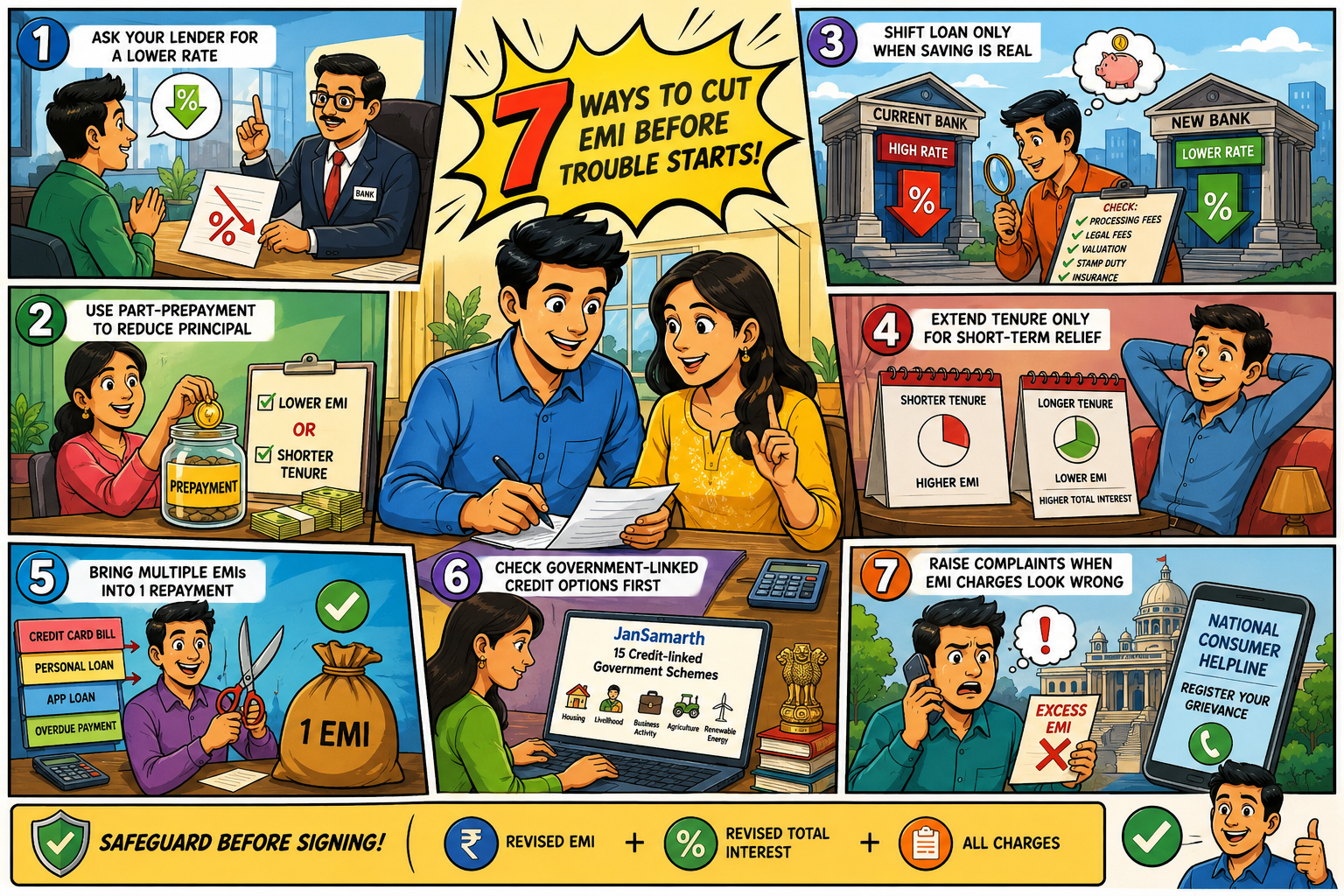
Borrowers should not wait for a missed EMI before speaking to the lender. Once a repayment bounces, the problem moves from budgeting to penalty, collection follow-up and credit-score damage. These 7 steps work best when the loan account is still regular.
A borrower with regular repayments can ask the current bank or NBFC for a rate review. This works better when the credit score has improved, income has increased or the lender’s newer customers are getting lower rates. The borrower should ask for the conversion fee and the revised repayment schedule before agreeing.
A bonus, incentive, arrear payment or maturity amount can be used to reduce the loan principal. Borrowers must state whether they want the EMI reduced or the tenure reduced. EMI reduction helps monthly cash flow. Tenure reduction can cut total interest faster.
A balance transfer can reduce EMI when another lender offers a lower rate. But the borrower should count processing charges, legal fees, valuation cost, stamp duty where applicable and insurance cost. A small rate difference may not help if the remaining tenure is short.
A longer tenure brings the monthly EMI down quickly. The cost is a higher total interest. This route suits borrowers facing a temporary salary cut, medical spend, job switch delay or business slowdown.
Borrowers with credit card dues, personal loans and app-based credit may use consolidation if the new loan replaces high-cost debt. LoansJagat explains that loan consolidation can combine multiple loans and credit card bills into 1 EMI through a bank or NBFC. The borrower still needs to check the rate, tenure and total repayment.
Some borrowers may qualify for scheme-linked loans instead of costlier unsecured credit. The Department of Financial Services says JanSamarth brings 15 credit-linked central government schemes on 1 portal across sectors such as housing, livelihood, business activity, agriculture and renewable energy.
If a lender charges an excess EMI, delays loan closure, ignores refund requests or keeps showing paid dues, the borrower should keep written proof. The National Consumer Helpline, run under the Department of Consumer Affairs, allows consumers to register grievances through its official portal.
The safest way is to ask for 3 numbers before signing any EMI-change request: revised EMI, revised total interest and all charges. A smaller monthly amount can look attractive, but the final cost decides whether the borrower has saved money or only delayed the burden.
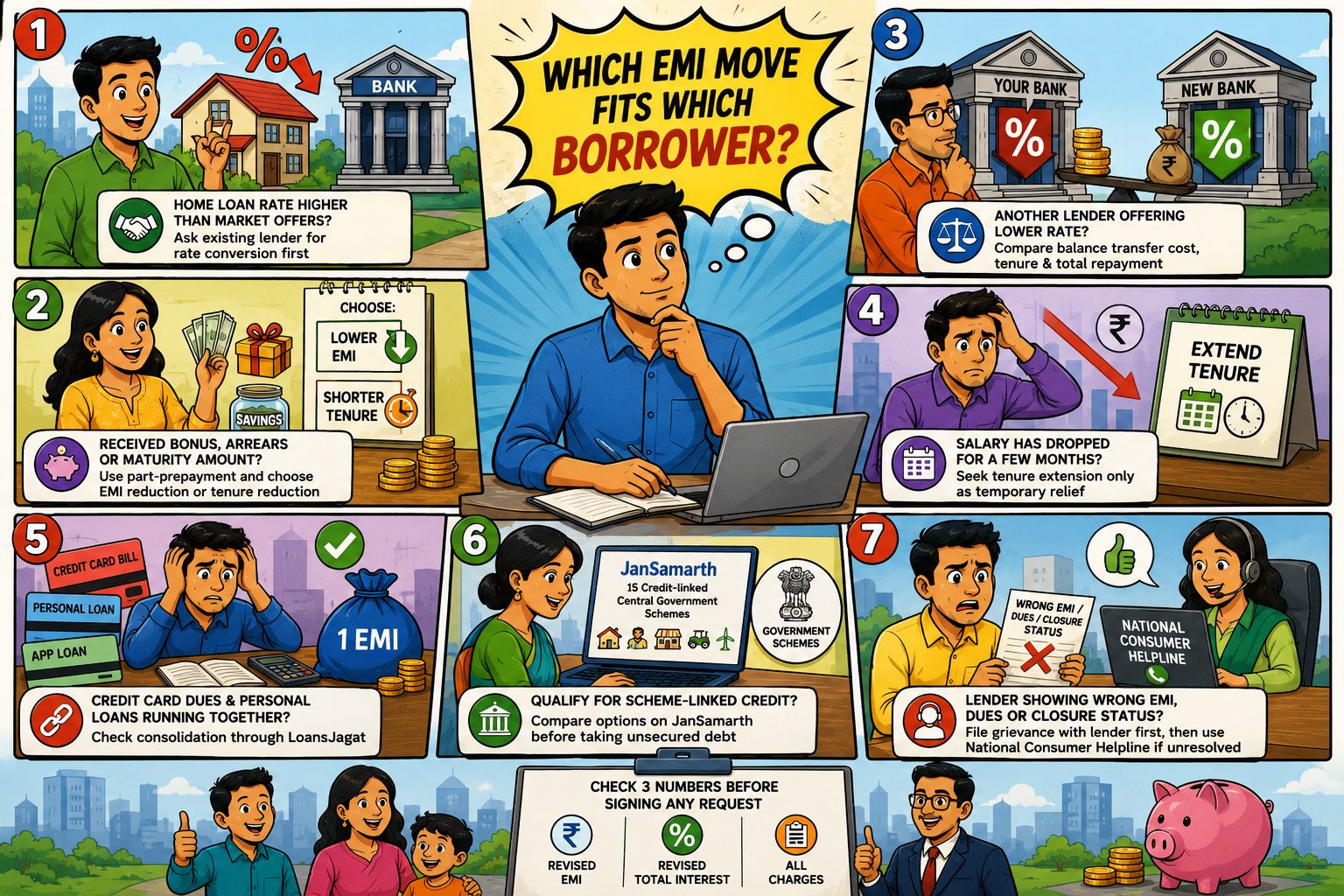
Every borrower does not need the same EMI-cut option. A salaried home loan customer, a small trader with 3 short-term loans and a vehicle loan borrower nearing closure may all need different steps. That is why the borrower should first identify the pressure point, then compare the repayment cost.
This table should be used as a first filter, not as the final decision. The borrower still needs the lender’s written quote, foreclosure amount, revised repayment sheet and full charge list before approving any EMI-change request.
The first effect will be felt in monthly budgets. A salaried borrower in Noida paying ₹31,000 for a home loan, ₹9,000 for a car loan and ₹6,500 toward a personal loan may not need a new loan if the existing EMI can be reduced through rate conversion or partial prepayment. Even ₹2,000 to ₹4,000 in relief can help families cover fuel, medicines or school transport.
There is also a positive credit impact when borrowers act early. A regular loan account gives the borrower more room to negotiate. Lenders usually treat timely repayment as a sign of lower risk. That can help during balance transfer checks, top-up loan applications or future borrowing for education, house repair or business expansion.
Loan advisers usually give 1 warning first: do not miss the EMI while searching for relief. A missed repayment may bring late charges, recovery calls and bureau reporting. The safer route is to call the lender before the due date and ask for written options. The borrower should compare the current loan, revised loan and transfer offer on total repayment, not only EMI.
The practical solution is simple. Keep the latest loan statement, foreclosure quote, rate-conversion offer, repayment schedule and charge sheet together. If the borrower has more than 2 EMIs on different dates, consolidation can be checked. If the borrower is eligible for a government-linked credit scheme, that option should be reviewed before taking another high-cost unsecured loan.
The previous official update came from the Press Information Bureau on May 5, 2026. The Ministry of Finance release said scheduled commercial banks recorded 15.9% non-food credit growth in FY 2025-26, against 10.9% in the previous year. It also said personal loans grew 16.2%, compared with 11.7% a year earlier.
That update showed retail credit demand stayed strong. Vehicle loans, gold-backed loans and housing credit supported the personal loan segment. For borrowers, the warning is plain. Easy access to loans does not reduce repayment pressure unless the EMI fits monthly income.
EMI relief should start before the due date, not after default. Borrowers can use rate talks, prepayment, balance transfer, tenure changes, consolidation, scheme-linked credit and consumer grievance routes to reduce pressure. The best option depends on the loan, income and repayment history.
The final check is not complicated. Borrowers should compare the revised EMI, total interest and all fees on paper. If the monthly payment falls but the total repayment rises sharply, the relief may be too costly. A lower EMI helps only when the borrower stays regular and does not add another debt trap.
What is the easiest way to reduce EMI?
The easiest way is to ask the existing lender for a lower rate or rate-conversion option.
Does part-prepayment reduce EMI immediately?
It can reduce EMI if the borrower chooses EMI reduction instead of tenure reduction after payment.
Is balance transfer always cheaper?
No. Borrowers must count the processing fee, legal cost, insurance cost and remaining tenure first.
Should borrowers extend tenure to reduce EMI?
Only for short-term cash pressure. Longer tenure usually increases total interest.
Where can borrowers complain about wrong EMI charges?
Borrowers can first write to the lender, then use the National Consumer Helpline if unresolved.










.png&w=3840&q=75)


