
Disclaimer: The information published on LoansJagat is intended for general informational and educational purposes only and should not be considered financial, legal, or investment advice. Interest rates, loan terms, statistics, and other data may change over time and may vary by lender or source. Please verify the latest information and consult a qualified financial advisor or the respective Bank/NBFC before making any financial decisions.
Subscribe Now
About the author

Arshathul Afia is a journalism graduate and fintech content writer with 4+ years of experience in digital publishing and research-led writing. She has written 200+ articles covering personal finance, lending, banking, digital payments, credit, insurance, and major financial developments in India. At LoansJagat, she focuses on simplifying complex fintech news, RBI updates, loan-related changes, policy developments, and industry trends for everyday readers. Her journalism background helps her approach stories with research, context, and clarity, while her SEO experience ensures content remains discoverable and relevant. She aims to make financial news easier to understand, practical, and useful for readers across India.
Related News
Simplify All Your Loans Into One Affordable EMI

Customers Served

Debt Consolidated

1200+ Reviews

Locations in India
Club all Loans & Credit Card Bills into Single EMI

Quick Apply Loan
Consolidate your debts into one easy EMI.

Takes less than 2 minutes. No paperwork.

10 Lakhs+
Trusted Customers

2000 Cr+
Loans Disbursed

4.7/5
Google Reviews

50+
Banks & NBFCs Offers
Banking agents are asking for a review of Aadhaar Enabled Payment System interchange fees after nearly a decade at the same rate.
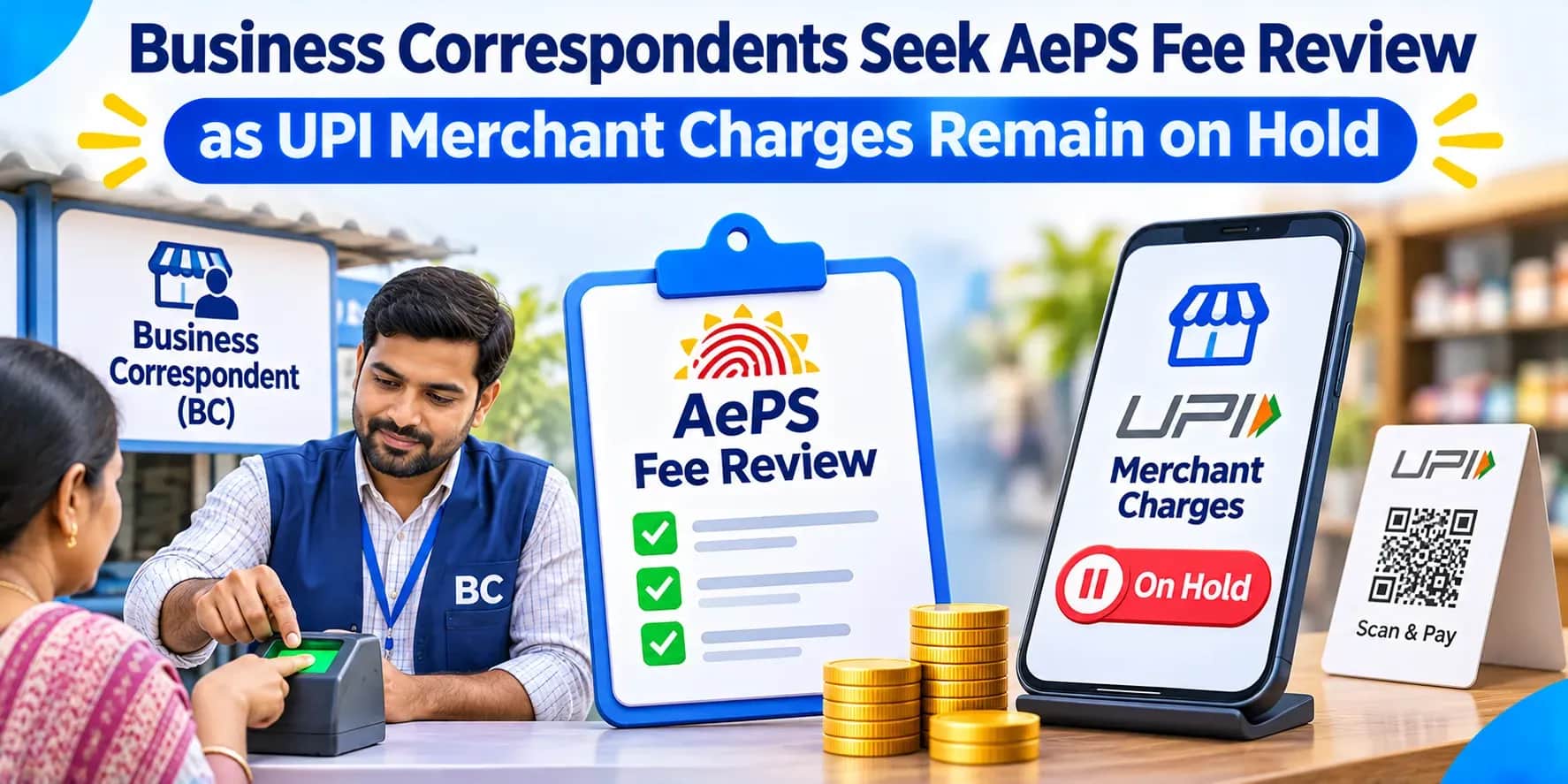
In villages where a banking outlet is the nearest place to withdraw cash, a fee set nearly a decade ago still helps pay for the service. Business correspondents want that fee reviewed under the Aadhaar Enabled Payment System (AePS). Their call comes as proposed merchant charges on the Unified Payments Interface (UPI) remain on hold.
The National Payments Corporation of India (NPCI) had scheduled the UPI merchant discount rate (MDR) to start on 15 October 2026. It deferred the start until after Diwali and had yet to announce a new date by 20 November. Under the proposed framework, eligible merchant payments above ₹2,000 would generally attract a 0.4 per cent charge capped at ₹300. Some categories, including railways and fuel, would pay a flat ₹5 on payments above ₹2,000.
AePS allows a customer with an Aadhaar-linked bank account to use Aadhaar and biometric authentication to withdraw cash, make a deposit or check a balance at a participating business correspondent outlet. The system works across participating banks, so agents can serve customers whose accounts are held elsewhere. The cash withdrawal interchange is paid between banks when a customer of one bank uses another bank’s outlet.
At the existing rate, the interchange on a ₹1,000 withdrawal works out to ₹5. It reaches the ₹15 cap at ₹3,000. Cash deposits and withdrawals account for more than 60 per cent of business correspondents’ earnings. Anand Kumar Bajaj, founder, managing director and CEO of PayNearby, said the economics of running these outlets affect whether agents stay in remote villages where an ATM may be commercially unviable.
The Reserve Bank of India’s (RBI) October 2026 bulletin records AePS cash withdrawals at micro-ATMs separately from withdrawals at conventional ATMs.
Households use these outlets to withdraw direct benefit transfers (DBT) and pension payments. Dharanidhar Tripathy, CEO of the Business Correspondent Resource Council, pointed to the role of these outlets for people who use Pradhan Mantri Jan Dhan Yojana (PMJDY) accounts. He argued that the renewed attention to UPI pricing gives the industry a reason to revisit how the AePS network is funded.
ATM networks can set the interchange banks pay each other. The cash withdrawal interchange at a conventional ATM is ₹19, which is ₹4 above the AePS maximum. The RBI separately sets a ceiling on what banks can charge customers once their free ATM allowance runs out. That ceiling rose to ₹23 per transaction from 1 May 2025, with applicable taxes charged separately.
Savings account holders are entitled to at least five free cash withdrawals a month at their own bank’s ATMs. Other banks’ ATMs must offer at least three free transactions in the six designated metros and five elsewhere. An industry participant called for periodic reviews of AePS interchange as operating costs change, pointing to talks between the RBI and the Confederation of ATM Industry about linking ATM interchange to the Wholesale Price Index.
Since 1 January 2026, acquiring banks have had to verify AePS operators before onboarding them, update their know-your-customer (KYC) records and monitor their transactions. If an operator goes three months without handling a customer transaction, the bank must carry out KYC again before allowing the operator to resume. The requirements add to compliance and technology costs for banks and service providers.
The National Strategy for Financial Inclusion 2025–30 also calls for work on agent pay, training and the range of services agents can offer. Sumita Kale, CEO and senior fellow of the Indicus Foundation, said its financial inclusion centre has pressed since 2014 for measures such as active and dormant agent counts, account usage and service quality. Those figures would help governments and providers see where a registered outlet translates into a service customers actually use.
The proposed UPI merchant charge has reopened a separate question about what banks pay to provide cash withdrawals through AePS. Business correspondents want the AePS interchange reviewed against the cost of running outlets, especially where conventional ATMs are scarce. A periodic review is one option raised by the industry. As of 20 November 2026, the AePS rate remained at 0.5 per cent with a ₹15 cap, and NPCI had yet to set a new date for the UPI merchant charge.
The interchange is 0.5 per cent of the amount withdrawn, capped at ₹15. It is paid between institutions when a customer uses another bank’s outlet.
Yes. A customer can withdraw cash at a participating banking outlet using an Aadhaar number linked to a bank account and completing biometric authentication there.
The rate was unchanged as of 20 November 2026. Business correspondents are seeking a review of the fee and a way to revisit it periodically.
Yes. PhonePe can scan a standard UPI QR code displayed by a merchant using Google Pay. Customers can choose any UPI app they already use.
The proposed MDR would apply to eligible merchants accepting payments above ₹2,000. The framework bars merchants from passing that charge on to customers at checkout.
Start your journey today
Apply Now*T&C apply











