By continuing, you agree to LoansJagat's Credit Report Terms of Use, Terms and Conditions, Privacy Policy, and authorize contact via Call, SMS, Email, or WhatsApp
Disclaimer: The information published on LoansJagat is intended for general informational and educational purposes only and should not be considered financial, legal, or investment advice. Interest rates, loan terms, statistics, and other data may change over time and may vary by lender or source. Please verify the latest information and consult a qualified financial advisor or the respective Bank/NBFC before making any financial decisions.
Subscribe Now
About the author

LoansJagat Team
‘Simplify Finance for Everyone.’ This is the common goal of our team, as we try to explain any topic with relatable examples. From personal to business finance, managing EMIs to becoming debt-free, we do extensive research on each and every parameter, so you don’t have to. Scroll up and have a look at what 15+ years of experience in the BFSI sector looks like.
Related News
Simplify All Your Loans Into One Affordable EMI

Customers Served

Debt Consolidated

1200+ Reviews

Locations in India
Club all Loans & Credit Card Bills into Single EMI

Quick Apply Loan
Consolidate your debts into one easy EMI.

Takes less than 2 minutes. No paperwork.

10 Lakhs+
Trusted Customers

2000 Cr+
Loans Disbursed

4.7/5
Google Reviews

50+
Banks & NBFCs Offers
Other services mentioned in this article
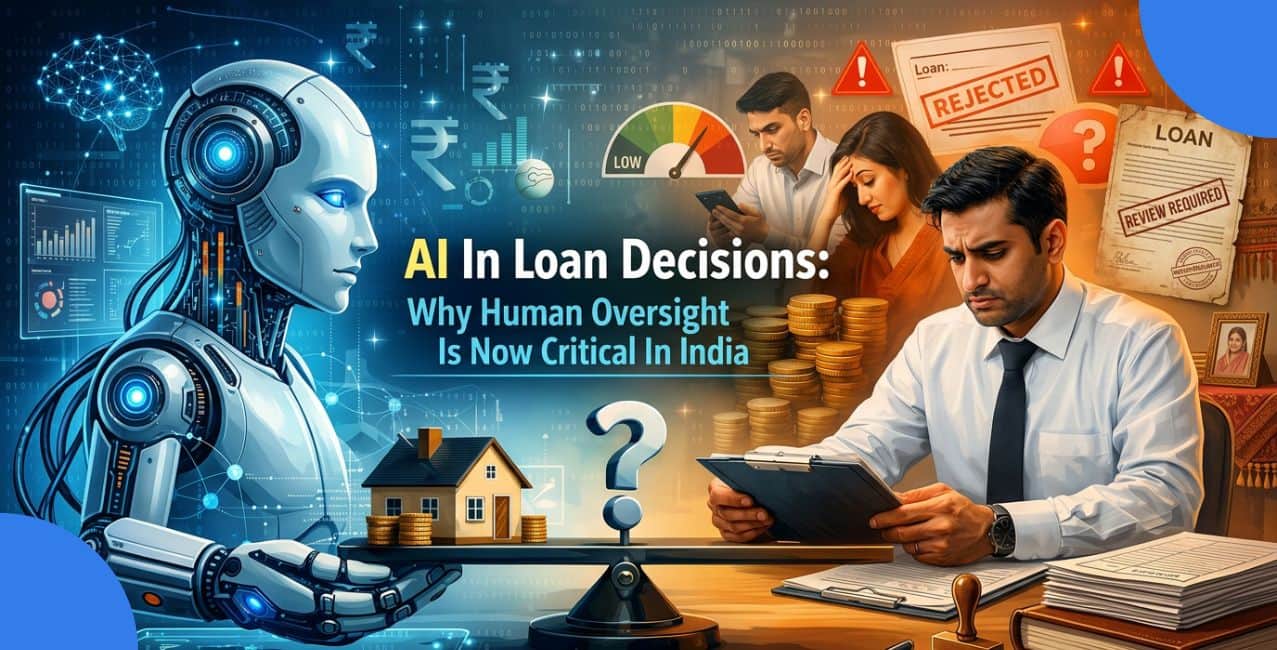
AI-driven underwriting is spreading across Indian lending. The bigger shift now is continuous human checks so faster approvals do not turn into scaled-up wrong calls.
India’s digital credit engine is getting more automated, with lenders leaning on models to screen customers, price risk, and flag fraud. The upside is speed and reach. The risk is silent error at scale.
If the data pattern shifts, or the model learns the wrong proxy, rejections rise for the wrong cohort, and delinquencies creep up without a clear reason. Recent moves by large players show the momentum. For example, Reuters reported on 23/02/2026 that Bharti Airtel plans ₹200 billion investment to expand digital lending capabilities.
The core issue is not AI scoring itself, but unchecked automation. Models can drift as borrower behaviour changes, and teams may still treat outputs as final.
That leads to 2 risks. First, credit losses rise if the model keeps approving weak profiles. Second, genuine borrowers get rejected when the model over-corrects. The impact is amplified in small-ticket, high-volume lending where decisions are rapid and repeatable. Industry data shows how concentrated this segment has become.
Read More - AI in Banking Sector: Can Robots Commit Frauds? Updated Guide
Before the deeper story, here is the scale snapshot lenders are reacting to.
This growth is exactly why human-AI teamwork is becoming a frontline control, not a compliance afterthought.
The practical playbook now is “automation for routine, humans for risk.” Lenders are redesigning underwriting into 3 layers. First, AI handles straight-through approvals only when confidence is high and the profile fits familiar patterns.
Second, a human review gate kicks in for edge cases: thin-file customers, irregular income, policy exceptions, or conflicting signals. Third, post-decision monitoring checks if the model is behaving differently from last month.
The monitoring piece is where outcomes improve. Teams track approval-rate swings by segment, early delinquency signals, and stability of rejection reasons. A sharp rise in overrides becomes a warning that the model is out of tune. KPMG’s note on the responsible AI framework highlights that automation can reduce human error but can also “amplify faults at scale,” and flags model drift and third-party risks.
The warnings around algorithm-heavy lending have been building for a while, especially for NBFC-led growth segments. Reuters reported on 16/05/2024 that the regulator cautioned non-bank lenders against growing reliance on algorithm-based credit models and flagged risks of aggressive lending in certain segments.
That caution was later echoed in mainstream business coverage in India, including a report dated 16/05/2024 highlighting similar concerns in the NBFC context.
More recently, the conversation shifted from warning to structured governance. Reuters reported on 13/08/2025 about a committee-backed AI framework for finance with 26 recommendations across governance, protection and assurance, and a proposal for a standing committee to keep assessing risks.
International trade press also covered this direction on 21/08/2025, noting the push for alternative data use and inclusion, but alongside risk controls.
Also Read - How Banks Are Using AI to Transform and Scale Digital Lending in FY26
Now the focus is operational: daily checks, not annual audits.
*T&C Apply
These controls help lenders protect portfolio quality and reduce avoidable rejections.
Lenders want faster approvals and lower costs, but risk teams want documented overrides and clear audit trails.
Borrowers want understandable rejection reasons and a review route. Vendors push automated tools, while internal audit teams ask for monitoring evidence. LoansJagat’s 22/08/2025 coverage frames the market direction as “ethical and resilient AI” with governance and assurance expectations.
Indian lending is scaling digital credit fast, but the winning model will be human-led governance with AI-led speed. Teams that monitor drift, overrides, and outcomes will improve decisions and reduce unfair declines.
Related Financial News | |||









.png&w=3840&q=75)



