
By continuing, you agree to LoansJagat's Credit Report Terms of Use, Terms and Conditions, Privacy Policy, and authorize contact via Call, SMS, Email, or WhatsApp
Disclaimer: The information published on LoansJagat is intended for general informational and educational purposes only and should not be considered financial, legal, or investment advice. Interest rates, loan terms, statistics, and other data may change over time and may vary by lender or source. Please verify the latest information and consult a qualified financial advisor or the respective Bank/NBFC before making any financial decisions.
Subscribe Now
About the author

Arshathul Afia
Arshathul Afia is a journalism graduate and fintech content writer with 4+ years of experience in digital publishing and research-led writing. She has written 200+ articles covering personal finance, lending, banking, digital payments, credit, insurance, and major financial developments in India. At LoansJagat, she focuses on simplifying complex fintech news, RBI updates, loan-related changes, policy developments, and industry trends for everyday readers. Her journalism background helps her approach stories with research, context, and clarity, while her SEO experience ensures content remains discoverable and relevant. She aims to make financial news easier to understand, practical, and useful for readers across India.
Related News
Simplify All Your Loans Into One Affordable EMI

Customers Served

Debt Consolidated

1200+ Reviews

Locations in India
Club all Loans & Credit Card Bills into Single EMI

Quick Apply Loan
Consolidate your debts into one easy EMI.

Takes less than 2 minutes. No paperwork.

10 Lakhs+
Trusted Customers

2000 Cr+
Loans Disbursed

4.7/5
Google Reviews

50+
Banks & NBFCs Offers
Ashok Lahiri’s UPI fee warning has revived India’s payment-cost debate, while the government continues to protect consumers and small merchants from direct transaction charges today.
NITI Aayog Vice-Chairman Ashok Kumar Lahiri said at the Global Fintech Fest 2026 in Mumbai on 10 September that UPI cannot remain free forever, reopening the debate over who should pay for India’s digital-payment network. He indicated that any eventual charge could be only a few basis points, not even 1%. The comment came after UPI processed ₹29.82 lakh crore in August 2026 across 24.51 billion transactions. The issue involves banks, fintech firms, merchants and millions of users across India.
Nothing changes for an ordinary user today. The Finance Ministry said on 8 August 2026 that consumers would not face transaction charges, P2P transfers would remain free and most merchant payments would also continue without MDR. In the short term, QR payments stay the same. Over time, a limited merchant fee could help fund fraud controls and payment technology, but a poorly designed charge could raise business costs or push some sellers back towards cash.
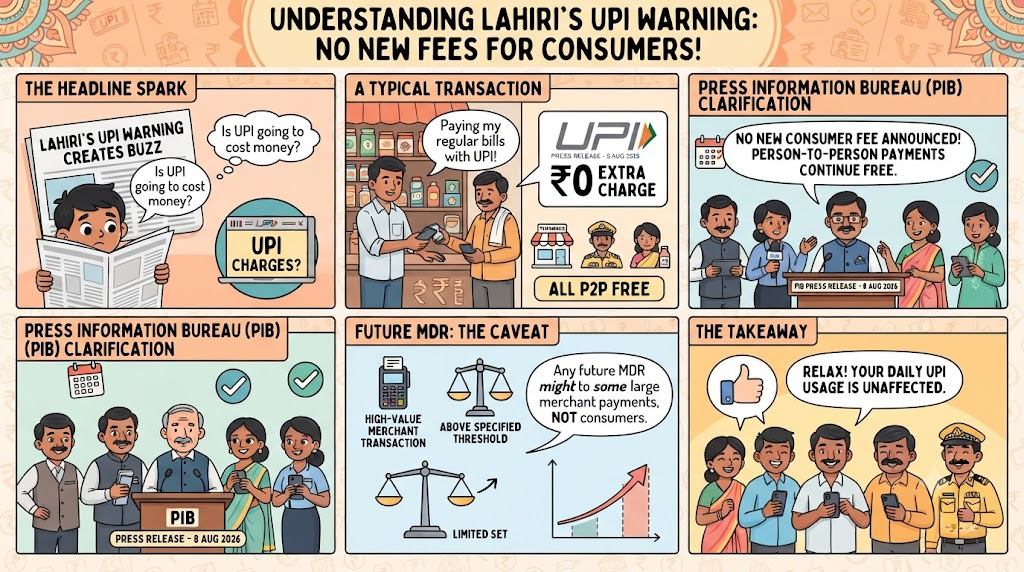
For households, the biggest point is simple. No new consumer fee has been announced. A person paying a kirana shop, pharmacy, taxi driver or family member through UPI does not suddenly owe an extra charge because of Lahiri’s comment. The Press Information Bureau said on 8 August 2026 that consumers would face no transaction charge and all person-to-person payments would continue free. Any future MDR, it said, would apply only to a limited set of merchant transactions above a specified threshold.
That protection is important for small-value payments. UPI grew because a ₹50 tea bill or a ₹500 grocery payment could move without an extra checkout fee. If small merchants stay outside a future MDR plan, that habit is less likely to change. The possible negative effect would come indirectly. A large merchant paying a processing charge could cut cashback, reduce payment-linked offers, or adjust prices.
The current position is easier to read when separated from proposals still under discussion.
The table shows why “UPI will become paid” is too broad. The debate is mainly about selected merchant payments, not a blanket fee on every scan or transfer. That distinction gives policymakers room to fund the system without disrupting small-value digital payments.
Every UPI payment depends on banks, payment service providers, security systems, dispute handling, and fraud checks. Users see a QR scan and confirmation screen, but the network behind it needs continuous spending. Lahiri’s argument is that payment firms need a business model that can support those costs as volumes keep rising.
A narrower solution would ask selected larger merchants or higher-value transactions to contribute a small MDR while protecting households and small sellers. Such a framework would need a defined merchant-turnover cut-off, transaction threshold, rate, and exemptions. It should also stop businesses from presenting a merchant processing cost as an automatic customer charge.
Lahiri also connected digital payments with formal credit. He argued that banks and fintech firms can use UPI transaction histories to assess small businesses better. A neighbourhood shop may have limited collateral or a thin borrowing record, but regular digital receipts can still show sales activity and cash flow.
From a LoansJagat borrower-impact view, this is where the story goes beyond UPI fees. If lenders use consent-based payment data responsibly, a small enterprise may be assessed on recent business activity instead of only older paperwork or collateral. That can widen access to formal credit. One weak month, however, should not become an automatic rejection. Payment data should work alongside existing debt, income stability, and repayment capacity.
The latest remarks follow years of government support for zero-MDR UPI. From January 2020, prescribed UPI merchant payments operated under a zero-MDR framework to encourage digital acceptance. The policy reduced direct acceptance costs for shops, while banks and payment firms continued spending on routing, security, fraud prevention, and customer support.
Government incentives covered part of that cost. In March 2025, the Union Cabinet approved a ₹1,500 crore incentive scheme for low-value BHIM-UPI merchant transactions for FY2024-25. Eligible payments of up to ₹2,000 received by small merchants stayed at 0% MDR, while participating payment entities received a 0.15% incentive.
A bigger policy change arrived in August 2026. Parliament passed the Taxation and Other Laws (Amendment) Bill, 2026. Finance Minister Nirmala Sitharaman told the Rajya Sabha on 11 August that the amendment itself did not impose a UPI tax or transaction fee on consumers. She also said the government did not intend to impose MDR on small merchants, according to Akashvani News, 11 August 2026.
The LoansJagat UPI MDR explainer published on 17 August 2026 also separately reported merchant-fee proposals from the actual policy position. No proposed rate had become a notified charge. The law now gives the government room to design a selective merchant fee, but the final commercial rules still need a formal decision.
Lahiri has taken a firm public position on long-term funding. His point is that digital payments need a business model that can support expansion, security and reliability even when the visible user charge stays at ₹0. He also wants banks and fintech firms to use technology and transaction data to widen formal credit access, particularly for smaller businesses.
The Payments Council of India has backed the consumer-free position. In August 2026, it said UPI would remain free for consumers and small merchants while payment firms continue investing in cybersecurity, fraud prevention and infrastructure. That broadly matches the government’s current direction.
Targeting will decide whether that approach works. A roadside seller and a national retailer do not operate with the same margins or payment volumes. A turnover test with a transaction-value threshold could separate them better. The final rule should also state whether merchants may pass the cost to customers.
For borrowers, UPI data can show business activity that older credit files may miss. A shop receiving regular digital payments may show recurring revenue even without a long borrowing history. Used responsibly, that record could improve credit appraisal for some micro and small businesses.
Merchants face a different calculation. Small firms want low-cost acceptance, while payment companies need money for technology and fraud controls. A narrowly targeted fee on larger merchants could provide revenue with limited disruption. The rules, however, need to be easy to follow so businesses know exactly when a charge applies.
Ashok Lahiri’s 10 September comment has pushed the UPI funding debate back into public view. His position does not mean every Indian will start paying for QR transactions. He is arguing that a payment network operating at this scale needs a model that can fund technology, security and future expansion.
For users, the current position stays unchanged. Consumer payments and P2P transfers remain free, while the government says small merchants should stay protected. The next real development will come only when authorities publish a final MDR rate, merchant threshold, and start date, if they decide to introduce one. Until then, claims that all UPI payments are becoming chargeable go beyond what has actually been announced.
No. Lahiri’s statement does not create a consumer fee. The government’s August 2026 position says consumers and P2P UPI transfers will remain free.
No start date has been announced. The final rate, merchant threshold, and effective date remain pending.
No blanket customer surcharge has been announced. If a future merchant MDR arrives, the government would still need to specify whether merchants can recover that cost from buyers.
UPI can be free to the user while banks and payment firms still pay for technology, security, fraud controls, and processing. The debate is about funding those costs without discouraging daily digital payments.
It may help lenders assess business cash flows when used with borrower consent and other credit checks. Lahiri has argued that UPI data can support better risk assessment for MSMEs.









.png&w=3840&q=75)


