
By continuing, you agree to LoansJagat's Credit Report Terms of Use, Terms and Conditions, Privacy Policy, and authorize contact via Call, SMS, Email, or WhatsApp
Disclaimer: The information published on LoansJagat is intended for general informational and educational purposes only and should not be considered financial, legal, or investment advice. Interest rates, loan terms, statistics, and other data may change over time and may vary by lender or source. Please verify the latest information and consult a qualified financial advisor or the respective Bank/NBFC before making any financial decisions.
Subscribe Now
About the author

Arshathul Afia
Arshathul Afia is a journalism graduate and fintech content writer with 4+ years of experience in digital publishing and research-led writing. She has written 200+ articles covering personal finance, lending, banking, digital payments, credit, insurance, and major financial developments in India. At LoansJagat, she focuses on simplifying complex fintech news, RBI updates, loan-related changes, policy developments, and industry trends for everyday readers. Her journalism background helps her approach stories with research, context, and clarity, while her SEO experience ensures content remains discoverable and relevant. She aims to make financial news easier to understand, practical, and useful for readers across India.
Related News
Simplify All Your Loans Into One Affordable EMI

Customers Served

Debt Consolidated

1200+ Reviews

Locations in India
Club all Loans & Credit Card Bills into Single EMI

Quick Apply Loan
Consolidate your debts into one easy EMI.

Takes less than 2 minutes. No paperwork.

10 Lakhs+
Trusted Customers

2000 Cr+
Loans Disbursed

4.7/5
Google Reviews

50+
Banks & NBFCs Offers
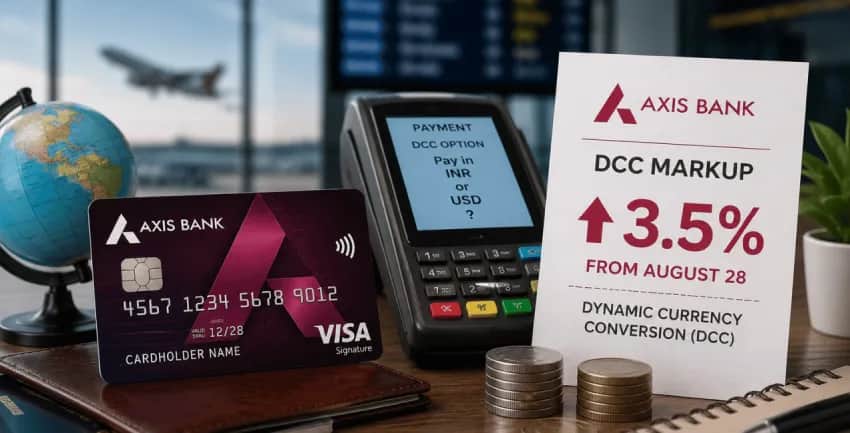
Axis Bank will revise card charges from August 28, raising DCC markup, changing late fees and removing rewards from toll-related payments for affected customers nationwide.
The short-term cost will fall mainly on international travellers and customers who miss a payment. Over a longer period, people who regularly use their cards for FASTag, road tolls or gift cards may receive less value from rewards and annual spending targets. CNBC-TV18 reported the approaching changes on August 18, 2026, 10 days before they take effect.

DCC appears when a shop, hotel, ATM or website outside India offers to charge an Indian card in rupees instead of the local currency. The merchant controls that conversion, after which Axis Bank adds its DCC markup and applicable taxes. On an eligible ₹1 lakh transaction, a 3.5% markup means a ₹3,500 bank charge before tax, compared with ₹1,500 earlier.
The revision also states how a partial payment will be used. It will cover fees and taxes, EMIs, interest, purchases and then cash advances. Domestic lounge access continues for eligible cards, but customers must show the Axis Bank card and a boarding pass instead of Priority Pass.
Ajay Awtaney, founder and editor of Live From A Lounge, wrote on July 28, 2026, that DCC commonly produces a poorer conversion rate for cardholders. He described the domestic lounge change as a cost-control step because Priority Pass access can cost the issuer more.
The safer checkout choice is usually the merchant’s local currency. Axis Bank’s normal foreign-currency fee may still apply, but DCC can be avoided. Travellers should check the displayed currency and keep the receipt. Full-bill autopay can reduce the separate risk of late charges.
Axis Bank has issued a general revision notice as well as separate terms for selected premium cards. The 3.5% rate, therefore, cannot be applied to every product without checking the card variant. The main changes are listed below.
The late-fee notice contains a small drafting conflict. Its explanatory sentence says ₹1,300 applies to an outstanding balance of ₹50,000 and above. The table in the same document places exactly ₹50,000 in the ₹1,200 slab and applies ₹1,300 only above ₹50,000. A customer billed for an exact ₹50,000 outstanding should seek written confirmation from Axis Bank.
A standard foreign-currency transaction happens when the cardholder pays in euros, dollars, dirhams or another local currency. The card network converts it into rupees and the issuer may add a forex fee. DCC starts when the overseas merchant converts the bill into INR at checkout.
Axis Bank has not announced a universal increase in every forex fee to 3.5%. An INR purchase can still attract DCC when the merchant is registered outside India, even if the customer is at home.
Before this revision, many Axis Bank cards carried a 1.5% DCC markup. The late fee reached ₹1,200 for applicable dues above ₹10,000. The new schedule keeps ₹1,200 for dues from ₹10,001 to ₹50,000 and raises the highest slab by ₹100.
For customers who pay on time, the late-fee revision may never apply. DCC on most affected cards rises by 2 percentage points and more than doubles. Overseas INR billing is therefore the bigger immediate expense. This comparison is based on the old and revised rates.
Gift-card exclusions also existed earlier. Selected terms kept such transactions outside rewards, fee waivers or milestones. The new Gift Card category may help Axis Bank identify these purchases more consistently than the wider Wallet classification.
Axis Bank has not attached a statement from a named executive to the revision documents. Its formal position comes through the product notices. The bank says gift-card purchases will remain outside rewards and applicable spending calculations. It also confirms that bridge, road and toll payments will no longer earn rewards or cashback after August 28.
The bank presents the lounge revision as a change in entry method, not a withdrawal of eligible domestic visits. Priority Pass remains valid for qualifying international lounges, including eligible facilities after immigration at Indian international terminals.
Card commentators see fewer reward optimisation routes. Gift cards and toll payments had helped some users reach annual spending thresholds. Customers should compare the remaining benefits with the annual fee and avoid buying vouchers only to reach a target.
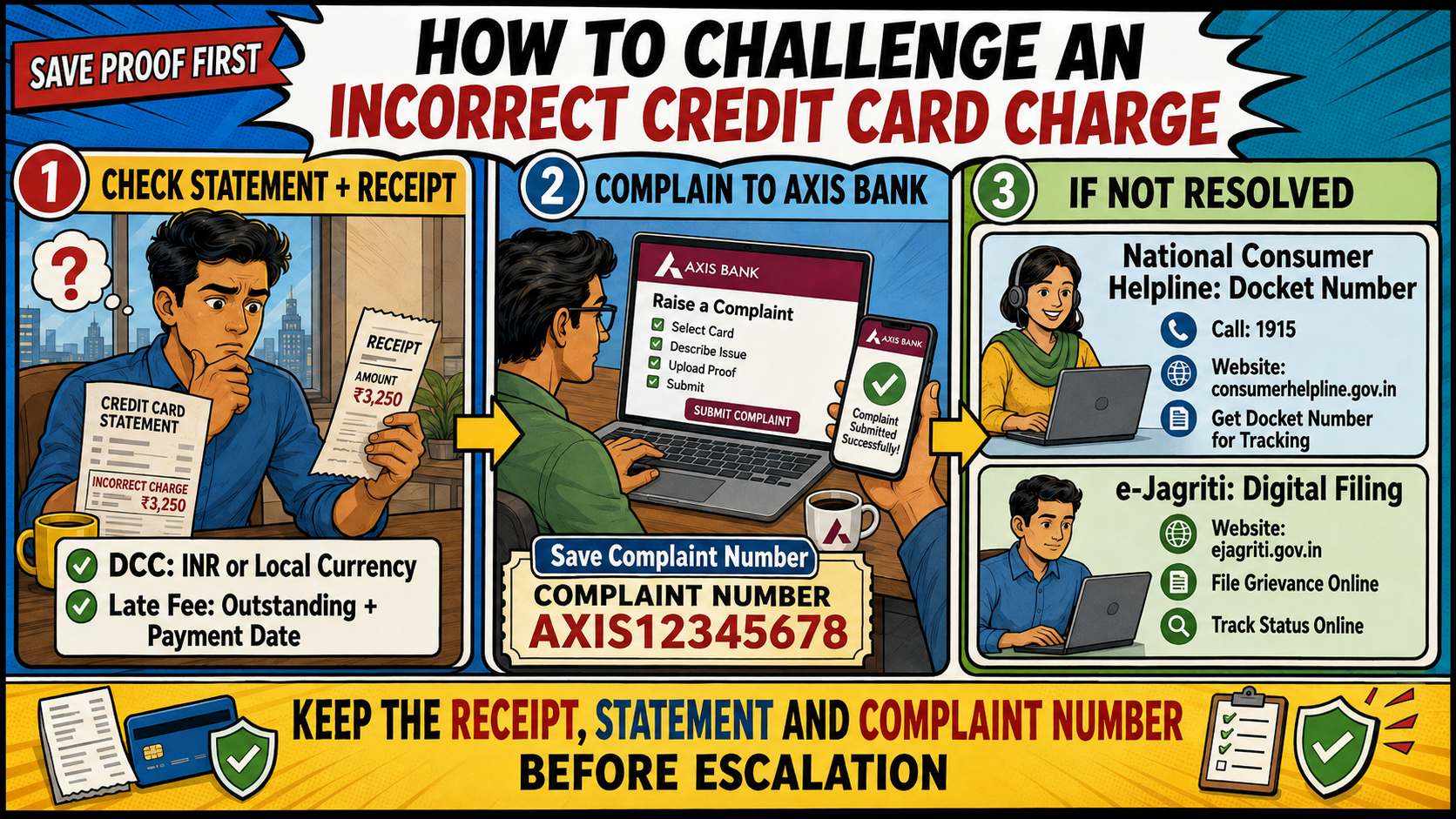
A cardholder should first complain to Axis Bank and save the complaint number, statement and receipt. For DCC, the receipt should show whether the merchant processed INR or local currency. For a late fee, the statement should record the outstanding and payment date.
If the bank does not resolve it, the Government of India’s National Consumer Helpline accepts grievances and issues a docket number. The Department of Consumer Affairs’ e-Jagriti platform provides digital filing facilities for Consumer Commission proceedings.
Axis Bank’s August 28 update will make overseas INR billing more expensive on most affected cards. It will also narrow reward eligibility, raise the highest late-payment fee and change how partial payments are allocated. Customers who pay in full and rarely travel may see little direct cost.
International travellers need to pay closer attention. The 3.5% DCC rate is not universal, but it is high enough to turn a convenient INR prompt into an avoidable charge. Selecting local currency, checking the card-specific notice and saving the transaction receipt can prevent a costly surprise later.
The DCC, late fee, reward, payment allocation, and domestic lounge changes start on August 28, 2026. Later benefit dates may differ by card.
No. Magnus and Magnus for Burgundy move to 2%, while Olympus has a revised rate of 1.8 percent. Some premium products carry separate conditions.
Bridge fees, road fees and toll payments will stop earning rewards or cashback. FASTag treatment depends on the merchant classification used for the payment.
Local currency generally avoids DCC. The normal foreign-currency fee may still apply, so travellers should check the card’s rate before departure.
DCC on Magnus becomes 2%, but the merchant may use a poorer INR conversion. Local currency provides the card-network conversion and the stated forex fee.









.png&w=3840&q=75)


