.png&w=3840&q=65)
By continuing, you agree to LoansJagat's Credit Report Terms of Use, Terms and Conditions, Privacy Policy, and authorize contact via Call, SMS, Email, or WhatsApp
Disclaimer: The information published on LoansJagat is intended for general informational and educational purposes only and should not be considered financial, legal, or investment advice. Interest rates, loan terms, statistics, and other data may change over time and may vary by lender or source. Please verify the latest information and consult a qualified financial advisor or the respective Bank/NBFC before making any financial decisions.
Subscribe Now
About the author

Arshathul Afia
Arshathul Afia is a journalism graduate and fintech content writer with 4+ years of experience in digital publishing and research-led writing. She has written 200+ articles covering personal finance, lending, banking, digital payments, credit, insurance, and major financial developments in India. At LoansJagat, she focuses on simplifying complex fintech news, RBI updates, loan-related changes, policy developments, and industry trends for everyday readers. Her journalism background helps her approach stories with research, context, and clarity, while her SEO experience ensures content remains discoverable and relevant. She aims to make financial news easier to understand, practical, and useful for readers across India.
Related News
Simplify All Your Loans Into One Affordable EMI

Customers Served

Debt Consolidated

1200+ Reviews

Locations in India
Club all Loans & Credit Card Bills into Single EMI

Quick Apply Loan
Consolidate your debts into one easy EMI.

Takes less than 2 minutes. No paperwork.

10 Lakhs+
Trusted Customers

2000 Cr+
Loans Disbursed

4.7/5
Google Reviews

50+
Banks & NBFCs Offers
Other services mentioned in this article
Axis Finance has launched Drishti, an in-house rules engine for 4 loan products, promising quicker decisions while keeping human review for complex borrower files nationwide.
Axis Finance Limited launched Drishti in Mumbai on July 27, 2026. The in-house Business Rules Engine will handle policy-led credit assessment for personal loans, business loans, loans against property and Disha home loans. It brings underwriting workflows, statistical scorecards and data checks into one system. Standard applications may move through straight-through processing. Files with irregular income, property issues or missing documents can still go to a credit officer. The lender says the platform should cut processing time and apply credit policy more consistently across its retail and MSME business.
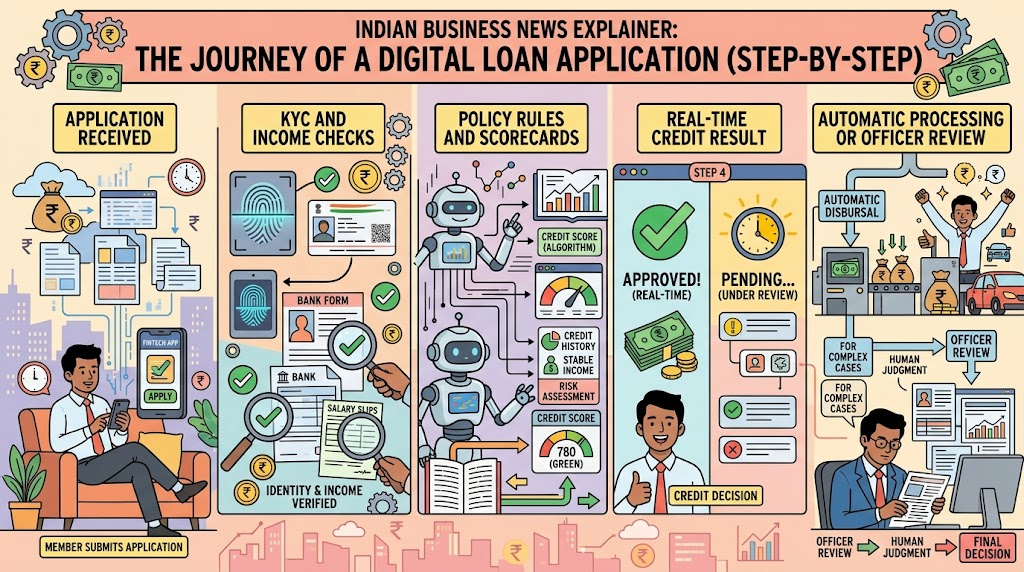
A salaried customer applying for a personal loan usually submits PAN, Aadhaar, salary slips, bank statements and credit history. Drishti can compare those details with approved lending rules without waiting for several manual queues. A file that fits the policy may move sooner. Approval is not assured, and the sanctioned amount will still depend on income, existing debt and repayment history.
Business borrowers bring harder files. A retailer may post strong festive sales and weaker receipts for months. A contractor may receive large payments at irregular intervals. Property-backed applicants also face valuation, title and legal checks. Those cases need staff judgement even when the first screening is automated. The Ministry of MSME Dashboard reported 8.94 crore Udyam and Udyam Assist registrations as of June 30, 2026, with estimated employment of 39.58 crore. Many of those firms will not fit a salaried template.
Credit teams will look beyond speed. They will want to know which rule stopped a file, whether the source data was current, and how quickly an incorrect record can be corrected. Drishti has been described as a Business Rules Engine, not as an autonomous system that approves every loan on its own. A rules engine applies conditions already approved by the lender. Scorecards and analytics add another layer, but a human decision can still be required.
A LoansJagat analysis of automation and AI in lending separates workflow automation from risk prediction and fraud detection. Drishti may speed document checks and policy matching, yet it still needs audit trails and a route for borrowers to report errors. A 5-minute decision helps only when the lender can explain it. Self-employed applicants and seasonal firms will need that support most.
Axis Finance says Drishti can update lending rules, connect with multiple data sources, and support straight-through and assisted processing. That gives the company one framework across branches and products. The company has not announced when Drishti will move beyond the first 4 products.
The table below shows the confirmed scope and the likely point at which human review may still enter the file.
The public-sector programme used digital KYC, GST data, bank statements, income-tax records, credit bureau checks and fraud screening. It reduced paperwork and moved more steps online. Drishti belongs to a private lender, so its rules will differ. The difficult part is keeping an assisted route open for files outside standard conditions.
Axis Finance had already started changing its credit process before July 2026. The company introduced ABC Scorecards to make assessments more consistent and less dependent on individual interpretation. It also deployed AI-assisted monitoring for collection calls. These systems do different jobs. ABC Scorecards support underwriting, the collection tool reviews customer interactions after disbursal, and Drishti handles rules, data, and workflow decisions at the credit stage.
Axis Finance was expanding at the same time. By March 31, 2026, Axis Finance had ₹47,692 crore in assets under finance, 22% higher year-on-year. Its retail and MSME book grew 30%, profit after tax rose 19% to ₹806 crore, and network coverage reached 1,120 locations. Gross and net NPAs were 0.94% and 0.36%. A larger network creates more chances for the same policy to be read differently.
On April 25, 2026, Axis Finance announced a ₹2,250 crore capital raise, including ₹1,500 crore from Axis Bank and ₹750 crore from Kedaara Capital, subject to approvals. The company linked the funds to retail, MSME and wholesale growth, plus investment in people and technology. Drishti went live about 3 months later, though Axis Finance has not disclosed its development cost.
Sai Giridhar, Managing Director and CEO of Axis Finance, said Drishti was built to deliver faster and more consistent credit decisions by placing analytics and automated workflows inside the lender’s main decision framework. He also referred to governance, risk controls, customer experience and portfolio quality. That is the official position. Borrowers will judge the system on simpler points, such as whether document requests reduce, status updates arrive on time, and a disputed result reaches a human reviewer.
The most useful outcome would be fewer repetitive checks without removing judgement from difficult cases. A small manufacturer may show lower monthly receipts because 2 large customers pay every 60 days. A standard rule could read that as weak cash flow. An officer with access to invoices and contract history may reach a different view. Drishti will be more useful when it sends such files to the right person instead of closing them at the first failed condition.
Before sending the application, borrowers should check their documents once. Even a small mismatch in the name on PAN, Aadhaar, bank records, or employment papers can delay the file. The details should also be current. It also helps to review the credit report for old loans that still appear open, duplicate accounts, or settled dues showing as unpaid.
Business owners should keep recent GST returns, bank statements, tax filings, and ownership papers ready, rather than searching for them after the lender raises a request. Property-backed borrowers should confirm title papers and valuation-related records before the lender asks.
Borrowers should avoid submitting several applications at once. Multiple hard enquiries over a short period can weaken the profile. One complete application is usually better than 4 rushed ones. When Drishti asks for a document, the applicant should upload that exact record. Many delays start with unrelated or unreadable files.
Axis Finance has moved 4 important loan products into a common credit decision system. Drishti can apply policy rules, scorecards, and data checks faster than a fully manual process, while assisted review remains available for files that need more work. Standard applications may move quickly. Complex cases will still depend on people.
The next useful disclosures would be actual turnaround times, automatic decision rates, error-correction steps and the number of applications sent for manual review. Until Axis Finance publishes those details, Drishti should be treated as a new operating system for credit assessment, not a promise of instant approval. Its performance will depend on accurate data, explainable decisions, and timely intervention by trained credit staff.
Drishti is an in-house Business Rules Engine used to process credit decisions for 4 Axis Finance loan products.
Personal loans, business loans, loans against property, and Disha home loans are included.
No. Standard files may move automatically, while unusual or incomplete cases can go to a credit officer.
Yes. An outdated bureau entry, mismatched income record or missing document can hold up the application.
Recent bank statements, GST returns, tax records, ownership papers and supporting income documents should be ready.
Banks may reject applications because of credit-report errors, high existing debt, unstable income, repeated enquiries or incomplete documents.










.png&w=3840&q=75)


