
By continuing, you agree to LoansJagat's Credit Report Terms of Use, Terms and Conditions, Privacy Policy, and authorize contact via Call, SMS, Email, or WhatsApp
Disclaimer: The information published on LoansJagat is intended for general informational and educational purposes only and should not be considered financial, legal, or investment advice. Interest rates, loan terms, statistics, and other data may change over time and may vary by lender or source. Please verify the latest information and consult a qualified financial advisor or the respective Bank/NBFC before making any financial decisions.
Subscribe Now
About the author

Arshathul Afia
Arshathul Afia is a journalism graduate and fintech content writer with 4+ years of experience in digital publishing and research-led writing. She has written 200+ articles covering personal finance, lending, banking, digital payments, credit, insurance, and major financial developments in India. At LoansJagat, she focuses on simplifying complex fintech news, RBI updates, loan-related changes, policy developments, and industry trends for everyday readers. Her journalism background helps her approach stories with research, context, and clarity, while her SEO experience ensures content remains discoverable and relevant. She aims to make financial news easier to understand, practical, and useful for readers across India.
Related News
Simplify All Your Loans Into One Affordable EMI

Customers Served

Debt Consolidated

1200+ Reviews

Locations in India
Club all Loans & Credit Card Bills into Single EMI

Quick Apply Loan
Consolidate your debts into one easy EMI.

Takes less than 2 minutes. No paperwork.

10 Lakhs+
Trusted Customers

2000 Cr+
Loans Disbursed

4.7/5
Google Reviews

50+
Banks & NBFCs Offers
Other services mentioned in this article
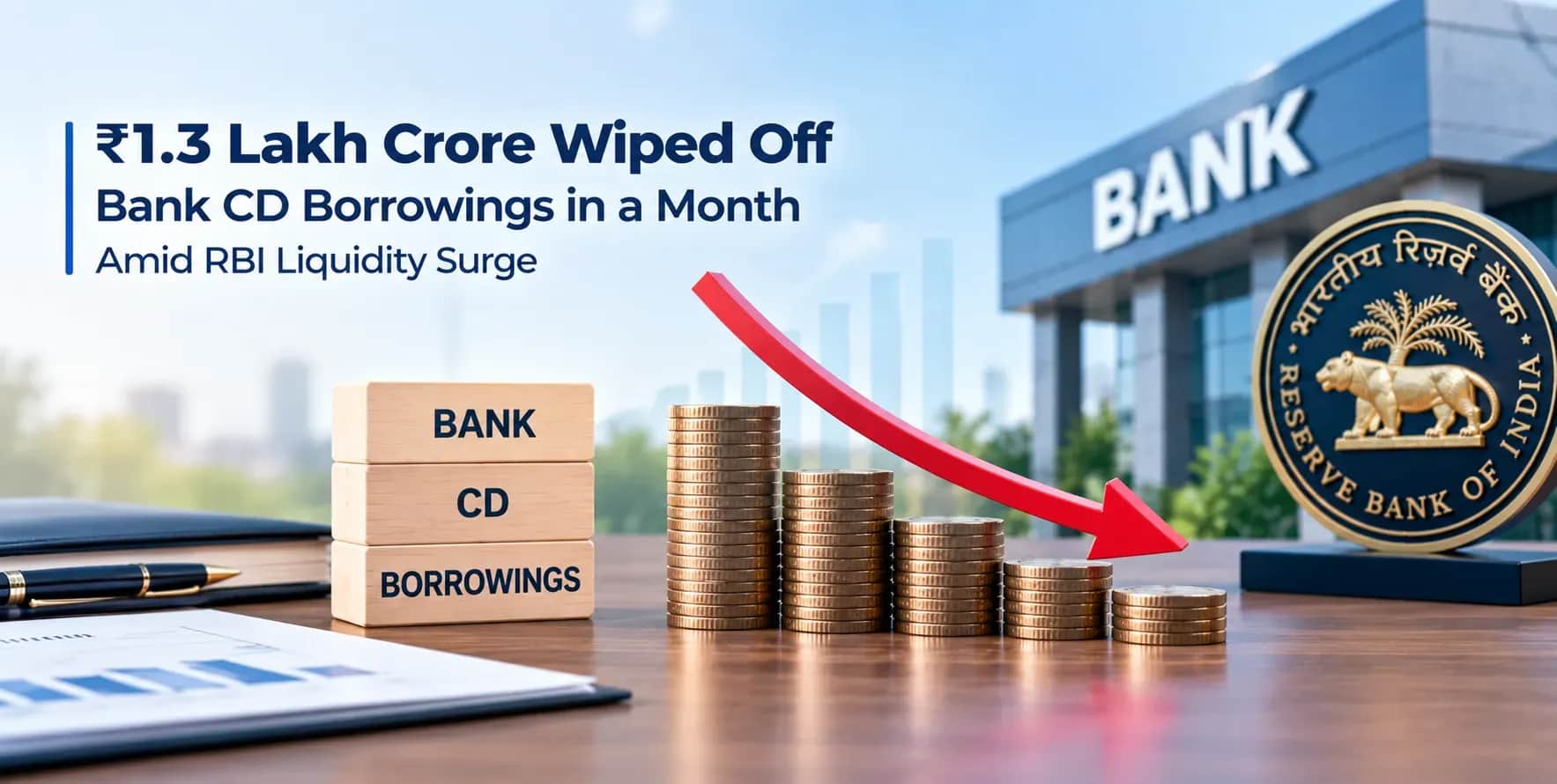
Indian banks cut certificate of deposit borrowings by ₹1.3 lakh crore in a month as surplus liquidity reduced their need for short-term wholesale funding significantly.
Key Highlights
Indian banks entered September 2026 with unusually high surplus liquidity, reducing their need to keep replacing short-term market borrowings as older CDs matured. By September 15, outstanding CDs had fallen to ₹5.60 lakh crore. The latest fortnight alone saw a ₹76,400 crore drop, while annual growth in outstanding CDs slowed to 11.5% from 28.4% at the end of August.
For borrowers, the immediate change is in bank funding costs rather than loan EMIs. Banks paying less for incremental short-term money have lower funding pressure. For depositors, surplus funds change the funding requirement at banks. When enough money is already available, the need to raise costly deposits reduces. Retail lending rates and fixed deposit rates do not change automatically because of this.
Banks use certificates of deposit to raise short-term funds from the market. With more rupee liquidity already available, some maturing CDs did not have to be replaced. Fresh issuance rose from ₹19,500 crore to ₹39,900 crore. Even with that increase, the stock of outstanding CDs kept falling as a larger amount of existing paper reached expiry.
The main numbers show how quickly that funding requirement changed.
The fall in outstanding CDs therefore did not come from banks leaving the CD market. They were still issuing new paper. The difference was that they needed less replacement funding while surplus liquidity remained available.
There is no direct loan-rate cut attached to the ₹1.3 lakh crore decline. The benefit is further inside a bank’s funding structure. When the cost of new CDs falls, incremental borrowing becomes cheaper, reducing one component of the money banks pay to fund loans.
For depositors, abundant liquidity can reduce the pressure on banks to compete for expensive money. This is the more useful way to read the development: it shows a change in banks’ funding requirement, not a guaranteed change in a household’s next EMI or fixed deposit rate. Our September 8 coverage had already recorded ₹6.12 lakh crore being absorbed through 2 liquidity auctions on September 7, showing how large the surplus had become.
Vineet Jain, Senior Director, BFSI at Care Ratings, said banks cut back on CDs as ample funds became available, while the call money rate fell to 4.97%. He also said the cost advantage may not last as short-term rates rise and excess cash is absorbed from the system.
Prateek Ancha of Axis Securities pointed to another part of the shift. Rates on 12-month CDs were about 60 basis points below their June 1 level. Lower costs on CDs and non-retail term deposits, he said, support bank profitability, liquidity coverage ratios and the pool of deposits available for lending.
The liquidity build-up had begun earlier. An official release dated August 24, 2026, said foreign-currency mobilisation under the special swap facility reached $73 billion by August 21, including $65.40 billion through FCNR(B) deposits. The facility opened on June 8, 2026.
The flow remained strong through the end of August. By August 31, 2026, 20 banking units in GIFT IFSC had sanctioned $54.02 billion under the FCNR(B) facility. An official update dated September 2, 2026, put the amount already disbursed at about $52.82 billion.
After the foreign currency was swapped for rupees, the funds became available within the domestic banking system. System liquidity later peaked at around ₹11.2 lakh crore in early September. That gave banks enough room to allow more CDs to mature without immediately replacing the full amount.
The ₹1.3 lakh crore fall in outstanding CDs is primarily a funding story. Banks had more rupee liquidity available and did not need to replace every CD that matured during the month.
Lower CD rates can reduce banks’ incremental funding costs. For households, however, the immediate effect stops there. The September 15 data does not by itself announce lower loan rates or changes to retail deposit rates.
By September 15, outstanding CDs stood at ₹5.60 lakh crore. That was ₹1.306 lakh crore below the roughly ₹6.90 lakh crore recorded in mid-August.
Surplus rupee liquidity increased after large foreign-currency inflows. Banks therefore had less need to replace all short-term CDs as they matured.
Not automatically. The decline lowers part of banks’ funding pressure, but the September 15 CD data does not represent a change in retail lending rates.
Yes. In India, banks use certificates of deposit as negotiable money-market instruments to raise short-term funds. They are different from ordinary retail fixed deposits.
A CD is issued by eligible banks as a negotiable money-market instrument for funding. A fixed deposit works differently. It is a regular deposit product offered directly to customers.









.png&w=3840&q=75)


