
Disclaimer: The information published on LoansJagat is intended for general informational and educational purposes only and should not be considered financial, legal, or investment advice. Interest rates, loan terms, statistics, and other data may change over time and may vary by lender or source. Please verify the latest information and consult a qualified financial advisor or the respective Bank/NBFC before making any financial decisions.
Subscribe Now
About the author

Arshathul Afia is a journalism graduate and fintech content writer with 4+ years of experience in digital publishing and research-led writing. She has written 200+ articles covering personal finance, lending, banking, digital payments, credit, insurance, and major financial developments in India. At LoansJagat, she focuses on simplifying complex fintech news, RBI updates, loan-related changes, policy developments, and industry trends for everyday readers. Her journalism background helps her approach stories with research, context, and clarity, while her SEO experience ensures content remains discoverable and relevant. She aims to make financial news easier to understand, practical, and useful for readers across India.
Related News
Simplify All Your Loans Into One Affordable EMI

Customers Served

Debt Consolidated

1200+ Reviews

Locations in India
Club all Loans & Credit Card Bills into Single EMI

Quick Apply Loan
Consolidate your debts into one easy EMI.

Takes less than 2 minutes. No paperwork.

10 Lakhs+
Trusted Customers

2000 Cr+
Loans Disbursed

4.7/5
Google Reviews

50+
Banks & NBFCs Offers
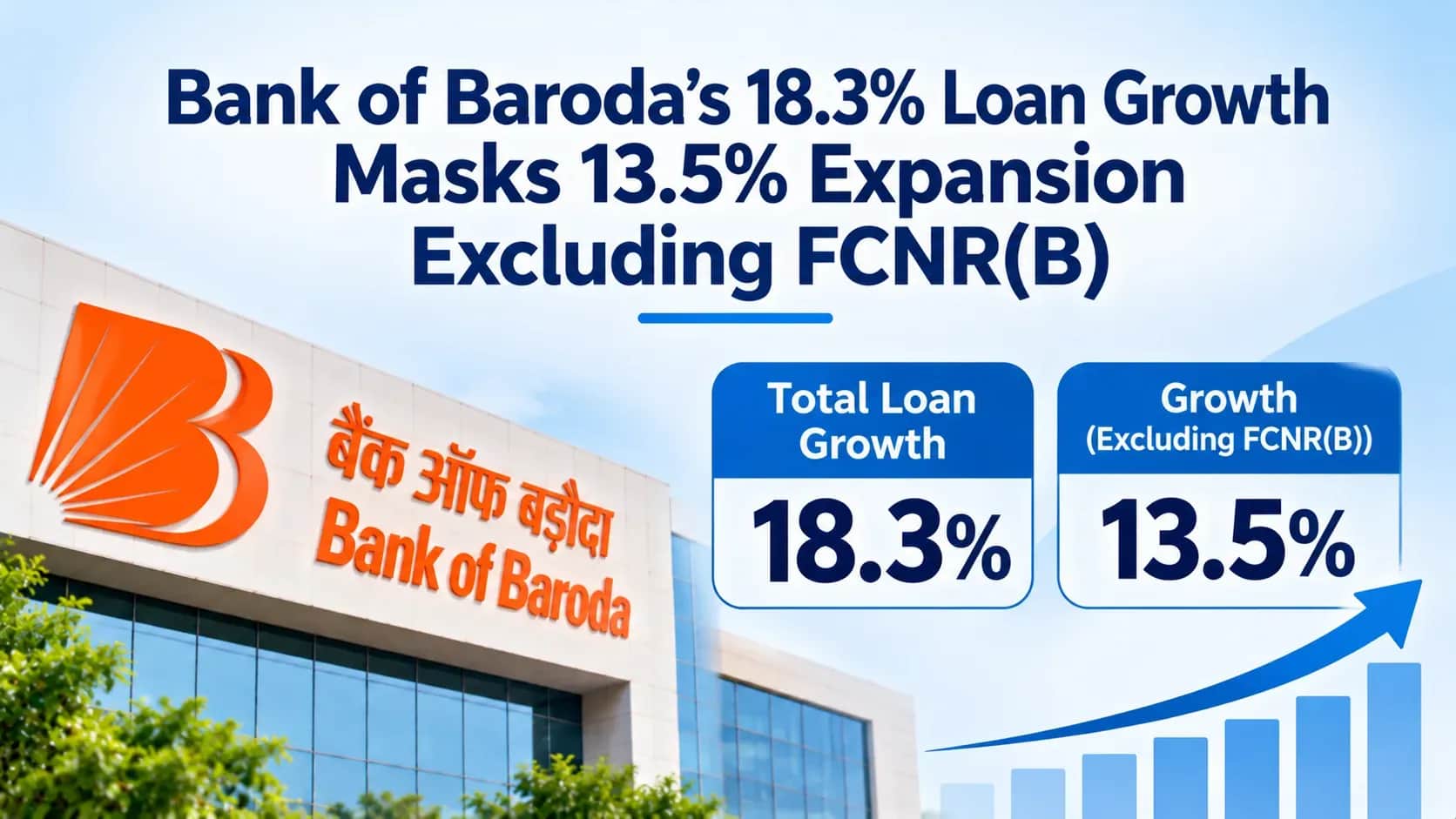
Bank of Baroda’s loan growth reached 18.3%, but expansion excluding FCNR(B) stood at 13.5%, drawing attention to underlying lending and implications for salaried borrowers nationwide.
Key Highlights
The Bank of Baroda released its results for the quarter ended 30 September 2026 on 30 October 2026. Lending against foreign currency deposits helped lift the reported credit growth. ICICI Securities excluded Foreign Currency Non-Resident (Bank), or FCNR(B), activity in its 2 November 2026 research note, putting advances growth at 13.5%.
The distinction concerns the source of expansion. Bank of Baroda’s global figures cover domestic and international lending, while its domestic advances also grew 13.5%. For salaried borrowers in India, that domestic figure provides a closer view of the lending business that serves them, although it includes corporate, agricultural and other loans alongside household credit.
Nomura’s assessment, reported on 3 November 2026, identified ₹60,500 crore of international lending against FCNR(B) deposits. This activity contributed to Bank of Baroda’s higher global advances growth.
An FCNR(B) account holds a fixed deposit in foreign currency for eligible non-resident customers. In Bank of Baroda’s results, the associated lending affected the global advances comparison. The 13.5% adjusted figure separates that activity from the rest of the loan book.
The bank’s reported figures and the analyst adjustment describe different parts of the same quarterly performance. All growth rates below compare the position with the corresponding period a year earlier.
Bank of Baroda disclosed the reported growth rates in its 30 October 2026 results. ICICI Securities’ 2 November 2026 note supplied the FCNR(B)-adjusted comparison.
At 18.3%, the headline rate is 4.8 percentage points above the 13.5% adjusted figure. Salaried borrowers reading the results need to allow for the deposit-linked lending behind part of that increase. Domestic advances and organic retail growth offer more relevant context for household borrowing, but even retail lending covers several products with different terms.
Bank of Baroda’s published personal loan conditions, checked on 3 November 2026, assess applicants by occupation, account relationship and repayment capacity. Its pricing also depends on the customer category and credit profile. Employees comparing personal loans for salaried borrowers therefore need to distinguish the bank’s capacity to fund loans from the terms attached to an individual application.
ICICI Securities analysts identified unused FCNR(B) liquidity and a possible recovery in margins as support for earnings in the second half of FY27. Their 2 November 2026 note also said improvements in fee income and operating efficiency had yet to materialise. That assessment places the adjusted lending figure alongside the bank’s ability to earn recurring income from its business.
Managing Director and CEO Debadatta Chand described the available funding as “stored liquidity” at the 30 October 2026 results briefing. For the quarters ending in December 2026 and March 2027, Chand said the bank planned to fund advances with that liquidity. The funds had already been raised; the lending he described was still planned.
Bank of Baroda’s FY27 credit growth guidance moved to 13–15% from 12–14% at the 30 October 2026 briefing. Chand cited demand and available liquidity when explaining the revision. Management also increased deposit growth guidance from 10–12% to 11–13%.
Management’s guidance concerns the financial year, while the reported and adjusted growth rates describe a completed quarter.
Bank of Baroda’s 18.3% reported loan growth includes a contribution from FCNR(B)-linked lending. The 13.5% adjusted rate gives a narrower view of expansion elsewhere in the loan book. For salaried borrowers, the useful distinction is between bank-wide growth, domestic lending and the conditions applied to personal credit. Each answers a different question about the bank’s business.
Global advances at Bank of Baroda were 18.3% higher in the quarter ended 30 September 2026. Domestic advances grew 13.5%. ICICI Securities’ research note dated 2 November 2026 placed global advances growth excluding FCNR(B)-linked activity at 13.5%.
Eligible non-resident customers hold foreign currency fixed deposits under the Foreign Currency Non-Resident (Bank), or FCNR(B), category. Lending associated with these deposits contributed to Bank of Baroda’s reported global advances growth during Q2 FY27.
Nomura’s assessment, reported on 3 November 2026, identified ₹60,500 crore of international lending against FCNR(B) deposits at Bank of Baroda. That figure describes an existing lending component within the bank’s quarterly business, rather than an individual customer’s application experience.
A borrower’s credit profile and customer category help set the personal loan rate at Bank of Baroda. Global advances growth measures changes in the bank’s loan book. It is a different measure from the interest rate charged on a salaried employee’s personal loan.
Management’s 30 October 2026 revision put FY27 credit growth guidance at 13–15%, against the earlier 12–14%. Chand linked the revision to demand and available funding. The guidance expresses management’s annual growth expectation, while Q2 FY27 figures record lending already on the balance sheet.
Start your journey today
Apply Now*T&C apply











