
By continuing, you agree to LoansJagat's Credit Report Terms of Use, Terms and Conditions, Privacy Policy, and authorize contact via Call, SMS, Email, or WhatsApp
Disclaimer: The information published on LoansJagat is intended for general informational and educational purposes only and should not be considered financial, legal, or investment advice. Interest rates, loan terms, statistics, and other data may change over time and may vary by lender or source. Please verify the latest information and consult a qualified financial advisor or the respective Bank/NBFC before making any financial decisions.
Subscribe Now
About the author

Arshathul Afia
Arshathul Afia is a journalism graduate and fintech content writer with 4+ years of experience in digital publishing and research-led writing. She has written 200+ articles covering personal finance, lending, banking, digital payments, credit, insurance, and major financial developments in India. At LoansJagat, she focuses on simplifying complex fintech news, RBI updates, loan-related changes, policy developments, and industry trends for everyday readers. Her journalism background helps her approach stories with research, context, and clarity, while her SEO experience ensures content remains discoverable and relevant. She aims to make financial news easier to understand, practical, and useful for readers across India.
Related Blog Post
Simplify All Your Loans Into One Affordable EMI

Customers Served

Debt Consolidated

1200+ Reviews

Locations in India
Club all Loans & Credit Card Bills into Single EMI

Quick Apply Loan
Consolidate your debts into one easy EMI.

Takes less than 2 minutes. No paperwork.

10 Lakhs+
Trusted Customers

2000 Cr+
Loans Disbursed

4.7/5
Google Reviews

50+
Banks & NBFCs Offers
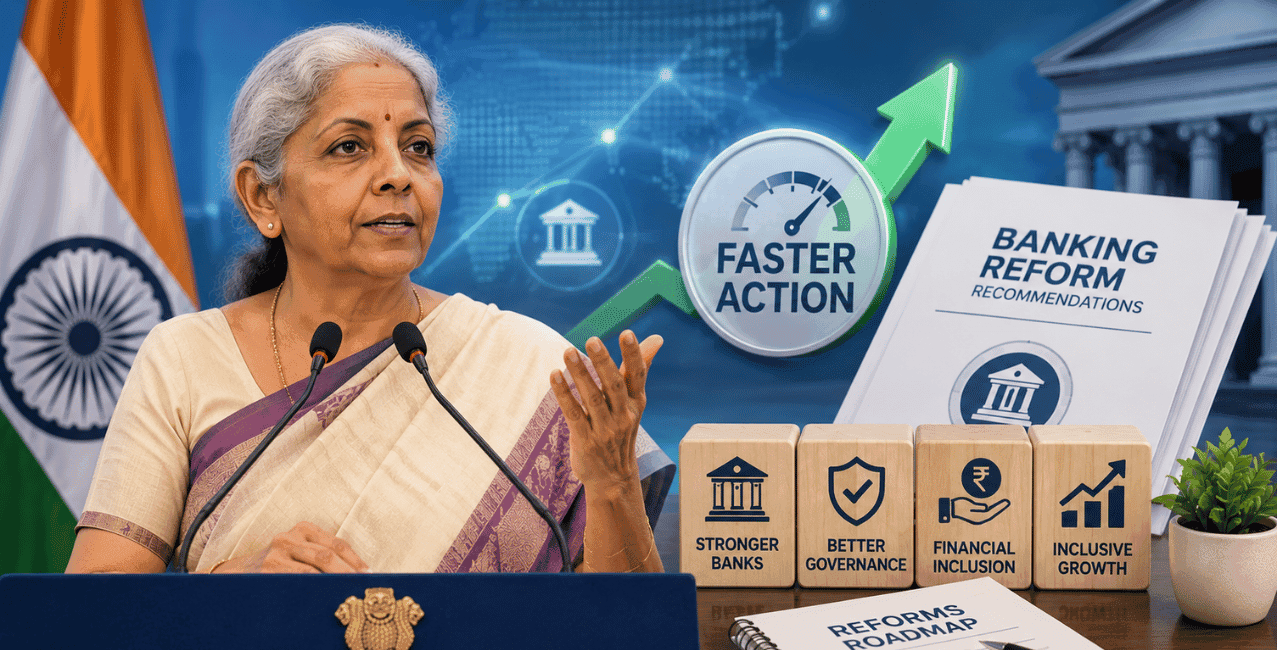
Finance Minister Nirmala Sitharaman says India’s banking reform panel will be announced soon, with faster government action expected after its recommendations are submitted for review.
In the short term, borrowers, depositors and bank employees will see no automatic change. Loan rates, deposit rates, branch operations and credit-card rules remain as they are. Over a longer period, the committee could influence how banks collect deposits, fund infrastructure, serve young customers and lend to small businesses. A poorly designed push for scale or automation could weaken local access and make screening harder for irregular-income borrowers. Consumer protection is therefore part of the panel’s stated mandate.
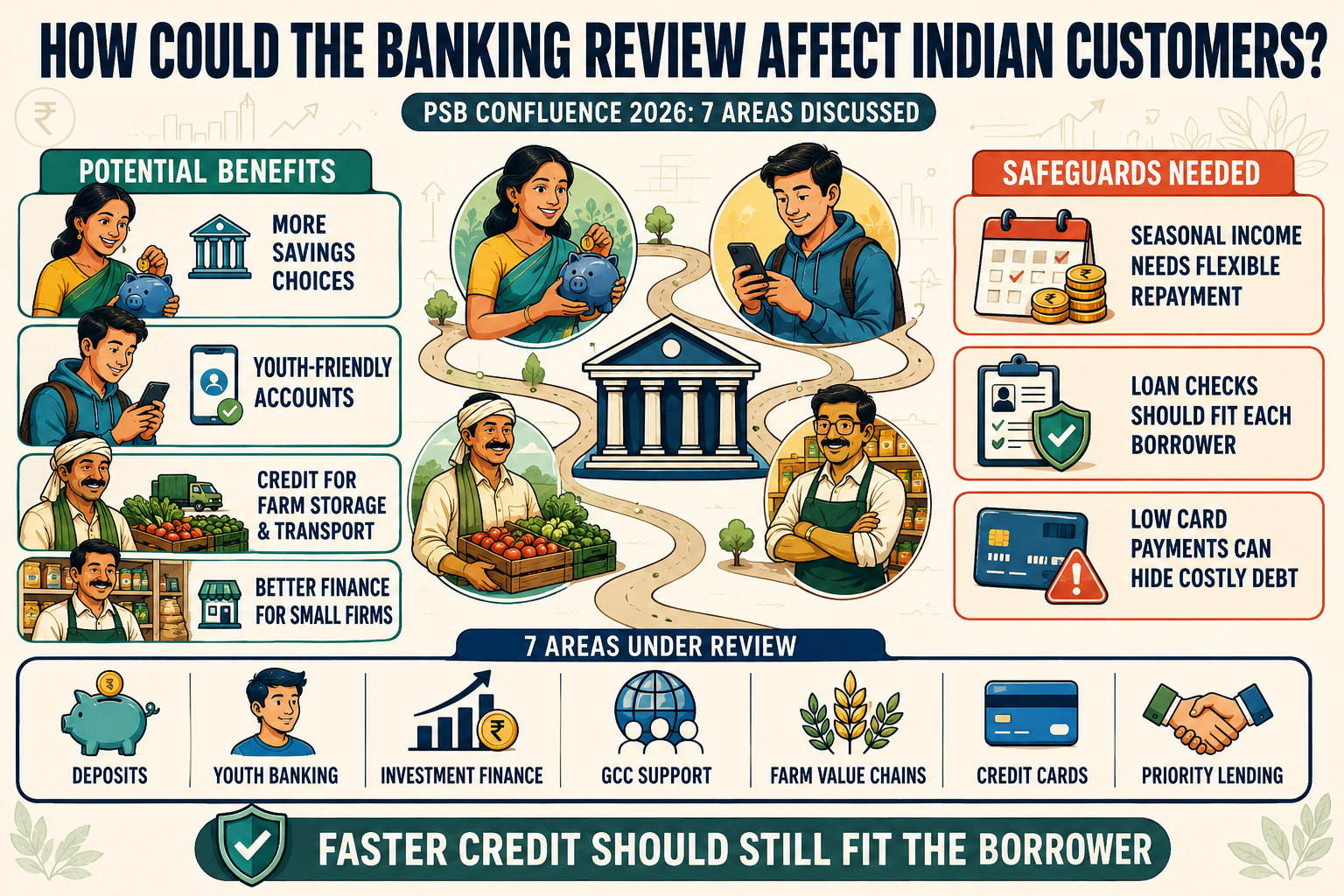
Sitharaman said the committee would receive material produced during the confluence. According to the Press Information Bureau announcement dated 10 August 2026, discussions covered 7 tracks: deposit mobilisation, banking for youth, investment finance, Global Capability Centres, agriculture and horticulture value-chain infrastructure, credit cards and priority sector lending. Better deposit products could offer savers more choice, while youth banking may produce accounts suited to students, gig workers and first-time earners.
Farmers and small firms could benefit if banks improve financing for warehouses, cold-storage units, processing facilities and local transport. Yet easier credit cannot mean hurried credit. A vegetable trader with seasonal income should not be assessed like a salaried employee. Banks need repayment schedules, documents and complaint channels that fit each borrower group. Credit-card expansion needs the same care because low minimum payments can hide the true cost of carrying debt for several months.
Management consultant and researcher Harsh Vardhan and Amrita Agarwal wrote in an Ideas for India analysis dated 16 March 2026 that stronger bank finances were necessary but insufficient for India’s 2047 financing needs. They favoured transparent merger rules, boards chosen for relevant skills, wider funding options and technology-based supervision. They also opposed allowing industrial conglomerates to control banks because lending within connected business groups can create conflicts that are difficult to contain.
The first solution is a specific mandate. The notification should identify the institutions covered and the tests each recommendation must pass. The committee should compare loan approval time, complaint turnaround, rural access, deposit costs and rejection rates across borrower types. Public consultation would bring in farmers, MSMEs, consumer groups and bank employees. Without those voices, a reform may create fresh queues, rejected applications or costly credit outside large cities.
Public sector banks are entering this review with higher profits, fewer stressed loans and more capital than during the earlier bad-loan period. That gives policymakers room to discuss future growth instead of arranging an emergency repair. It also raises expectations. Stronger balance sheets should translate into dependable service and wider productive lending, not only larger headline numbers.
The table uses Ministry of Finance figures released through the Press Information Bureau on 12 May 2026. It keeps the main numbers together without turning the report into a financial results note.
The Press Information Bureau’s FY 2025-26 PSB performance release shows that advances grew faster than deposits. That gap explains why deposit mobilisation received a full discussion track. Banks require stable deposits to expand loans without depending heavily on costlier market funding. If funding costs stay high, even healthy banks may tighten approval standards or price some loans higher.
A borrower-focused reading points to a problem that a balance-sheet review can easily miss. When deposits rise more slowly than credit, the effect may appear first in eligibility filters rather than advertised interest rates. A salaried applicant with regular bank credits may still pass. A shopkeeper with uneven monthly receipts could face more documents, a smaller sanctioned amount or a request for collateral. That difference should be measured before any reform is called inclusive.
This concern also appears in a LoansJagat analysis published on 6 May 2026. It found that deposit pressure could keep loan pricing sticky and lead banks to screen unsecured and small-business applications more tightly. The useful policy response is not forced lending. Banks need better cash-flow assessment, verified digital records and products built around seasonal or irregular income. This view adds a borrower test to the committee’s task: growth should improve approval quality without pushing deserving applicants towards informal lenders.
The proposal first appeared in the Union Budget speech delivered on 1 February 2026. The official India Budget portal said the committee would review banking and align the sector with India’s next growth phase while safeguarding financial stability, inclusion and consumer protection. The speech also said banking services covered more than 98% of Indian villages. Coverage does not confirm that every customer can obtain suitable credit or resolve a complaint without repeated branch visits.
During a post-Budget interview on 2 February, Sitharaman said the committee should decide whether India needed more banks, better banks or bigger banks. She did not state a preferred outcome on further public sector bank consolidation. She also declined to pre-judge whether large corporate groups should enter banking. Those decisions remain open because the formal terms have not been released.
Public sector banks have already used the EASE programme for governance, lending quality, risk controls and digital operations. The proposed committee is wider. It can examine banking structure, finance for large projects and whether products serve new forms of work.
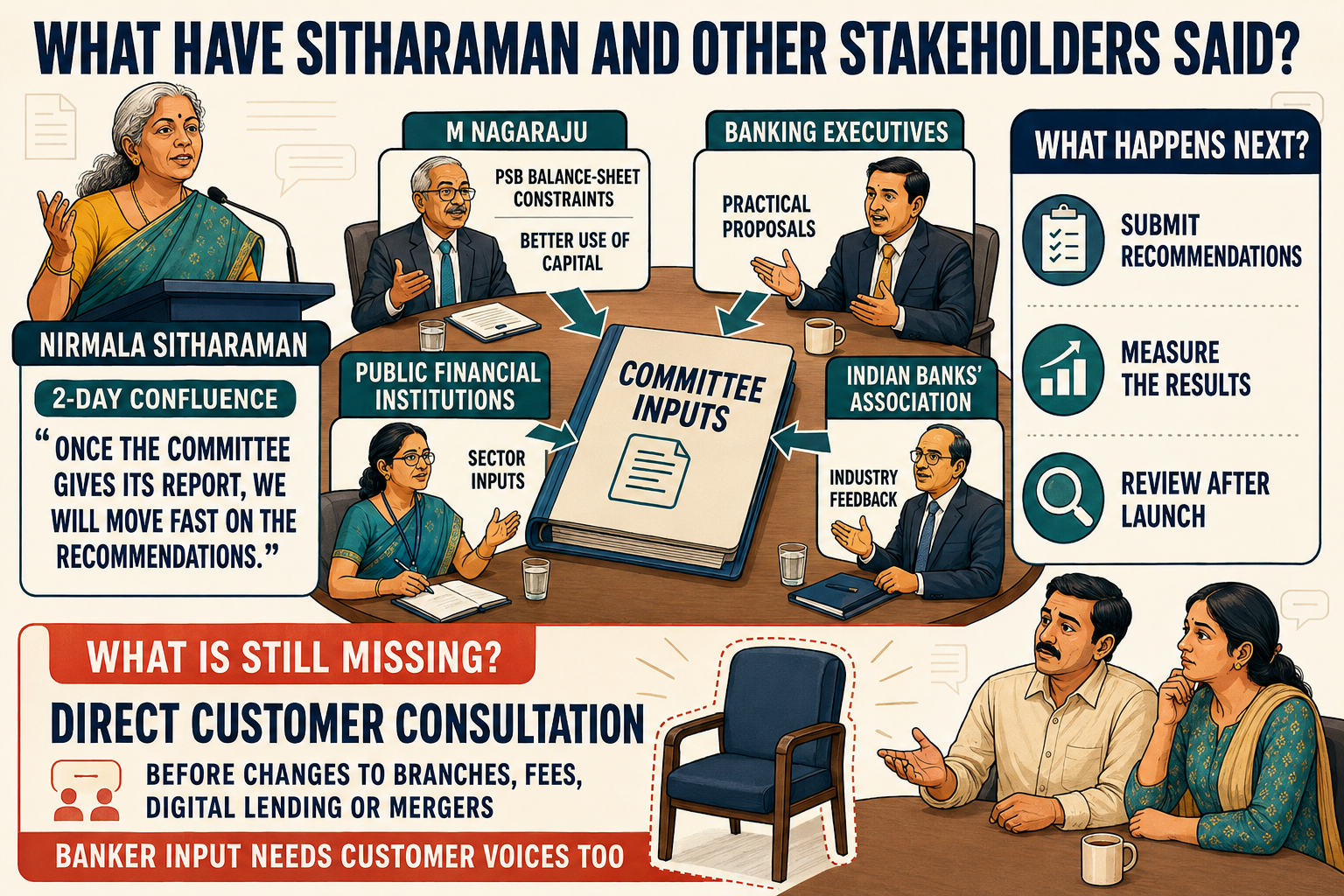
At the confluence, Sitharaman told participants that the material produced during the 2 days would help the committee. She also said, “Once the committee gives its report, we will move fast on the recommendations.” The statement places pressure on bankers to submit proposals that can be implemented, measured and reviewed after launch.
Financial Services Secretary M Nagaraju said in May that the committee would examine PSB balance-sheet constraints and better use of capital. Banking executives, public financial institutions and the Indian Banks’ Association are contributing through the confluence. Customers are not represented in the same direct way. A consultation window would address that gap before proposals involving branches, fees, digital lending or mergers move forward.
The Banking for Viksit Bharat committee could become India’s broadest bank review in years, but its formal notification will reveal how far it intends to go. The names of members, scope of work, consultation process and deadline deserve close attention. They will show whether the exercise stays focused on service improvements or examines ownership, mergers and bigger regulatory change.
For borrowers, the best outcome would be fairly simple: dependable deposits supporting affordable loans, faster decisions based on verified income, and a complaint process that works. Bigger banks alone cannot deliver that. The government’s promise of speed will carry weight only if the recommendations protect customers while expanding credit to productive parts of the economy.
It is a proposed high-level panel that will review banking growth, financial stability, inclusion and consumer protection for India’s development plans through 2047.
Sitharaman said on 17 August 2026 that it would be announced soon. A finance ministry source expects formation during August, but no date is official.
Future recommendations may influence loan assessment, MSME credit, youth banking and credit cards. No current loan rate or eligibility rule has changed.
Not automatically. Home loan pricing depends on funding costs, borrower risk and each bank’s policy. The committee has announced no rate reduction.
No merger has been announced. If consolidation is recommended later, the government would need a separate decision and a customer migration plan.








.png&w=3840&q=75)


