

By continuing, you agree to LoansJagat's Credit Report Terms of Use, Terms and Conditions, Privacy Policy, and authorize contact via Call, SMS, Email, or WhatsApp
Disclaimer: The information published on LoansJagat is intended for general informational and educational purposes only and should not be considered financial, legal, or investment advice. Interest rates, loan terms, statistics, and other data may change over time and may vary by lender or source. Please verify the latest information and consult a qualified financial advisor or the respective Bank/NBFC before making any financial decisions.
Subscribe Now
About the author

Arshathul Afia is a journalism graduate and fintech content writer with 4+ years of experience in digital publishing and research-led writing. She has written 200+ articles covering personal finance, lending, banking, digital payments, credit, insurance, and major financial developments in India. At LoansJagat, she focuses on simplifying complex fintech news, RBI updates, loan-related changes, policy developments, and industry trends for everyday readers. Her journalism background helps her approach stories with research, context, and clarity, while her SEO experience ensures content remains discoverable and relevant. She aims to make financial news easier to understand, practical, and useful for readers across India.
Related News
Simplify All Your Loans Into One Affordable EMI

Customers Served

Debt Consolidated

1200+ Reviews

Locations in India
Club all Loans & Credit Card Bills into Single EMI

Quick Apply Loan
Consolidate your debts into one easy EMI.

Takes less than 2 minutes. No paperwork.

10 Lakhs+
Trusted Customers

2000 Cr+
Loans Disbursed

4.7/5
Google Reviews

50+
Banks & NBFCs Offers
RuPay credit cards now let UPI users earn rewards on merchant payments, but fees, app conditions and exclusions decide which card actually offers better value.
Indian UPI users can link eligible RuPay credit cards to supported apps in 2026 and pay merchants without using money from their bank accounts immediately. The payment reaches the credit-card statement instead. Several banks now compete through cashback, reward points, low fees and app-based offers. The better choice depends on where the customer spends, which UPI app is used and how each issuer values its points.
The short-term benefit is easy to spot. Regular payments at supermarkets, restaurants and neighbourhood stores may earn something back. Over time, credit-card acceptance can reach merchants that do not keep a card machine. The risk also grows quietly. Small QR payments can build a large monthly bill, and missed repayments attract the card’s normal finance and late-payment charges. Reward exclusions create another problem because fuel, rent, insurance, education and government transactions often earn nothing.
Only a RuPay variant should be considered for credit-card payments through UPI. A customer who receives the Visa or Mastercard version of the same product may get similar card benefits, but the card cannot be linked through the RuPay credit-card route.
The figures below reflect issuer terms available in August 2026. They show the annual cost, the actual UPI proposition and the restriction most likely to affect the final return.
The advertised rate tells only part of the story. HDFC Bank’s 3% CashPoints do not equal 3% cash because every point converts to ₹0.25. Tata Neu Infinity reaches 1.5% only through the Tata Neu UPI ID. Axis Bank super.money offers direct cashback, yet the ₹500 statement-cycle cap limits the return once eligible spending crosses roughly ₹16,667.
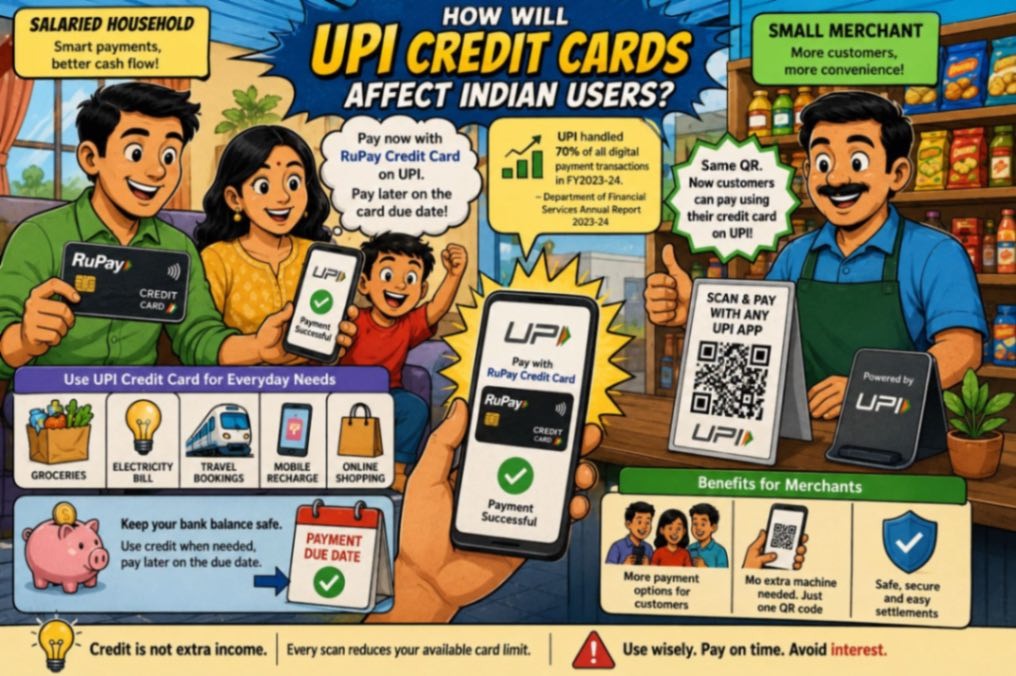
For salaried households, RuPay credit cards can keep bank balances untouched until the card’s payment date. That may help during a week packed with grocery purchases, electricity bills and travel bookings. Small merchants also gain access to card-funded purchases through an existing QR code, without asking the buyer to swipe plastic.
India had already moved heavily towards UPI before these cards became common. The Department of Financial Services Annual Report 2023-24 said UPI accounted for 70% of digital payment transactions during FY2023-24. Credit-card linkage adds borrowing to that familiar payment habit. It can help during short cash gaps, but a UPI PIN does not turn borrowed money into income. Every scan still reduces the available card limit.
Payment specialists generally point to 4 checks: the annual fee, the real redemption value, monthly reward caps and excluded merchant categories. A large cashback number on a telecom bill may look attractive, yet it offers little to someone who pays another operator. The same problem appears with fuel cards when a benefit works only through a specific app or point-of-sale route.
A LoansJagat analysis published on 22 April 2026 found that RuPay’s share of new credit-card issuance was approaching 40%. Its analysis also linked the increase to frequent QR-based card usage. For borrowers, the useful response is fairly plain: choose a card around existing expenses, avoid shifting purchases merely to earn points and pay the total amount due each month.
A practical comparison should use rupees, not only reward percentages. If a card costs ₹1,499 plus taxes, its UPI return must first recover that expense. A lifetime-free card with a lower rate may leave more money with a light spender. Someone already buying from Tata brands may reach the opposite result.
NPCI issued Operating Circular NPCI/2022-23/RuPay/019 on 4 October 2022 for RuPay credit cards linked to UPI. The document allowed eligible cards to connect with a UPI ID and set the operating structure for issuers, acquiring banks and payment apps.
On 29 March 2023, NPCI announced merchant-transaction support with BharatPe, Cashfree Payments, Google Pay, Paytm, PayU, Pine Labs and Razorpay. That expansion helped online sellers and physical merchants accept card-funded UPI payments through existing checkout systems.
The payment remains restricted to merchant use. A RuPay credit card cannot fund a transfer to a friend, another card, an IPO application or a cash withdrawal. The user must select the credit card at checkout and authorise it with the UPI PIN created for that card.
Consumer charges also require careful separation. The Ministry of Finance said through a Press Information Bureau release dated 8 August 2026 that consumers would not face a UPI transaction charge. That statement does not remove a credit card’s joining fee, annual fee, interest, late fee or category-based processing charge.
Axis Bank launched the super.money RuPay credit card on 22 May 2025. Arnika Dixit, President and Head of Cards, Payments and Wealth Management at Axis Bank, said the partnership aimed to make payment products more accessible and useful. Super.money founder Prakash Sikaria placed the focus on flat cashback and responsible credit behaviour.
Sohini Rajola, Executive Director for Growth at NPCI, described the card as a route to easier everyday payments with meaningful rewards. Earlier, on 29 March 2023, NPCI’s Nalin Bansal said payment aggregators would help widen merchant acceptance. The comments point towards the same commercial goal: more card transactions at QR-enabled merchants.
Axis Bank super.money appears stronger for frequent merchant scans through its own app. Tata Neu Infinity works better for customers who already use Tata Neu and can spend NeuCoins without changing shopping habits. Existing HDFC customers may prefer the ₹99 virtual UPI card, though they should calculate the cash value of CashPoints first.
IndusInd Platinum offers a simpler lifetime-free choice without a ₹2,000 reward threshold. PaisaSave and Klick may suit larger UPI bills, but routine payments below ₹2,000 miss their UPI reward condition. Airtel Axis and ICICI HPCL Super Saver remain category-led cards rather than universal UPI cashback products.
The best RuPay credit card for UPI in 2026 depends on actual monthly purchases. Axis Bank super.money leads on direct Scan & Pay cashback, while Tata Neu Infinity serves committed Tata users. HDFC Bank offers a low-fee virtual option, and IndusInd Platinum keeps joining and renewal costs at zero.
Before applying, customers should confirm the RuPay variant, app requirement, reward cap, redemption value and exclusions. The final test comes at billing time. If the complete statement cannot be paid by the due date, even a strong cashback rate becomes poor value.
No. The credit-card linking facility covered here requires an eligible RuPay credit card from a participating issuer. A Visa or Mastercard card cannot use the same RuPay UPI route, even when the bank offers an identically named card on several networks.
No. The facility supports eligible merchant payments. Person-to-person transfers, card-to-card payments and cash withdrawals are restricted. If the scanned QR belongs to an individual rather than an approved merchant, the credit-card option may not appear.
Axis Bank super.money offers 3% on eligible Scan & Pay transactions through its app, capped at ₹500 per statement cycle. Tata Neu Infinity offers up to 1.5% through Tata Neu UPI. The better result depends on app preference, spending and fee recovery.
It can be better when the payment earns a useful reward and the full card bill is paid by the due date. A bank-account payment avoids borrowing. The credit-card route adds repayment risk and may encourage more spending than planned.
Some do, but the card’s minimum transaction value and merchant category decide the result. YES BANK PaisaSave and Klick require UPI payments above ₹2,000 for their stated reward. HDFC Bank’s UPI RuPay card starts awarding CashPoints on eligible transactions from ₹100.









.png&w=3840&q=75)


