
By continuing, you agree to LoansJagat's Credit Report Terms of Use, Terms and Conditions, Privacy Policy, and authorize contact via Call, SMS, Email, or WhatsApp
Disclaimer: The information published on LoansJagat is intended for general informational and educational purposes only and should not be considered financial, legal, or investment advice. Interest rates, loan terms, statistics, and other data may change over time and may vary by lender or source. Please verify the latest information and consult a qualified financial advisor or the respective Bank/NBFC before making any financial decisions.
Subscribe Now
About the author

Arshathul Afia
Arshathul Afia is a journalism graduate and fintech content writer with 4+ years of experience in digital publishing and research-led writing. She has written 200+ articles covering personal finance, lending, banking, digital payments, credit, insurance, and major financial developments in India. At LoansJagat, she focuses on simplifying complex fintech news, RBI updates, loan-related changes, policy developments, and industry trends for everyday readers. Her journalism background helps her approach stories with research, context, and clarity, while her SEO experience ensures content remains discoverable and relevant. She aims to make financial news easier to understand, practical, and useful for readers across India.
Related Blog Post
Simplify All Your Loans Into One Affordable EMI

Customers Served

Debt Consolidated

1200+ Reviews

Locations in India
Club all Loans & Credit Card Bills into Single EMI

Quick Apply Loan
Consolidate your debts into one easy EMI.

Takes less than 2 minutes. No paperwork.

10 Lakhs+
Trusted Customers

2000 Cr+
Loans Disbursed

4.7/5
Google Reviews

50+
Banks & NBFCs Offers
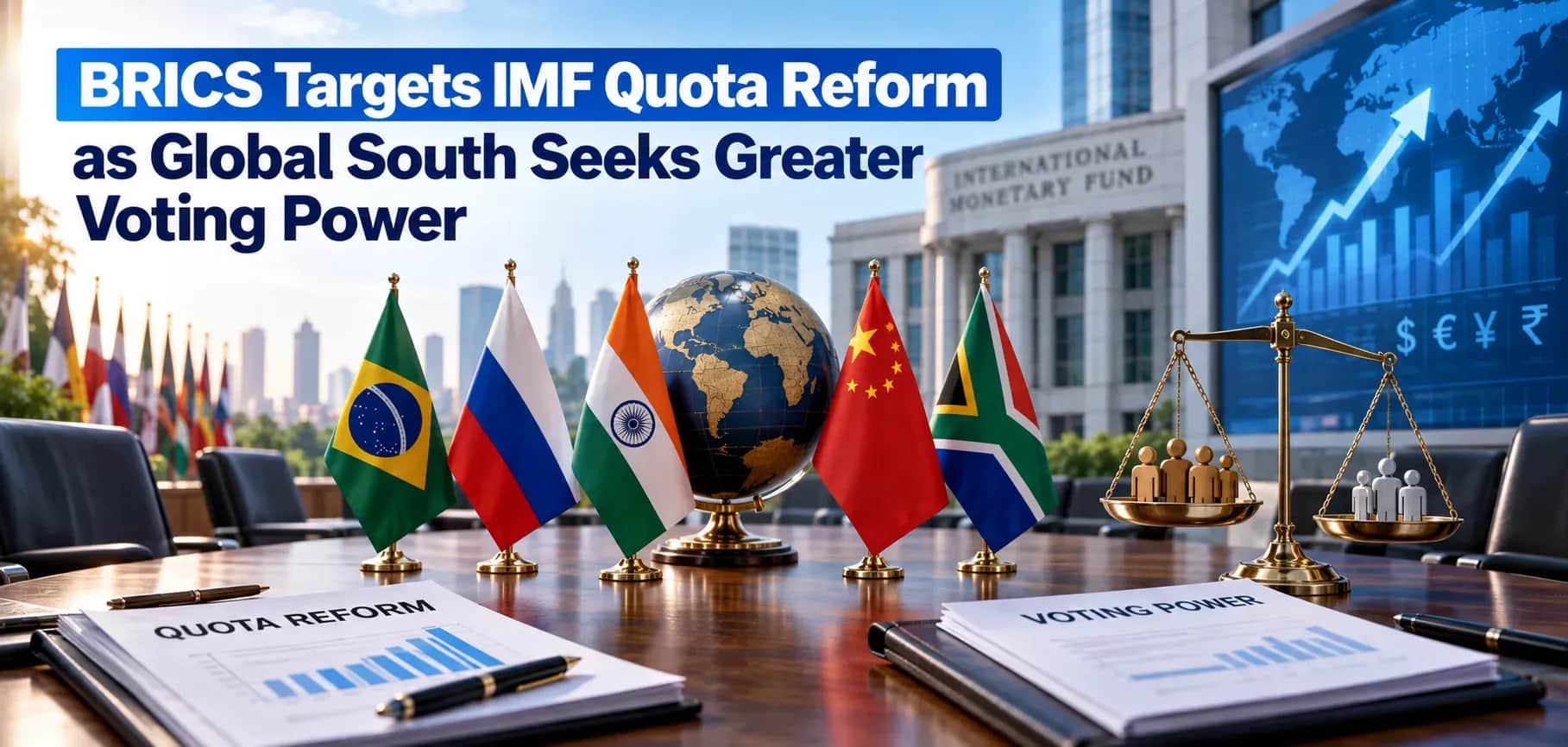
BRICS finance leaders are asking for a larger say at the IMF and World Bank, where voting rights have favoured long-established economic powers for decades.
The discussion went beyond IMF votes. BRICS also sought wider representation at the World Bank, more local-currency lending through the New Development Bank and further work on cheaper cross-border payments. The Ministry of Finance of China confirmed on 10 September that members had adopted the joint statement. The announcement came shortly before the BRICS Leaders’ Summit in New Delhi.
Nothing in the declaration changes an Indian family’s EMI or remittance charge today. Over time, greater Indian influence could shape crisis loans, development funding and global financial rules. Local-currency finance may also reduce dollar exposure for Indian infrastructure. The risk is delay. IMF and World Bank voting changes require wide support, and countries holding large shares may resist redistribution. Another failed round could push BRICS towards parallel lending and payment arrangements.
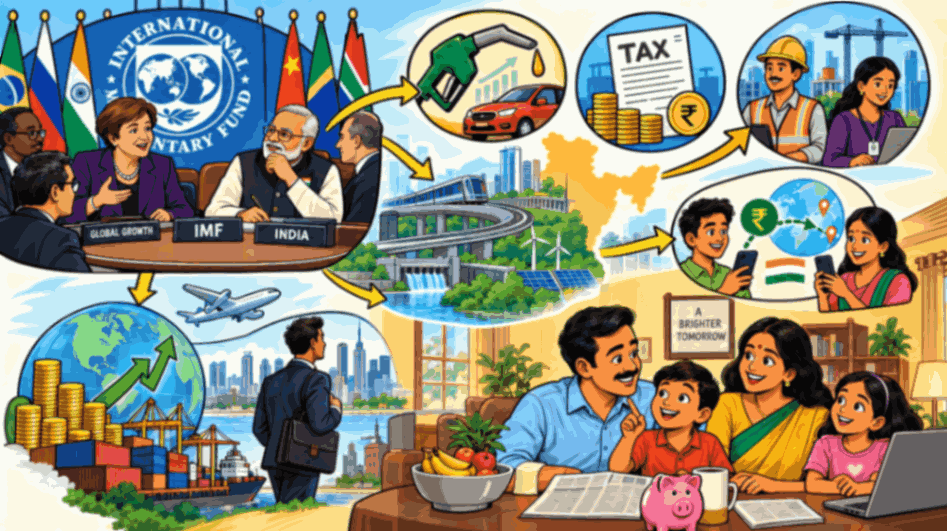
IMF voting rules rarely enter household conversations, but their effects can travel through fuel bills, taxes, jobs and borrowing costs. During a balance-of-payments crisis, the Fund can provide emergency finance and recommend conditions covering public spending or taxation. India does not need such assistance now. A larger vote would still increase its influence over rules that affect trading partners and countries employing Indian workers.
Public projects offer a more direct link. The New Development Bank finances transport, water systems, clean energy and other work in member countries. When a project earns rupees but repays dollars, currency weakness can raise its debt burden. Rupee funding reduces that exposure, although it does not guarantee a low interest rate.
Payments could bring another benefit. BRICS wants national payment and messaging systems to work together while respecting domestic rules. An Indian exporter may then receive money through fewer banking layers. Students and tourists could see quicker settlement later, although no launch date or retail fee promise exists. LoansJagat coverage of proposed BRICS digital-currency links, published on 21 January 2026, found that interoperability would still require shared technical, legal and compliance standards.
LoansJagat’s assessment is narrower than the political pitch. Households gain only when reform changes the price or delivery of finance. A vote share has no direct rupee value. A completed project or cheaper transfer does. Claims of immediate savings would run ahead of the evidence.
BRICS argues that economic power has shifted faster than voting power at institutions created more than 8 decades ago. Quotas at the IMF affect a country’s financial contribution, voting strength, access to IMF resources and share in a general Special Drawing Rights allocation. The dispute therefore covers influence as well as funding. Countries with larger quotas have a stronger voice when the Fund approves programmes or changes important policies.
The table shows what BRICS requested and where each proposal stood after the Mumbai meeting. It separates formal decisions from work that remains under negotiation.
The comparison needs care because the IMF formula does not use GDP alone. It also considers openness, external-flow variability and reserves. Even so, the 11 BRICS members hold only slightly more voting power than the US, despite including several of the largest emerging economies.
The IMF completed its 16th General Review of Quotas in December 2023. Members approved a 50% increase, equal to SDR 238.6 billion or about $320 billion. That decision increased the Fund’s resources but allocated the rise in proportion to existing quotas. It did not redistribute voting shares. The IMF policy paper recording the decision went live on 18 December 2023.
Implementation then slowed. An IMF policy paper published on 8 May 2026 said members representing 76.66% of quotas had consented by 29 April 2026. The increase requires consent from members holding at least 85%. The deadline was extended to 15 November 2026. BRICS now wants the 17th review to address the allocation of shares rather than repeat another proportional rise.
The World Bank’s 2025 Shareholding Review reached a similar obstacle. Its Report to Governors, released on 10 April 2026, identified 45 of 189 IBRD members as under-represented, accounting for 47.5% of shareholding. A selective capital increase and higher basic votes failed to receive enough support. Participation and consultation changed, but the main share structure remained largely intact.
That history gives the September demand a specific target. Yet BRICS published no country-by-country allocation. Negotiations become harder when a formula shows which members could lose part of their existing share.
The BRICS joint statement said international financial institutions should become more representative, transparent and accountable. It also called for an open, merit-based and inclusive method for selecting IMF and World Bank leaders, with better regional representation. On trade, finance chiefs criticised unilateral tariffs, non-tariff measures and financial restrictions that they said distort commerce and conflict with World Trade Organisation rules.
China’s Assistant Finance Minister Chang Junhong called for deeper cooperation on economic policy, development finance and infrastructure investment. Her comments, published on 10 September 2026, connected governance reform with practical funding.
World Bank Managing Director Wencai Zhang said on 17 June 2026 that developing countries required a stronger voice and more long-term finance. That suggests agreement on the direction, but not on redistribution. Share changes can reduce another member’s influence, which invites political resistance.
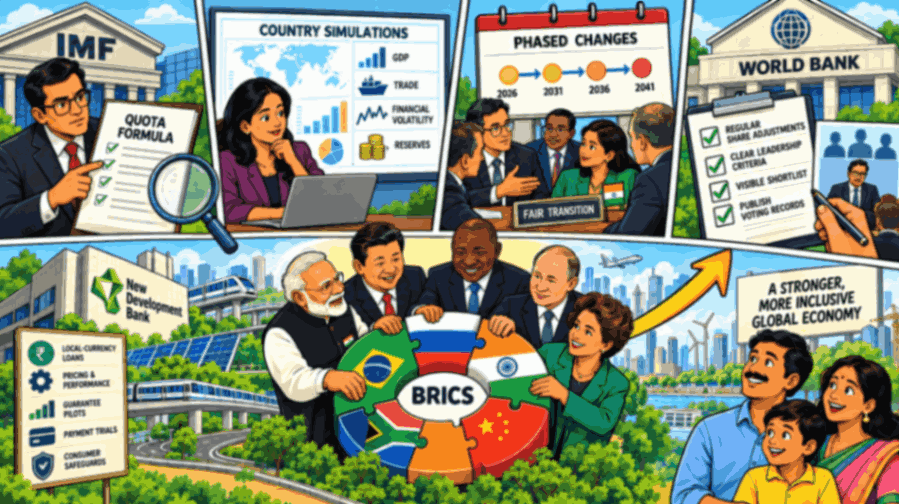
The IMF first needs a quota formula that members can inspect. Country-level simulations should show how GDP, trade, financial volatility and reserves affect each share. Negotiators could phase in changes over several reviews, limiting sudden losses while protecting poorer members.
World Bank members could use modest, regular share adjustments. Waiting for a large redistribution every 5 years has produced long talks and little movement. Leadership appointments also need published criteria, a visible shortlist and voting records.
BRICS must also prove its alternatives work. The New Development Bank should disclose the pricing and performance of local-currency loans. Guarantee pilots need public results, while payment trials should publish settlement time, charges and consumer safeguards.
The Mumbai meeting brought an old demand back with a sharper target. BRICS wants the next IMF review to alter representation after previous rounds mainly raised resources or expanded consultation.
India may gain a stronger voice, safer currency terms for selected projects and better cross-border payment routes if the proposals move from negotiation to delivery. None is automatic. Published formulas, pilot results and agreed timelines will show whether the 2026 push produces institutional change or becomes another statement carried into the next summit.
BRICS requested a meaningful quota and voting-share realignment under the IMF’s 17th General Review. It also called for transparent leadership selection and protection for the poorest members.
A larger share could increase India’s influence over crisis lending, policy rules and Special Drawing Rights decisions. It would not directly reduce household loan rates or EMIs.
The IMF links voting power mainly to quotas. Quotas reflect economic measures and determine each member’s contribution, voting strength, access to funding and share of SDR allocations.
No common currency was approved in the Mumbai statement. Members discussed local-currency settlement and links between existing payment systems while retaining their national currencies and regulations.
Any redistribution would require negotiations under the 17th quota review and broad member approval. The September statement did not provide a completion date or a proposed allocation.








.png&w=3840&q=75)


