
By continuing, you agree to LoansJagat's Credit Report Terms of Use, Terms and Conditions, Privacy Policy, and authorize contact via Call, SMS, Email, or WhatsApp
Disclaimer: The information published on LoansJagat is intended for general informational and educational purposes only and should not be considered financial, legal, or investment advice. Interest rates, loan terms, statistics, and other data may change over time and may vary by lender or source. Please verify the latest information and consult a qualified financial advisor or the respective Bank/NBFC before making any financial decisions.
Subscribe Now
About the author

Arshathul Afia
Arshathul Afia is a journalism graduate and fintech content writer with 4+ years of experience in digital publishing and research-led writing. She has written 200+ articles covering personal finance, lending, banking, digital payments, credit, insurance, and major financial developments in India. At LoansJagat, she focuses on simplifying complex fintech news, RBI updates, loan-related changes, policy developments, and industry trends for everyday readers. Her journalism background helps her approach stories with research, context, and clarity, while her SEO experience ensures content remains discoverable and relevant. She aims to make financial news easier to understand, practical, and useful for readers across India.
Related News
Simplify All Your Loans Into One Affordable EMI

Customers Served

Debt Consolidated

1200+ Reviews

Locations in India
Club all Loans & Credit Card Bills into Single EMI

Quick Apply Loan
Consolidate your debts into one easy EMI.

Takes less than 2 minutes. No paperwork.

10 Lakhs+
Trusted Customers

2000 Cr+
Loans Disbursed

4.7/5
Google Reviews

50+
Banks & NBFCs Offers
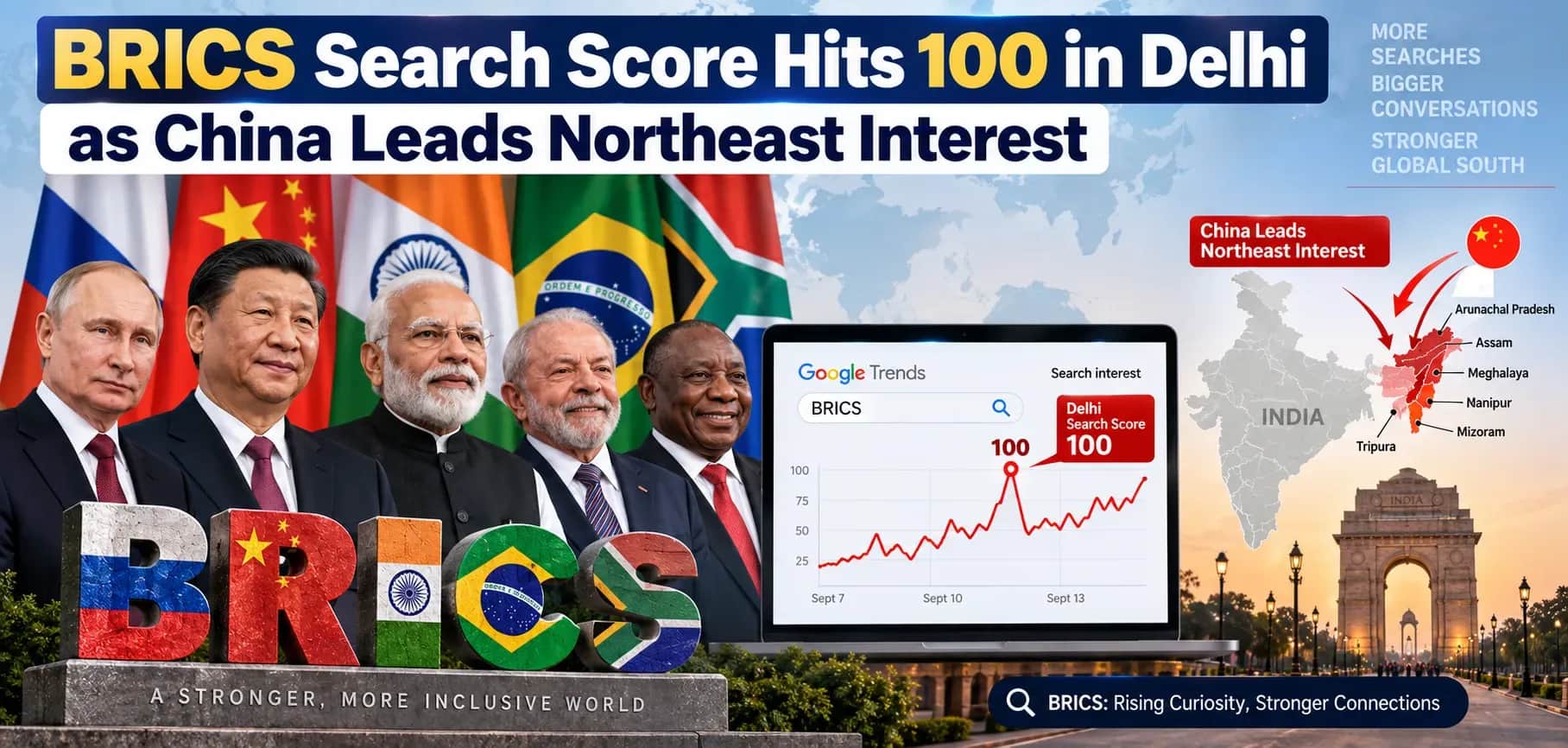
Delhi firmly led BRICS searches during the September summit, while Iran drew southern attention and China attracted stronger online interest across several northeastern Indian states.
BRICS became India’s biggest geopolitical search theme during the 18th summit in New Delhi on September 12 and 13, 2026, but the attention did not spread evenly. A September 14 analysis of Google Trends data found that Delhi recorded a BRICS search score of 100. Iran claimed a larger share of attention in parts of southern India, while China drew stronger interest across several northeastern states.
The immediate effect appears in the news people choose to follow. Delhi residents saw the summit as a major local event, while readers elsewhere followed the parts tied more closely to travel, oil supplies, education or border security. Over a longer period, these regional differences can help public agencies explain foreign policy in a more useful way. A careless reading brings a risk, though. Search activity does not prove that people support the country or subject they searched.
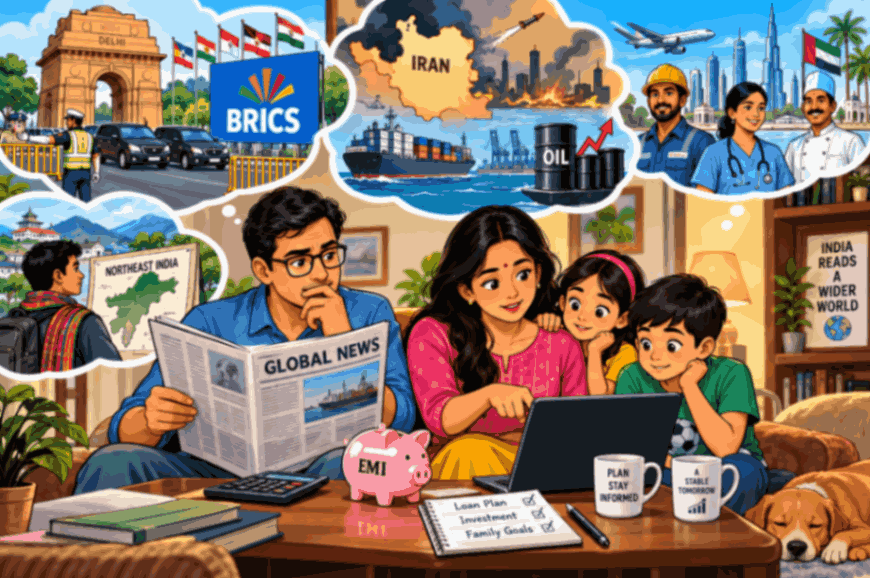
International affairs often reach an Indian household through an ordinary concern. In Delhi, road restrictions, visiting delegations and continuous coverage kept BRICS in public view. Southern readers had reasons to follow Iran because fighting in West Asia can disturb shipping, air routes, oil movement and the lives of Indians employed across Gulf countries. A disruption may later appear in transport bills or delivery charges, even if the diplomatic talks feel far away.
From a LoansJagat borrower viewpoint, families carrying EMIs need dependable information before changing a loan plan or cutting a long-term investment during an oil shock. Regional interest also tells publishers what readers need explained. Southern audiences may seek updates on Iran and Indian workers abroad, while northeastern readers may look for accurate maps and border news. Search trends identify attention, though they cannot predict fuel prices or assign political beliefs to a query.
Google Trends ranks relative popularity, rather than the raw number of searches from each state. Delhi’s score of 100 marks the peak for the selected term, location and period. The table retains the original categories because the BRICS location score, Iran comparison share and standalone China index use different calculations.
The figures leave BRICS well ahead nationally, even where Iran or China gained a larger regional share. Jammu and Kashmir also broke the broad North-South pattern by leading Iran-related interests, although the published analysis did not state its exact score. A separate 7-day India tracker placed the wider BRICS query cluster above 500,000 searches by September 14. That tracker groups related searches and must not be combined with the state-level index.
The official methodology guidance says the service uses an anonymised and aggregated sample of actual search requests. It divides each data point by all searches from that location and period, then scales the results from 0 to 100. A smaller state can rank above a more populated one when the subject forms a larger portion of its searches. Delhi’s 100 therefore does not mean every resident searched for BRICS.
The guidance also states that Trends is not a scientific opinion poll. Publishers should disclose the terms, dates, area and search type, then identify whether a figure comes from a standalone index or comparison. Words such as “support” and “approval” need survey evidence. Foreign-policy analyst Michael Kugelman added another warning before the summit. He said expansion had increased BRICS’ appeal, yet disputes among newer participants could weaken its effectiveness. Tehran and Abu Dhabi had already struggled to agree on wording related to the West Asia conflict.
Iran arrived after months of conflict and disruption around the Strait of Hormuz. Its dispute with the UAE had affected earlier BRICS meetings. For southern families with relatives working in Gulf countries, developments involving flights, shipping routes and regional security carried a personal connection. That provides context for the higher Iran share across the southern states.
Jammu and Kashmir followed another route. Students from the region have travelled to Iran for medical education, while Persian cultural links remain part of Kashmir’s history. These links may help explain why Iran drew attention there, but the search data cannot establish the reason behind individual queries. Some users may have followed the Iranian delegation. Others may have checked conflict or travel updates.
China’s pull in the Northeast came during Xi Jinping’s first visit to India in 7 years. His meetings followed attempts by both countries to stabilise relations after military tension along the disputed Himalayan frontier. For residents living closer to that frontier, the China story carried a local relevance that many summit announcements did not.
A government action had already returned Arunachal Pradesh to the news. On August 7, 2026, the Centre and the state government formally identified 27 places and geographical features by their standard names on Survey of India maps. The official August 7 announcement said the exercise aimed to improve accurate recognition and public awareness. News reports connected it with China’s repeated renaming attempts, although the announcement itself did not call the step retaliation.
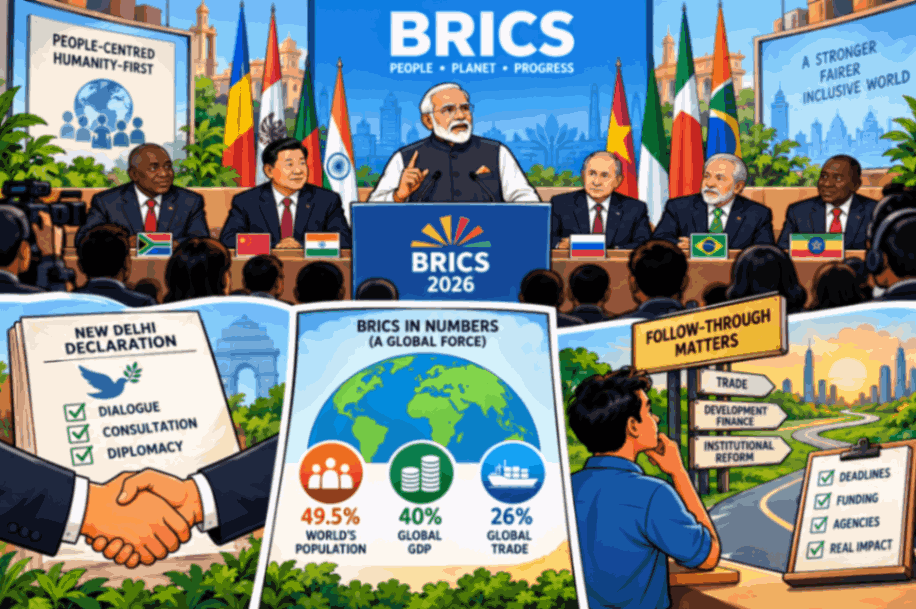
Prime Minister Narendra Modi described India’s chairship as people-centred and humanity-first in his opening remarks released on September 12, 2026. He said BRICS followed an approach that was “not against anyone” and proposed a Continuity and Implementation Mechanism. The proposed system would record decisions, timelines and implementation progress when the annual chairship moves to another country.
The New Delhi Declaration adopted on September 12 committed members to resolving disputes through dialogue, consultation and diplomacy. It also backed stronger representation for developing economies in international institutions. An official backgrounder released on September 10 placed the bloc at 49.5% of the world’s population, 40% of global GDP and 26% of global trade. Those figures explain the summit’s reach, but they do not settle the differences among its members.
The useful test now is follow-through. Search interest will fall after the summit, but proposals on trade, development finance and institutional reform will remain. Future coverage should track which promises receive deadlines, funding and named agencies.
Delhi’s BRICS score of 100 reflected the capital’s close connection with the summit. Iran’s stronger share in parts of southern India and China’s higher Northeast index showed how geography and personal exposure can pull a national story in different directions.
The data offers a snapshot of curiosity, concern and news demand. It does not reveal political loyalty. When publishers explain the scale, period and limits of the index, the figures can support useful reporting. Without that context, an online search can quickly become a claim the evidence never proved.
It means Delhi recorded the highest relative search interest for BRICS within the selected locations and period. It does not mean 100% of residents searched for the term or that Delhi produced the greatest raw number of queries.
The data does not provide a reason. Conflict in West Asia, oil and shipping risks, air travel, and family links with Gulf countries offer possible context. These explanations should remain separate from the measured search scores.
The region follows India-China frontier developments closely, particularly those involving Arunachal Pradesh. Xi Jinping’s first India visit in 7 years and the August 7 mapping of 27 Arunachal locations also kept China in the news.
BRICS gives India a forum to seek institutional reforms, expand economic cooperation and raise concerns shared by developing countries. India also maintains separate relations with Western and Indo-Pacific partners.
Its role will depend on whether members turn declarations into working payment links, trade access and agreed diplomatic positions.









.png&w=3840&q=75)


