
By continuing, you agree to LoansJagat's Credit Report Terms of Use, Terms and Conditions, Privacy Policy, and authorize contact via Call, SMS, Email, or WhatsApp
Disclaimer: The information published on LoansJagat is intended for general informational and educational purposes only and should not be considered financial, legal, or investment advice. Interest rates, loan terms, statistics, and other data may change over time and may vary by lender or source. Please verify the latest information and consult a qualified financial advisor or the respective Bank/NBFC before making any financial decisions.
Subscribe Now
About the author

Arshathul Afia
Arshathul Afia is a journalism graduate and fintech content writer with 4+ years of experience in digital publishing and research-led writing. She has written 200+ articles covering personal finance, lending, banking, digital payments, credit, insurance, and major financial developments in India. At LoansJagat, she focuses on simplifying complex fintech news, RBI updates, loan-related changes, policy developments, and industry trends for everyday readers. Her journalism background helps her approach stories with research, context, and clarity, while her SEO experience ensures content remains discoverable and relevant. She aims to make financial news easier to understand, practical, and useful for readers across India.
Related News
Simplify All Your Loans Into One Affordable EMI

Customers Served

Debt Consolidated

1200+ Reviews

Locations in India
Club all Loans & Credit Card Bills into Single EMI

Quick Apply Loan
Consolidate your debts into one easy EMI.

Takes less than 2 minutes. No paperwork.

10 Lakhs+
Trusted Customers

2000 Cr+
Loans Disbursed

4.7/5
Google Reviews

50+
Banks & NBFCs Offers
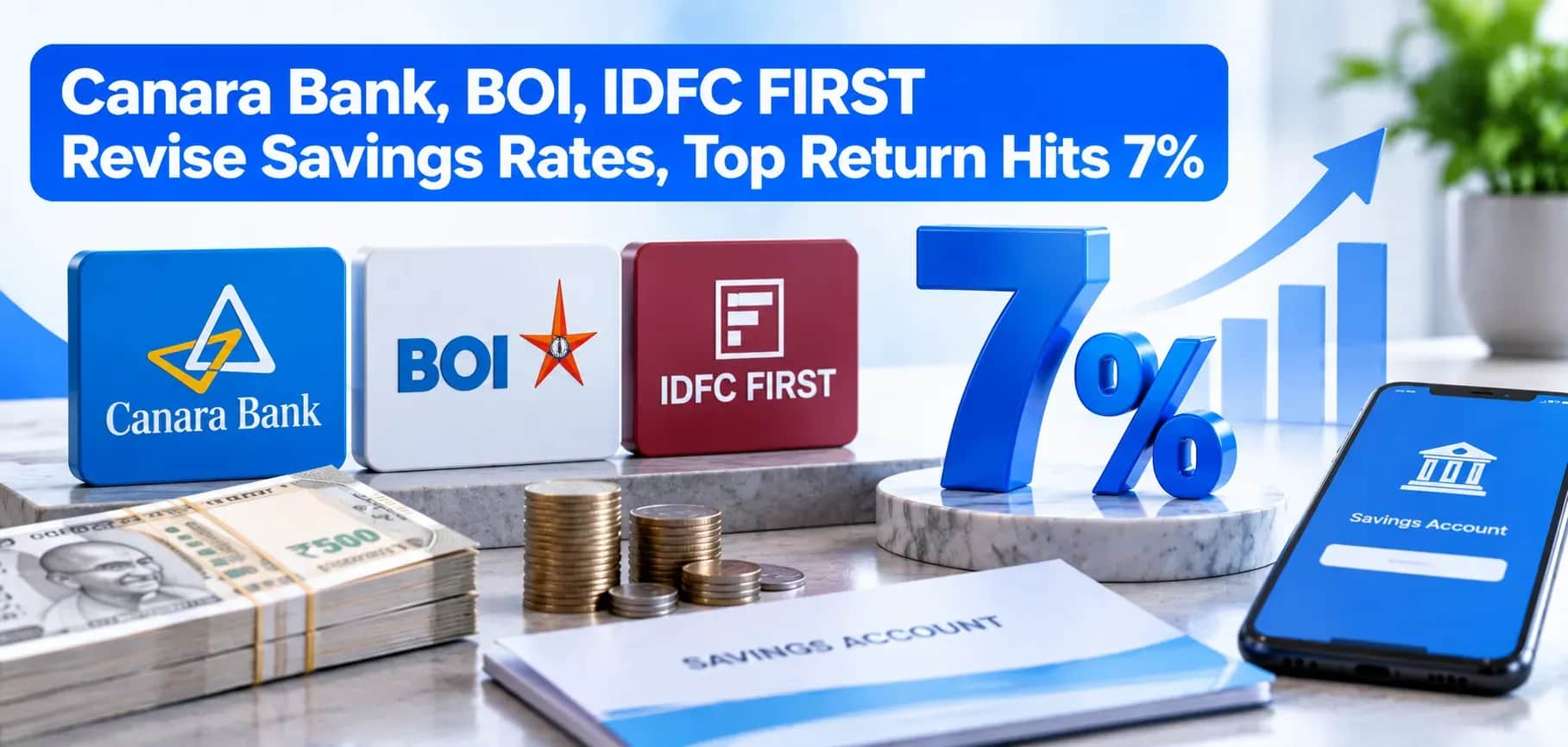
Canara Bank, Bank of India and IDFC FIRST Bank revised savings rates in September 2026, with IDFC FIRST offering a headline rate of 7% annually.
Canara Bank, Bank of India and IDFC FIRST Bank have changed savings account interest rates in India in September 2026, putting deposit returns back in focus. Bank of India and IDFC FIRST Bank made their revisions effective from September 1, while Canara Bank’s new rate card took effect from September 5. The largest number in the new set is 7% from IDFC FIRST Bank. There is a catch. That rate applies progressively to the portion of a savings balance above ₹3 lakh and up to ₹25 lakh. It is not a flat 7% on every rupee held in the account.
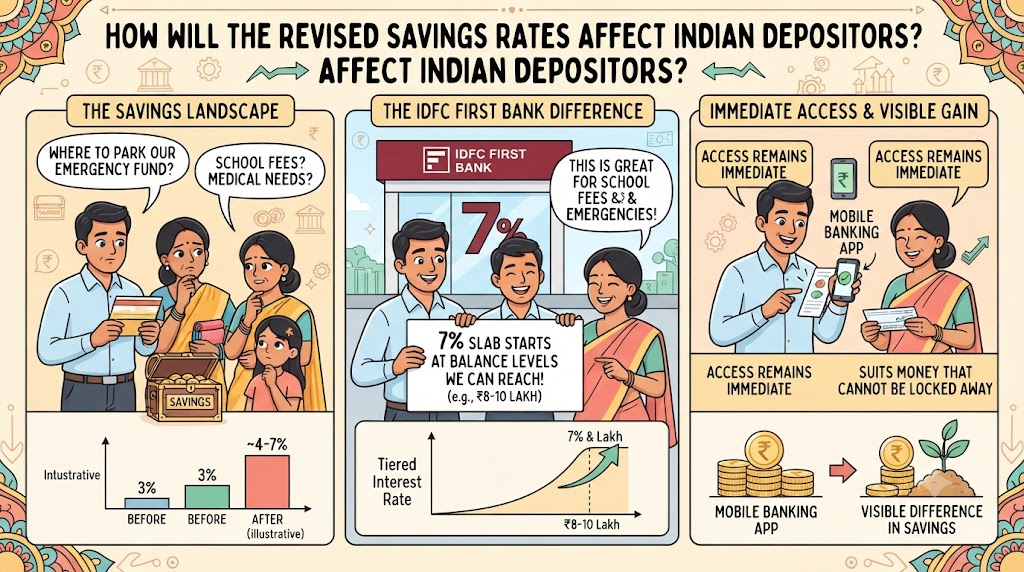
The biggest retail difference appears at IDFC FIRST Bank because its 7% slab begins at a balance level that many salaried households, professionals, and small-business owners may actually reach. A family keeping ₹8 lakh or ₹10 lakh aside for school fees, medical needs or an emergency fund can therefore see a visible difference. Access remains immediate, which suits money that cannot be locked away.
India also has a huge base of bank account holders. A Ministry of Finance update published through the Press Information Bureau on August 27, 2026 said PM Jan Dhan Yojana accounts had reached 59.09 crore as of August 19, 2026. That figure is not a count of customers at these banks, but it shows the reach of bank accounts across India. For a retail saver, the useful question is not which bank advertises the biggest percentage. The right figure is the rate applicable to the balance actually maintained.
The current rate cards show why that distinction is important. Canara Bank’s official savings rate card applies from September 5, IDFC FIRST Bank lists its revised progressive slabs from September 1, and Union Bank’s current structure became effective on August 10. Bank of India’s September 1 revision places its highest rate at 6.25% for balances above ₹3,000 crore.
The table exposes the main trap for customers comparing accounts. A maximum rate cannot be used as a shortcut for the return on the whole balance. IDFC FIRST Bank calculates savings interest through progressive slabs. If a customer keeps ₹10 lakh through the year, the first ₹3 lakh falls in the 2.50% slab, and the next ₹7 lakh falls in the 7% slab. On a simple slab-wise annual calculation, that works out to about ₹56,500 before allowing for daily balance changes and monthly interest credits. Applying 7% to the entire ₹10 lakh would overstate the return.
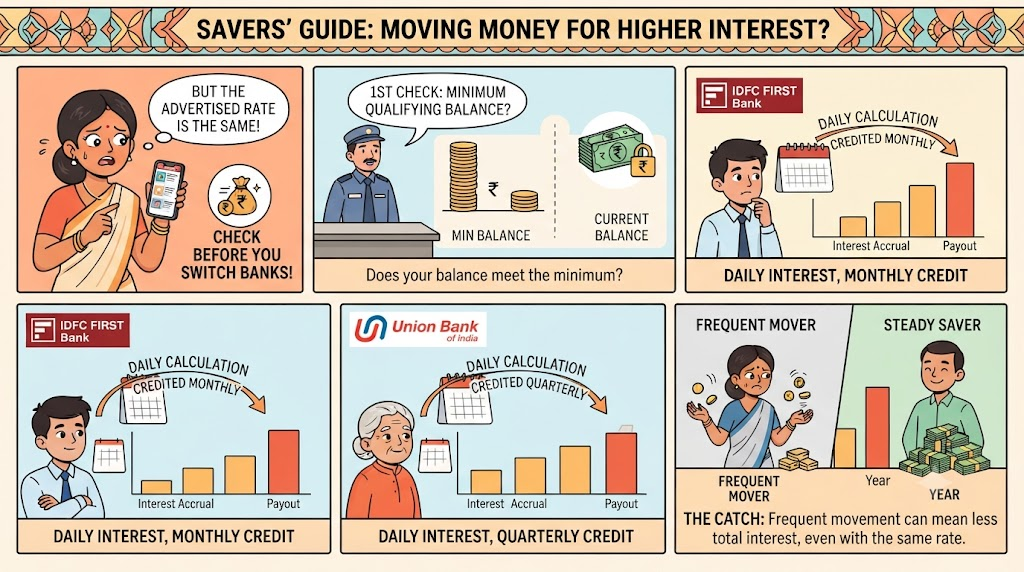
The first check should be the qualifying balance, followed by how the bank calculates and credits interest. IDFC FIRST Bank says it calculates savings interest daily and credits it monthly. Union Bank also uses daily balances but credits savings interest quarterly. Those differences can alter the amount received. A customer who frequently moves money may earn less than one who keeps a steadier balance, even when both see the same advertised annual rate.
The LoansJagat guide on calculating interest rates, published May 15, 2025 explains that calculation method and compounding frequency can change the effective amount earned. Applied to these September revisions, the saver-first approach is fairly simple: identify the exact slab, estimate the usual daily balance and check the credit frequency before comparing 2 accounts. Deposit safety also deserves attention. The Department of Financial Services states that DICGC covers eligible savings, fixed, current and recurring deposits together up to ₹5 lakh per depositor per bank, including principal and interest, subject to applicable rules.
Union Bank of India had already altered its savings deposit structure from August 10, 2026, weeks before the Canara Bank, Bank of India and IDFC FIRST changes. Its rate is 2.50% for balances up to ₹50 lakh and rises across larger bands, reaching 6.25% only above ₹3,000 crore. The bank’s earlier rate card had been effective from June 11, showing that savings rates can be adjusted within a fairly short period rather than remaining fixed for years.
That earlier move gives useful context for September’s revisions. Savings rates are variable, and banks can alter them as their deposit requirements and pricing decisions change. A household switching its primary banking relationship for a temporary rate advantage may later find that the gap has narrowed. Salary credits, standing instructions, UPI usage, branch access, service quality, and minimum-balance requirements can carry more day-to-day value than a small difference in annual interest.
IDFC FIRST Bank is positioning its savings account around progressive interest and monthly credits, which makes its 7% band more relevant to retail balances than the top rates shown by Canara Bank or Bank of India. Canara Bank’s rate card takes a different route, with higher returns appearing only as balances move into very large levels. Union Bank also reserves its strongest rates for extremely high balances. The banks are targeting different balance bands rather than offering the same structure.
For depositors, this produces a useful distinction between liquidity and return. Savings accounts keep money readily available. A saver holding funds for a hospital expense, upcoming house payment, school fees, or working-capital requirement may prefer that access even when another product offers a slightly higher return. Someone with stable surplus cash can separately compare sweep deposits or fixed deposits. The September changes create another option, but the advertised maximum alone does not identify the best account.
There is also an editorial takeaway from the rate cards themselves. For a ₹10 lakh customer, IDFC FIRST Bank’s progressive calculation is far more relevant than Canara Bank’s 4% maximum or BOI’s 6.25% maximum because those 2 headline rates require balances running into thousands of crores. That difference should remain visible whenever the 7%, 6.25% and 4% figures are compared. Otherwise, a rate comparison can be technically accurate while still giving a retail reader the wrong impression.
The September 2026 savings rate changes give customers a genuine reason to reopen their bank’s rate card, particularly those keeping several lakhs in liquid savings. IDFC FIRST Bank’s 7% slab stands out because it begins above ₹3 lakh, while Canara Bank and Bank of India reserve their maximum rates for balances measured in thousands of crores.
Still, the useful number is the rate that applies to the customer’s own balance. A depositor who checks the slab, daily balance method, interest-credit frequency, and deposit protection will get a more accurate picture than someone comparing only the largest percentage in an advertisement. The latest revisions offer more choice. The calculation decides whether that choice actually pays.
No. From September 1, 2026, 7% applies progressively to the portion above ₹3 lakh and up to ₹25 lakh.
Canara Bank lists a maximum savings rate of 4% from September 5, 2026, applicable from ₹2,000 crore and above.
No. The first ₹3 lakh falls under the 2.50% slab, while the next ₹7 lakh falls under the 7% progressive slab.
Not always. Customers should compare the applicable balance slab, interest-credit frequency, banking access, charges and deposit protection before shifting money.
No. Eligible deposits receive DICGC insurance up to ₹5 lakh per depositor per bank, including principal and interest, subject to applicable rules.









.png&w=3840&q=75)


