
By continuing, you agree to LoansJagat's Credit Report Terms of Use, Terms and Conditions, Privacy Policy, and authorize contact via Call, SMS, Email, or WhatsApp
Disclaimer: The information published on LoansJagat is intended for general informational and educational purposes only and should not be considered financial, legal, or investment advice. Interest rates, loan terms, statistics, and other data may change over time and may vary by lender or source. Please verify the latest information and consult a qualified financial advisor or the respective Bank/NBFC before making any financial decisions.
Subscribe Now
About the author

Arshathul Afia
Arshathul Afia is a journalism graduate and fintech content writer with 4+ years of experience in digital publishing and research-led writing. She has written 200+ articles covering personal finance, lending, banking, digital payments, credit, insurance, and major financial developments in India. At LoansJagat, she focuses on simplifying complex fintech news, RBI updates, loan-related changes, policy developments, and industry trends for everyday readers. Her journalism background helps her approach stories with research, context, and clarity, while her SEO experience ensures content remains discoverable and relevant. She aims to make financial news easier to understand, practical, and useful for readers across India.
Related Blog Post
Simplify All Your Loans Into One Affordable EMI

Customers Served

Debt Consolidated

1200+ Reviews

Locations in India
Club all Loans & Credit Card Bills into Single EMI

Quick Apply Loan
Consolidate your debts into one easy EMI.

Takes less than 2 minutes. No paperwork.

10 Lakhs+
Trusted Customers

2000 Cr+
Loans Disbursed

4.7/5
Google Reviews

50+
Banks & NBFCs Offers
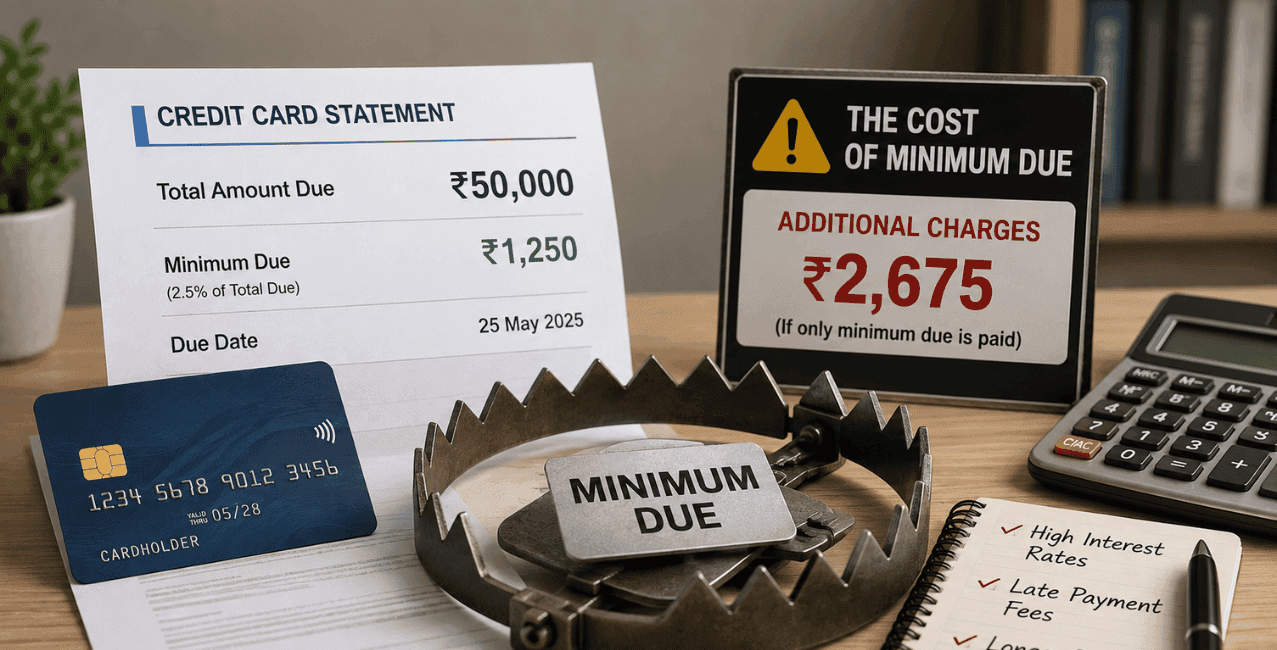
A ₹50,000 credit card bill can add ₹2,675 in charges when only the minimum due is paid, leaving most of the original debt still untouched.
The example concerns SBI Card users across India, but the warning applies more widely because other issuers also offer minimum-payment facilities. In the short term, the smaller payment can prevent a late fee. Over several billing cycles, it can leave families carrying expensive debt, losing the interest-free purchase period and using a growing part of their monthly income for charges rather than principal.
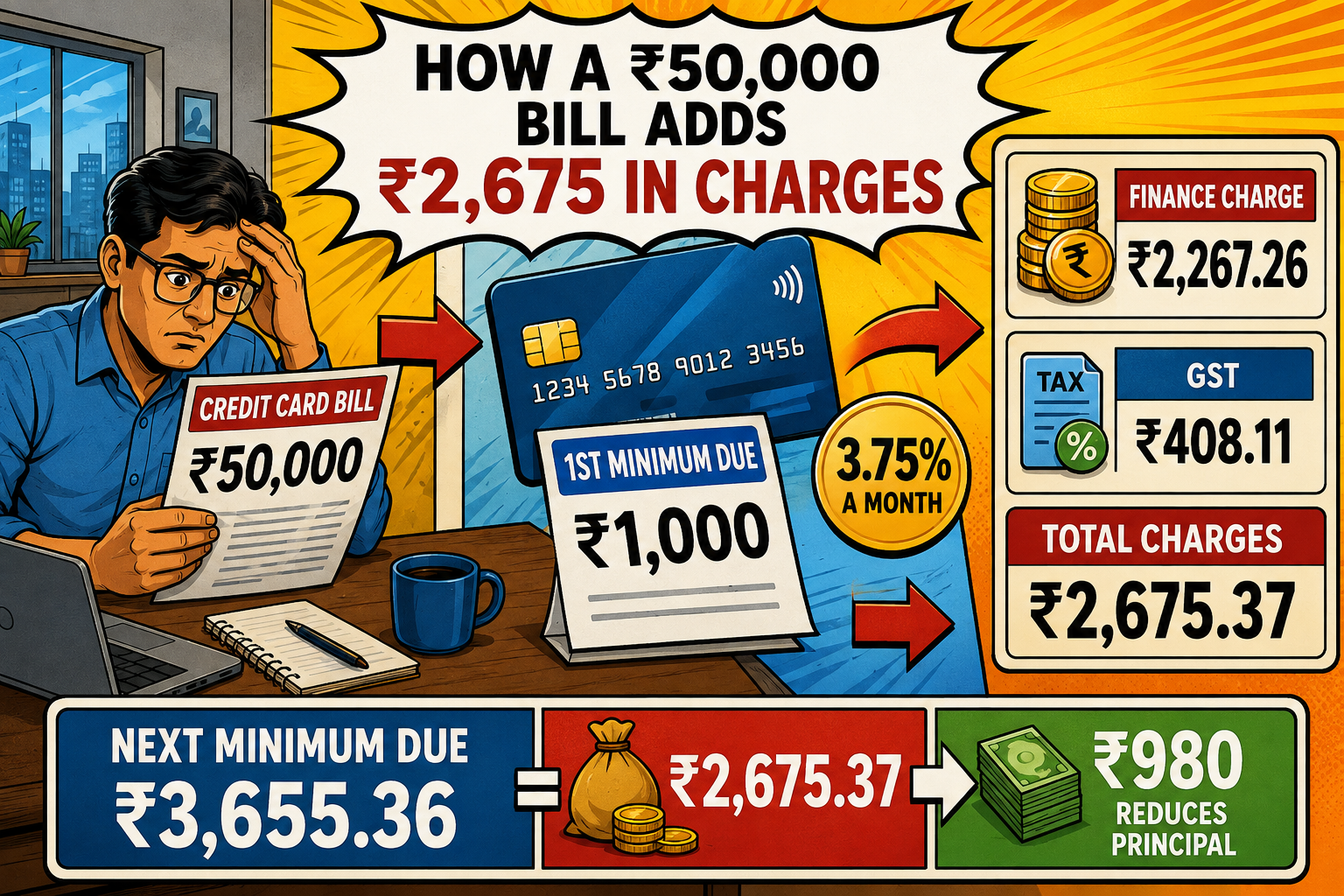
The minimum amount due is the lowest payment requested for a billing cycle. It is not a fixed instalment designed to finish the debt within a stated period. SBI Card’s formula takes 100% of GST, EMIs, fees, finance charges and any over-limit amount, then adds 2% of the remaining balance. For unsecured cards, its published finance charge is 3.75% a month, equal to 45% a year.
The issuer’s worked example begins with a ₹50,000 purchase on 7 May. After the cardholder pays ₹1,000 as the 1st minimum due, the following statement shows the amounts below. The source is SBI Card’s Most Important Terms and Conditions, accessed on 11 August 2026.
The table shows where the repayment goes. From the following minimum due of ₹3,655.36, about 73.2% pays the finance charge and GST. Only 26.8%, or ₹980, reaches the purchase principal. That calculation is especially relevant for households that continue using the same card for food, fuel, school costs or medical bills while an older balance remains unpaid.
GST raises the expense further. The Central Board of Indirect Taxes and Customs services schedule, carrying rates applicable from 1 April 2023, places financial and related services under Heading 9971 at 18%. The tax is added to the finance charge, which is why ₹2,267.26 in interest becomes a combined burden of ₹2,675.37 in the SBI example.
The benefit is narrow but useful. A person facing a temporary income delay can pay the displayed minimum and generally avoid a late-payment fee. For a family waiting for salary or insurance reimbursement, that breathing room can help for 1 cycle.
Repeated use changes the outcome. The available limit stays occupied, fresh purchases can attract finance charges, and the principal falls slowly. If several cards carry balances, the burden becomes harder to track because every card follows its own date, formula and rate.
Autopay creates another problem. SBI Card and several other issuers allow the customer to select either total amount due or minimum amount due while registering an auto-debit instruction. A successful bank debit does not prove that the whole statement was paid. Someone who selected the minimum option months earlier may keep paying interest without noticing the setting.
The safer step is simple. Cardholders should open the mandate page, read the selected payment type and check the linked bank balance before the due date. A total-due instruction avoids finance charges on eligible retail purchases when the complete statement amount is paid on time. The monthly statement still needs attention, since a failed debit or an old balance can change the result.
Financial adviser Harsh Roongta said in a report published on 7 June 2025 that paying the minimum prevents late-payment charges but does not stop interest from building on the remaining balance. That distinction matches the SBI Card calculation. A person can comply with the payment request and still pay a high price for carrying the rest.
TransUnion CIBIL offered a related view in a statement released on 11 April 2017. It said consumers who paid more than the minimum were less likely to become delinquent. Paying the minimum on time does not automatically create a missed-payment entry. A high carried balance can still keep credit utilisation elevated, while lenders can review repayment patterns and balance movement over time.
LoansJagat’s analysis of the SBI illustration adds a borrower-focused finding: nearly 3 out of every 4 rupees in the following minimum payment go towards finance charges and GST. The LoansJagat guide to minimum due, published on 20 August 2025, also explains that issuer formulas may include EMIs, interest, taxes and fees alongside a small share of principal.
For borrowers, the workable response is to stop fresh spending on the card and pay above the minimum whenever funds allow. An EMI conversion may cost less than revolving card debt, though the interest rate, processing fee and total payable amount must be checked first. A lower-cost personal loan can also help in some cases, but only when it replaces the card balance and comes with a fixed repayment plan.
SBI Card revised its minimum-due calculation from 15 July 2025. The new structure included 100% of GST, EMIs, fees, finance charges and the over-limit amount, followed by 2% of the remaining balance. The change made the bill’s components more visible, yet it also showed how little principal a minimum payment may remove.
The issuer changed the payment-allocation order on the same date. Payments now go towards GST, EMIs, fees and finance charges before balance transfers, retail purchases and cash advances. That order explains the ₹980 principal reduction in the ₹3,655.36 payment. The headline payment amount looks sizeable. The debt barely moves.
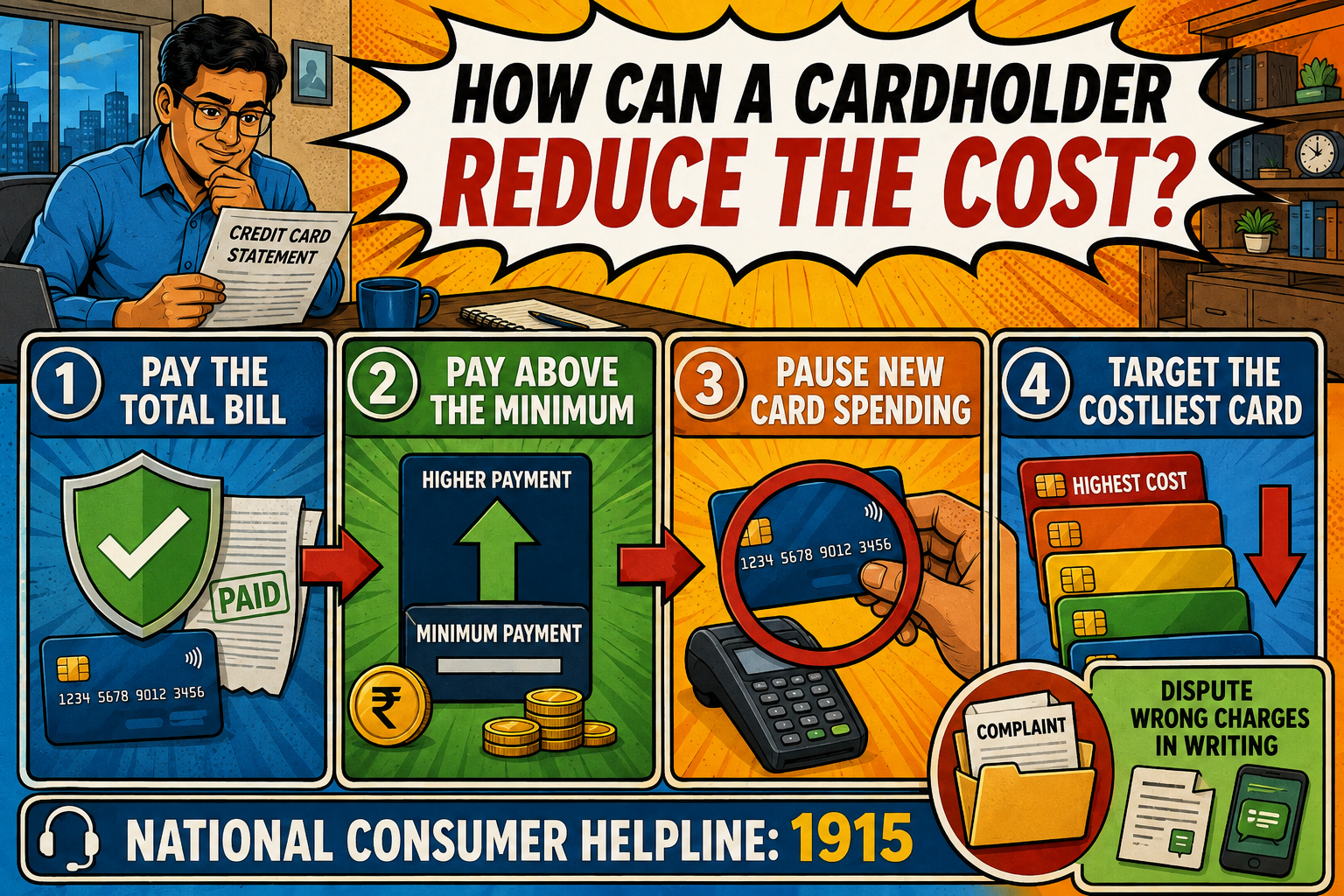
The fastest option is paying the total statement amount before the deadline. If that is not possible, the user can pay as much as available above the minimum and avoid further purchases on that card. Early payments during the cycle can also reduce the balance on which later finance charges may be calculated, subject to the issuer’s method.
People carrying debt on several cards can list each balance, rate and due date. Extra money can go first to the card with the highest cost. Closing a card does not erase its unpaid balance, while repeated transfers can add processing fees.
Incorrect charges should be disputed in writing with the issuer. The customer should attach the statement, payment receipt, transaction reference and autopay screenshot. If the problem remains unresolved, the government’s National Consumer Helpline accepts grievances through its portal, the 1915 helpline, WhatsApp and mobile application.
The ₹50,000 SBI Card example shows the hidden weakness in minimum payments. The cardholder pays the required ₹1,000, yet the next statement adds ₹2,675.37 in finance charges and GST. From the following minimum payment of ₹3,655.36, only ₹980 reduces the original purchase.
Minimum due can cover a brief cash shortage. It becomes costly when autopay repeats it quietly month after month. Checking the mandate, stopping fresh card use and paying above the displayed minimum can shorten the debt. Paying the total statement amount remains the most direct way to avoid finance charges on eligible retail purchases.
It is the lowest payment required for that billing cycle. Paying it does not remove finance charges from the unpaid balance.
SBI Card’s example includes ₹2,267.26 in finance charges and ₹408.11 in GST after the 1st minimum payment.
Only if the customer selected the total amount due. A minimum-due mandate pays the smaller figure and leaves the balance unpaid.
Yes, as a regular habit. Interest continues, principal falls slowly and new purchases may lose the interest-free facility.
The minimum payment generally prevents a late fee. It does not waive interest on the remaining statement balance.








.png&w=3840&q=75)


