Disclaimer: The information published on LoansJagat is intended for general informational and educational purposes only and should not be considered financial, legal, or investment advice. Interest rates, loan terms, statistics, and other data may change over time and may vary by lender or source. Please verify the latest information and consult a qualified financial advisor or the respective Bank/NBFC before making any financial decisions.
Subscribe Now
About the author

Arshathul Afia is a journalism graduate and fintech content writer with 4+ years of experience in digital publishing and research-led writing. She has written 200+ articles covering personal finance, lending, banking, digital payments, credit, insurance, and major financial developments in India. At LoansJagat, she focuses on simplifying complex fintech news, RBI updates, loan-related changes, policy developments, and industry trends for everyday readers. Her journalism background helps her approach stories with research, context, and clarity, while her SEO experience ensures content remains discoverable and relevant. She aims to make financial news easier to understand, practical, and useful for readers across India.
Related News
Simplify All Your Loans Into One Affordable EMI

Customers Served

Debt Consolidated

1200+ Reviews

Locations in India
Club all Loans & Credit Card Bills into Single EMI

Quick Apply Loan
Consolidate your debts into one easy EMI.

Takes less than 2 minutes. No paperwork.

10 Lakhs+
Trusted Customers

2000 Cr+
Loans Disbursed

4.7/5
Google Reviews

50+
Banks & NBFCs Offers
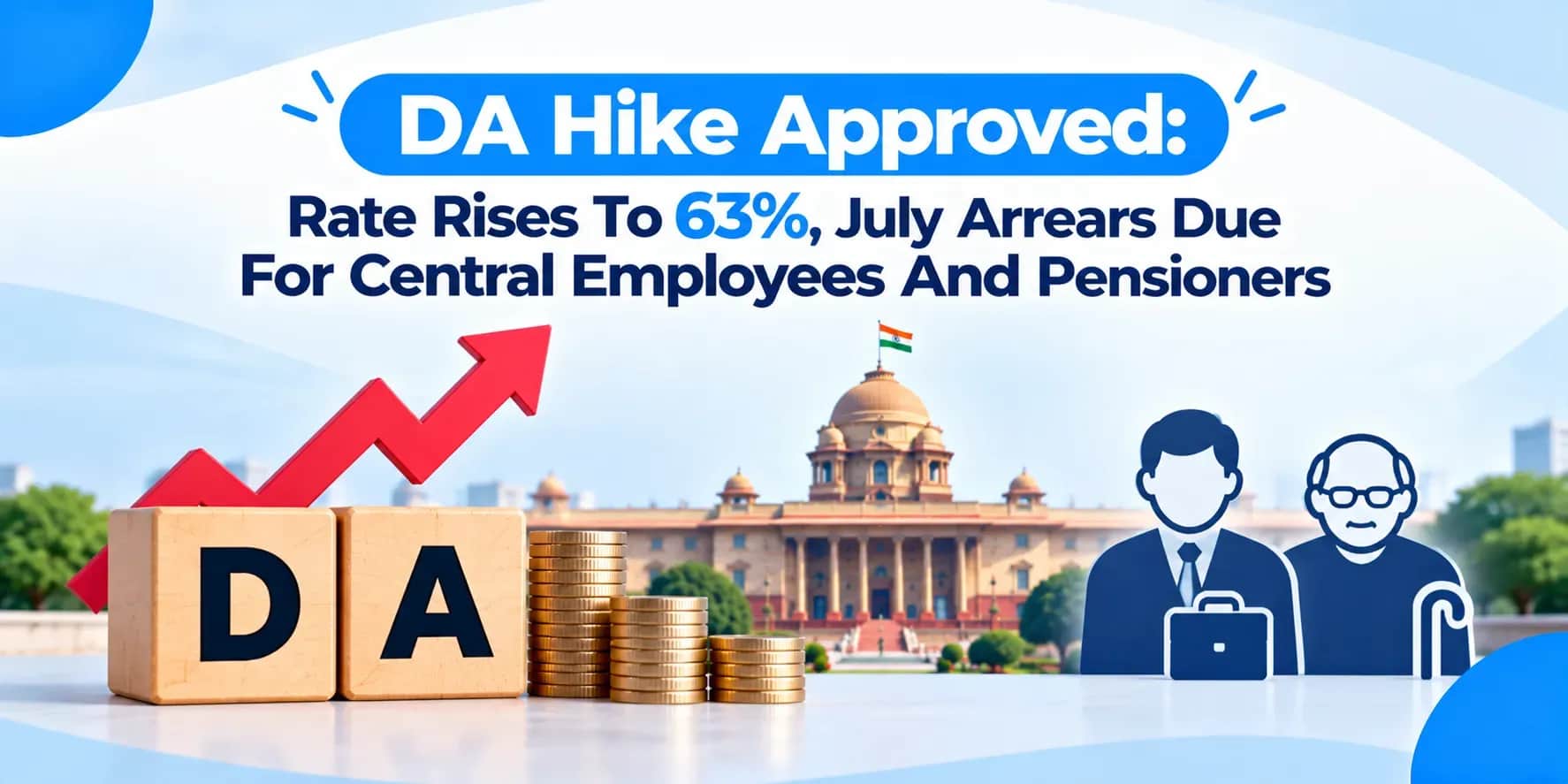
Central employees and pensioners gain entitlement to DA and DR at 63%, including arrears from 1 July 2026, under the increase approved by the Cabinet.
Key Highlights
New Delhi: The Union Cabinet approved higher Dearness Allowance for central government employees and Dearness Relief for pensioners at its 28 October 2026 meeting, chaired by Prime Minister Narendra Modi. The change adds 3 percentage points to the previous 60% rate. The Ministry of Finance announcement, Release ID 2329485, records the revised 63% of basic pay or pension, applicable retrospectively from 1 July 2026.
Eligible households gain a larger monthly allowance, with arrears covering their entitlement from July. The government has linked the increase to compensation against rising prices. The Centre puts the additional annual cost at ₹10,016.10 crore, an expense that recurs as it pays the higher allowance. Arrears cover the earlier months. After that accumulated payment, beneficiaries continue to receive the revised monthly amount.
Pensioners account for 68.71 lakh of the beneficiaries, while the central government employee count stands at 48.54 lakh. Together, the government’s figures total approximately 117.25 lakh. Serving employees receive the increase through DA; pensioners receive DR. Both groups get the same change in the allowance rate, although the amount payable differs with each person’s basic pay or pension. The approved terms appear below.
Basic pay or basic pension provides the calculation base for the additional 3 percentage points in the allowance rate. Employees calculate the extra DA on basic pay, without applying a 3% increase to the full monthly credit or every salary component. Pensioners receive the corresponding adjustment on basic pension. The higher rate applies to a defined payment component in each case.
An employee managing loan repayments has to account for higher DA each month as well as arrears from July. Of these 2 amounts, the arrears cover the earlier period. The monthly DA increase continues after the arrears have been paid. A borrower who carries the arrears amount into every month’s repayment budget would count money that will not recur and overestimate what is available for instalments.
What remains in the household budget depends on the difference between revised monthly income and existing monthly commitments. Arrears belong in a separate calculation because they settle past entitlement. This follows directly from the structure of the Cabinet’s decision: the government approved a recurring allowance increase with retrospective effect. The headline rate alone cannot show how much additional income an individual employee has available for regular repayments.
Union Information and Broadcasting Minister Ashwini Vaishnaw announced the increase after the Cabinet meeting on 28 October 2026. He confirmed the revised rate and its July effective date. The Ministry of Finance described the purpose as compensation against price rise and said the government had followed the accepted formula based on the 7th Central Pay Commission’s recommendations.
C Srikumar, secretary of the All India Defence Employees’ Federation, explained in comments published on 28 October 2026 that the revised rate applied from July. His comments address the period covered by the allowance. October marks the Cabinet’s approval, while July establishes the start of the revised entitlement. Employees therefore receive the benefit for the applicable earlier period as well as the higher monthly allowance.
For the period beginning 1 January 2026, DA and DR stood at 60% following a 2-percentage-point rise from 58%. The Cabinet approved the retrospective revision on 18 April 2026. Its announcement, Release ID 2253245, also cited the accepted formula based on the 7th Central Pay Commission’s recommendations.
The October decision covers the July instalment that follows the January adjustment. Reading the approvals together gives the rate progression during 2026. The April approval established the earlier entitlement; the latest approval raises the rate further and creates a separate arrears calculation from July.
The Cabinet’s approval brings eligible central employees and pensioners a higher allowance with entitlement from July. The Centre will meet the additional recurring expenditure. For beneficiaries, the practical outcome has 2 parts: arrears for the applicable earlier period and a higher monthly allowance, calculated on basic pay or pension.
The revised DA rate is 63% of basic pay, replacing 60%. The Cabinet approved the increase on 28 October 2026, alongside the corresponding DR increase.
Employees and pensioners gain entitlement to the higher rate from 1 July 2026. The Cabinet’s October approval applies retrospectively to that date.
The increase equals 3% of basic pay. The calculation does not apply a 3% increase to the employee’s full salary or every allowance.
The revised entitlement begins before the October approval. Arrears cover the difference between the previous allowance and the higher amount payable for the applicable period.
Serving central employees receive Dearness Allowance, while eligible pensioners receive Dearness Relief. The Cabinet approved the corresponding increase for both groups, calculated on basic pay or pension.
Start your journey today
Apply Now*T&C apply