
By continuing, you agree to LoansJagat's Credit Report Terms of Use, Terms and Conditions, Privacy Policy, and authorize contact via Call, SMS, Email, or WhatsApp
Disclaimer: The information published on LoansJagat is intended for general informational and educational purposes only and should not be considered financial, legal, or investment advice. Interest rates, loan terms, statistics, and other data may change over time and may vary by lender or source. Please verify the latest information and consult a qualified financial advisor or the respective Bank/NBFC before making any financial decisions.
Subscribe Now
About the author

Arshathul Afia
Arshathul Afia is a journalism graduate and fintech content writer with 4+ years of experience in digital publishing and research-led writing. She has written 200+ articles covering personal finance, lending, banking, digital payments, credit, insurance, and major financial developments in India. At LoansJagat, she focuses on simplifying complex fintech news, RBI updates, loan-related changes, policy developments, and industry trends for everyday readers. Her journalism background helps her approach stories with research, context, and clarity, while her SEO experience ensures content remains discoverable and relevant. She aims to make financial news easier to understand, practical, and useful for readers across India.
Related Blog Post
Simplify All Your Loans Into One Affordable EMI

Customers Served

Debt Consolidated

1200+ Reviews

Locations in India
Club all Loans & Credit Card Bills into Single EMI

Quick Apply Loan
Consolidate your debts into one easy EMI.

Takes less than 2 minutes. No paperwork.

10 Lakhs+
Trusted Customers

2000 Cr+
Loans Disbursed

4.7/5
Google Reviews

50+
Banks & NBFCs Offers
The Delhi High Court has paused selected judges’ ITR processing while it examines whether statutory judicial allowances remain outside taxable salary under India’s new tax regime.
The Delhi High Court, in New Delhi, modified its earlier interim protection on 10 August 2026 after the Income Tax Department raised a problem with automated processing. A division bench of Justice Dinesh Mehta and Justice Rajneesh Kumar Gupta asked private secretaries of affected judges to provide PAN and return details. The Delhi High Court supplementary list records the department’s modification application in Delhi Tax Bar Association v. Union of India, W.P.(C) 9365/2026.
The short-term effect is narrow. Identified returns will remain unprocessed, while demands and refunds linked to any affected return already processed will wait. This prevents an automatic tax demand before the judges decide the legal dispute. Over time, the ruling may settle whether a special law governing judges’ service benefits can override restrictions attached to the new tax regime. A wrong interpretation could either collect tax not authorised by Parliament or grant a benefit the regime does not permit.
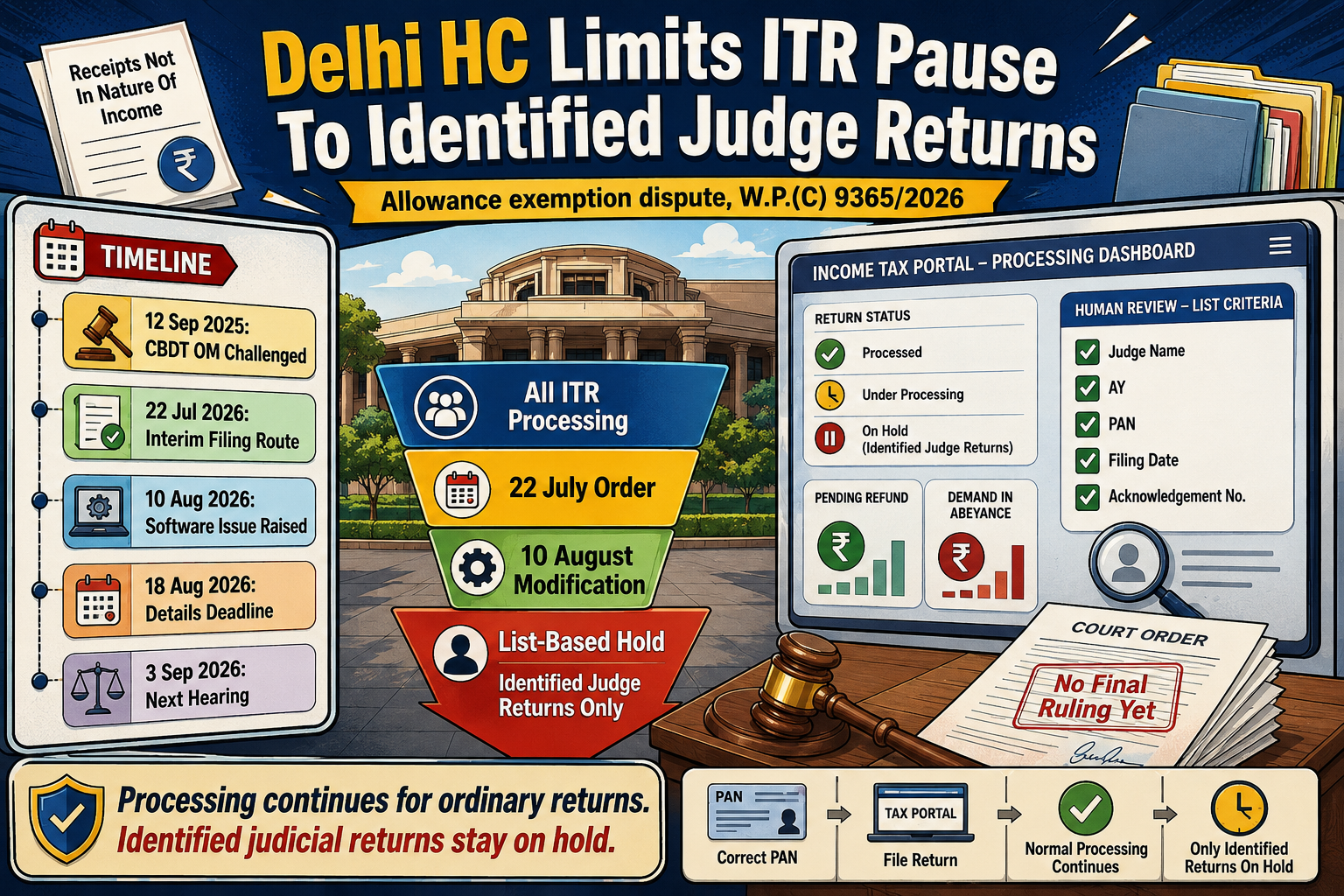
The court’s 22 July order allowed serving Supreme Court and High Court judges to place the disputed allowances under “receipts not in the nature of income." It also directed that returns filed through this route should not be processed until further orders. The Income Tax Department then sought a modification because its software could not recognise a return as belonging to a serving judge.
Department counsel Shlok Chandra told the bench on 10 August that around 98% of returns could be processed without human intervention by the end of August 2026. The figure appears in the dated court order and was not issued as a separate statistical report. Strict compliance with the first direction, the department argued, could require a far wider processing stop. The bench chose a list-based solution instead.
The sequence below separates the original dispute from the later software fix. The court has not yet delivered a final ruling on taxability.
After receiving the details, the department must avoid processing the identified return. The required information includes the judge’s name, assessment year, PAN, filing date and acknowledgement number. If a judge files an original or revised return later under the same arrangement, the Private Secretary may provide the details within 12 hours.
A demand from an affected return already processed must remain in abeyance. A calculated refund should not be released, while any amount already paid will depend on the final outcome.
The direction does not stop ITR processing for salaried employees, pensioners, businesses or other individual taxpayers. Their acknowledgements, refunds and tax communications will continue under the usual system. The identification method lets officials isolate a small set of judicial returns without delaying unrelated filings across India. That is the immediate public benefit.
There is a longer legal effect worth following. The judgment may explain how a general tax provision should operate when another parliamentary law removes a specific benefit from salary computation. LoansJagat’s analysis is that the court has created an administrative holding arrangement, not a fresh tax concession. Taxpayers still need to check AIS, Form 26AS, interest and property entries, as explained in this LoansJagat guide to AY 2026-27 filing errors.
Senior Advocate Sachit Jolly, appearing for the Delhi Tax Bar Association, argued that the disputed benefits are statutory exclusions rather than ordinary deductions. Section 22D of the High Court Judges Act, 1954 on India Code states that specified benefits shall not be included while computing salary income. Section 23D of the corresponding Supreme Court law uses similar treatment.
CBDT’s recorded position runs the other way. Its 12 September 2025 memorandum treated the benefit as unavailable under the new regime because that system offers modified tax rates with restricted deductions and exemptions. The petitioner replies that an amount excluded before salary is computed cannot be treated like a deduction claimed after income is calculated. The difference is technical, but the tax result is direct.
The bench found the petitioner’s reading persuasive at the interim stage. It observed on 22 July that Sections 22D and 23D contain overriding language and may prevail over Section 115BAC. That was a provisional view. The Union government and CBDT can still contest the argument before a final judgment.
For now, the practical solution has 2 parts. Judges may disclose the covered amounts through the temporary category approved by the court, and their offices must quickly identify the returns for tax officials. A permanent fix may require the ITR utility to add a dedicated reporting field if the association succeeds. If CBDT succeeds, judges opting for the new regime may have to include the benefits in taxable salary or choose another legally available regime.
The dispute arose after the return utility reportedly offered no dedicated field for the claimed statutory treatment under the new regime. The Delhi Tax Bar Association then challenged CBDT’s Office Memorandum dated 12 September 2025. It said the memorandum wrongly reduced a benefit created by Parliament.
During the 22 July hearing, Jolly suggested using the “receipts not in the nature of income” category as a temporary filing route. The bench accepted it. Serving Supreme Court and High Court judges could file an original or revised return through that category, while the department was told not to proceed with those filings.
The association also relied on Articles 125 and 221 of the Constitution. It argued that judicial allowances and service benefits cannot be varied to a judge’s disadvantage after appointment. According to the petition, an administrative memorandum cannot narrow statutory protection and interfere with judicial independence.
The department’s August application focused on implementation. Once officials explained that automated processing could not identify judges, the court replaced the broad direction with a return-specific hold.
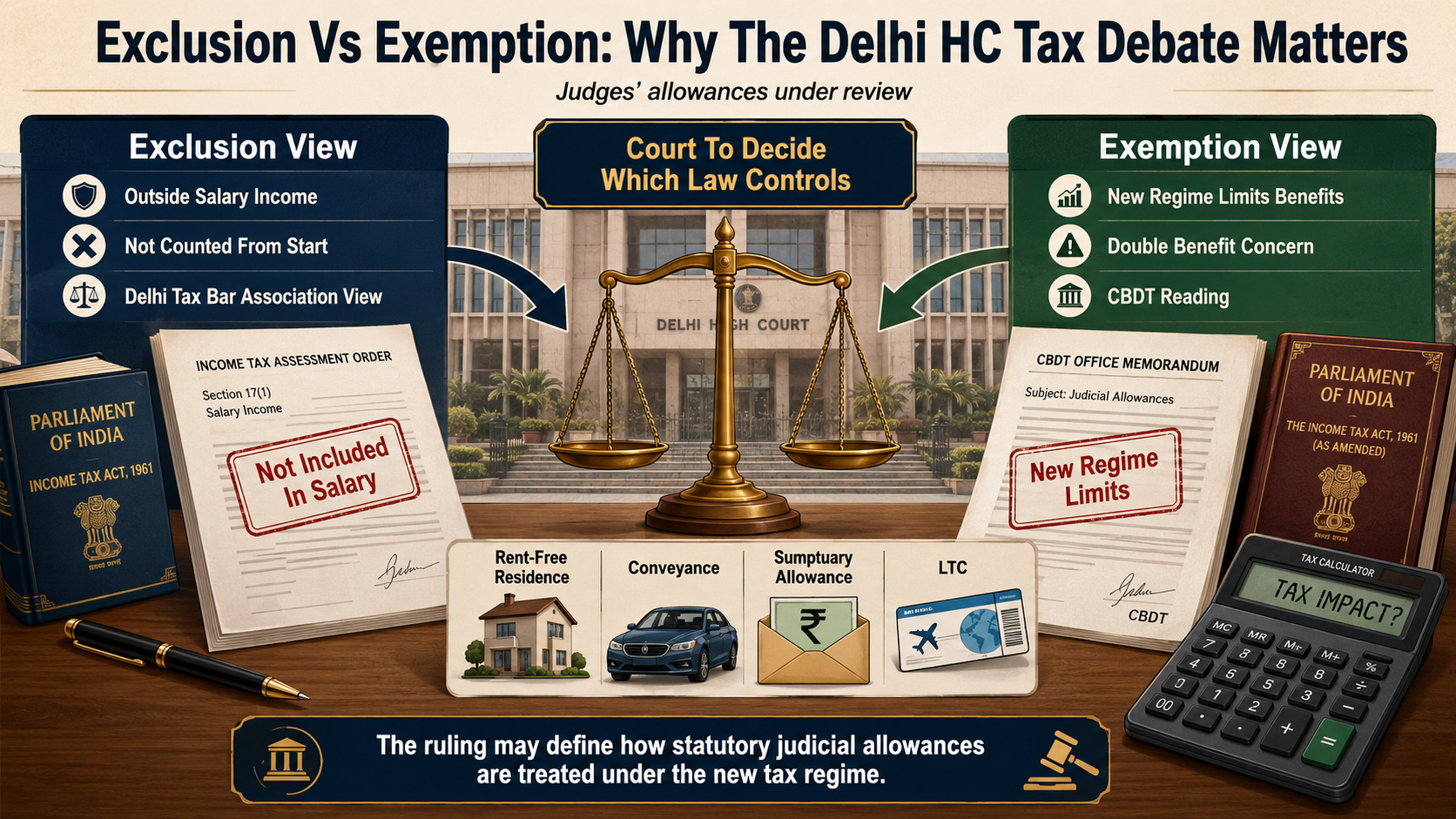
The challenged benefits include a rent-free official residence or related housing allowance, conveyance facilities, a sumptuary allowance and a leave travel concession. Their governing provisions say these values shall not be included in salary income. The Delhi Tax Bar Association therefore treats them as amounts outside the tax calculation from the start.
CBDT views the new regime as a package of adjusted rates and limited exemptions. On its reading, permitting the judicial benefits alongside the regime’s rate structure could produce a double benefit. The court must decide which law controls and whether an administrative clarification went beyond the wording approved by Parliament.
The Delhi High Court has frozen the processing consequences for a defined group of judicial returns, not for taxpayers across India. Its 10 August 2026 order also protects the Income Tax Department from releasing refunds that may later require reversal.
The next stage will focus on statutory wording. If Sections 22D and 23D remove the covered benefits from salary itself, restrictions under the new regime may not apply. If they operate as ordinary exemptions, CBDT’s approach may survive. Until the court rules, identified returns, demands and refunds will remain on hold under the temporary process.
No. It covers identified returns filed by serving Supreme Court and High Court judges under the court-approved temporary route.
No. The dispute covers specified housing, conveyance, sumptuary and leave travel benefits under Sections 22D and 23D.
It is the temporary ITR category approved for reporting disputed allowances without treating them as taxable salary during the case.
Yes. Judges pay income tax on taxable income. This case concerns only the treatment of specified statutory benefits under the new regime.
Withholding both demands and refunds preserves the tax position until judgment and reduces the risk of later recovery or repayment.








.png&w=3840&q=75)


