By continuing, you agree to LoansJagat's Credit Report Terms of Use, Terms and Conditions, Privacy Policy, and authorize contact via Call, SMS, Email, or WhatsApp
Disclaimer: The information published on LoansJagat is intended for general informational and educational purposes only and should not be considered financial, legal, or investment advice. Interest rates, loan terms, statistics, and other data may change over time and may vary by lender or source. Please verify the latest information and consult a qualified financial advisor or the respective Bank/NBFC before making any financial decisions.
Subscribe Now
About the author
Arshathul Afia
Arshathul Afia is a journalism graduate and fintech content writer with 4+ years of experience in digital publishing and research-led writing. She has written 200+ articles covering personal finance, lending, banking, digital payments, credit, insurance, and major financial developments in India. At LoansJagat, she focuses on simplifying complex fintech news, RBI updates, loan-related changes, policy developments, and industry trends for everyday readers. Her journalism background helps her approach stories with research, context, and clarity, while her SEO experience ensures content remains discoverable and relevant. She aims to make financial news easier to understand, practical, and useful for readers across India.
Related Blog Post
Simplify All Your Loans Into One Affordable EMI

Customers Served

Debt Consolidated

1200+ Reviews

Locations in India
Club all Loans & Credit Card Bills into Single EMI

Quick Apply Loan
Consolidate your debts into one easy EMI.

Takes less than 2 minutes. No paperwork.

10 Lakhs+
Trusted Customers

2000 Cr+
Loans Disbursed

4.7/5
Google Reviews

50+
Banks & NBFCs Offers
Other services mentioned in this article
Flexible health benefits in offices are pushing employees to match cover with age, family duties and medical risks before choosing workplace perks.
A report indicates that employer health insurance plans in India differ from fixed group cover to flexible benefit choices. Such plans consider the needs of their employees and report that health support is needed based on the stresses and personal situations of individuals at different ages. The plan accounts for the 28-year-old managing work stress, the 32-year-old and the family, and the 45-year-old managing ageing parents. This change is impacting multiple employees in all of India and is especially important since many employees rely on the health plans offered by their employers as their primary source of health insurance.
In the short run, employees get more control during HR enrolment. They can pick benefits that match their own family situation. The risk is poor selection. A worker may choose gym reimbursement, dental cover or a small OPD wallet before checking hospitalisation cover, parent cover or pre-existing disease support. That can hurt later, especially when one medical emergency can drain savings quickly.
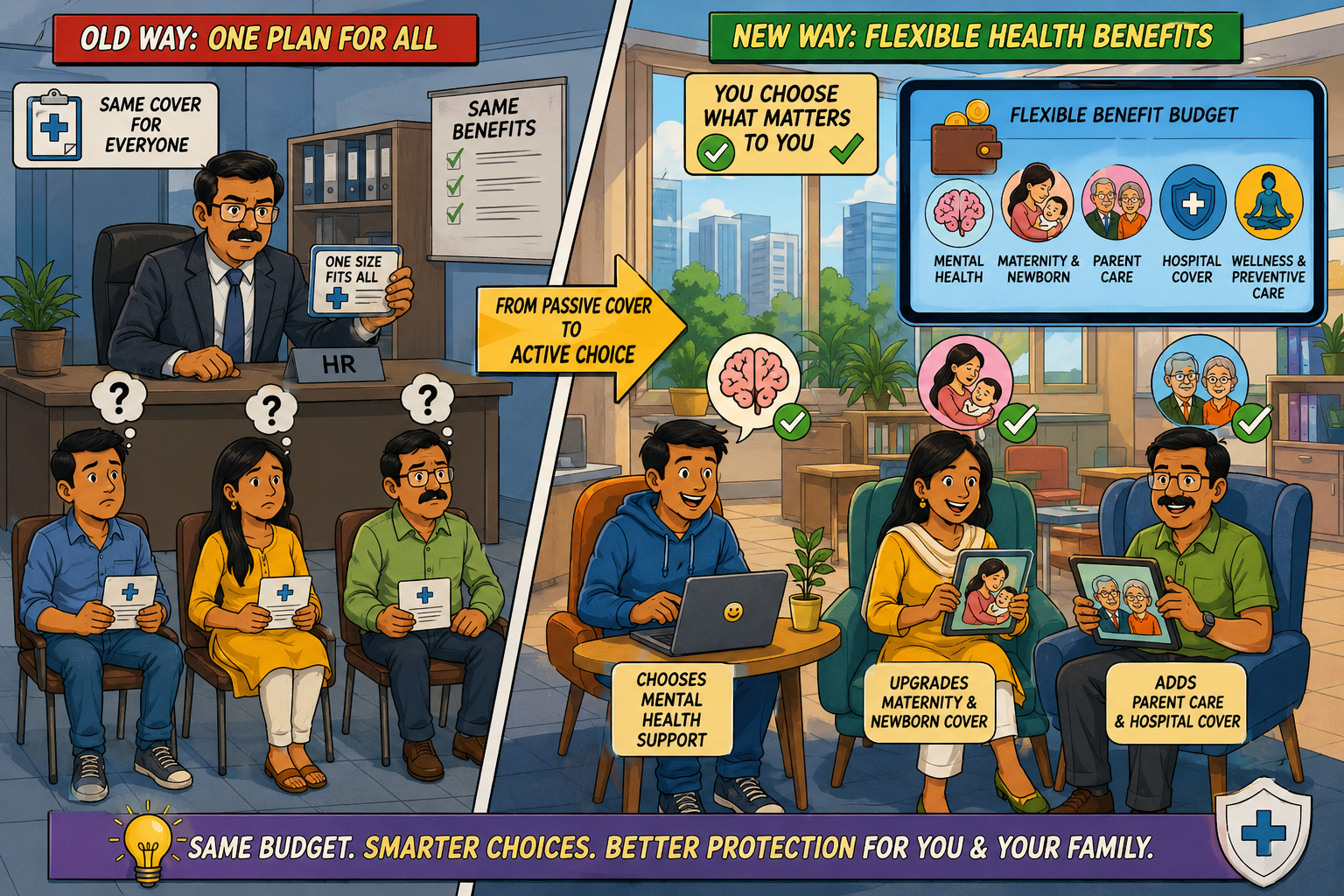
For many years, office health cover was simple. The employer bought one policy, HR shared the card, and employees looked at the details only during admission or claim filing. That old format worked for administration, but it did not work equally for all employees. Family needs changed faster than the policy design.
Flexible health benefits change that format. Instead of giving the same benefits to everyone, companies can give workers a fixed health budget or choice-based cover. One employee can pick mental health support. Another can increase maternity or newborn cover. A third can use the same benefit window for parents. The main news is this shift from passive cover to active selection.
For salaried Indians, the direct benefit is better use of the employer’s health budget. A young employee in Bengaluru may want therapy sessions and annual diagnostics. A worker in Pune planning a child may need maternity cover. A mid-career employee in Delhi NCR may worry more about parents with diabetes, heart risk or repeated hospital visits.
The larger benefit is financial. The Press Information Bureau release on National Health Accounts Estimates 2022-23, issued on 27 May 2026, said out-of-pocket expenditure fell from 64.2% of total health expenditure in 2013-14 to 43.4% in 2022-23. That fall is positive, but 43.4% still means families carry a heavy share of healthcare costs. Employer cover can reduce that pressure if employees choose wisely.
Before ticking options on an HR portal, employees need a basic order of priority. First comes hospitalisation. Then dependents. Then parents. After that, OPD, wellness and lifestyle benefits can be added.
The table shows why one office policy cannot serve everyone equally. A 28-year-old may not need maternity cover. A 45-year-old may not care much about gym reimbursement if parent hospitalisation is the real risk at home. The same company budget can work better when employees use it for the largest uncovered gap.
The first step is not picking the most attractive benefit. It is checking exposure. Employees should read the base sum insured, room rent cap, co-pay clause, waiting period, disease sub-limit, maternity terms, parent premium and claim process. Boring details, yes. But these details decide how much money leaves the family account during a hospital stay.
The solution is to compare office cover with personal cover. If a worker already has OPD reimbursement through a spouse’s policy, adding another OPD wallet may not help much. If parents are not covered anywhere, the flexible benefit budget may be better used there. A LoansJagat health insurance tax guide also explains how health insurance premiums can be relevant for Section 80D tax planning, depending on eligibility and the tax regime chosen. That makes insurance selection a salary planning issue too, not only an HR formality.
India has already been expanding health protection through public schemes and worker-focused health programmes. That background explains why employer benefits are also getting sharper. On 17 March 2026, the Ministry of Health and Family Welfare said 43.52 crore Ayushman cards had been created under AB-PMJAY, including 1.14 crore Ayushman Vay Vandana cards for senior citizens aged 70 and above.
Worker health also received policy attention in 2026. On 7 May 2026, the Ministry of Labour and Employment said ESIC had launched annual health check-ups for workers aged 40 and above. The ministry said ESIC coverage had grown from around 7 crore beneficiaries a decade ago to nearly 15 crore beneficiaries. This push towards early screening is relevant because many employer plans now include preventive tests, annual check-ups and wellness benefits.
Abhishek Poddar, co-founder and CEO of Plum, wrote in Mint that flexible benefits shift employees from being passive recipients of a company policy to active participants in building their own protection. That view fits the current change. The employee now has to read, compare and choose. HR cannot make every personal health decision for every family.
Dr. Mansukh Mandaviya, Union Minister for Labour and Employment, said during the ESIC annual health check-up launch on 7 May 2026 that screenings can help detect disease early and allow timely treatment. The same idea applies in offices. Preventive care may look smaller than hospital cover, but it can help workers catch problems before they become expensive.
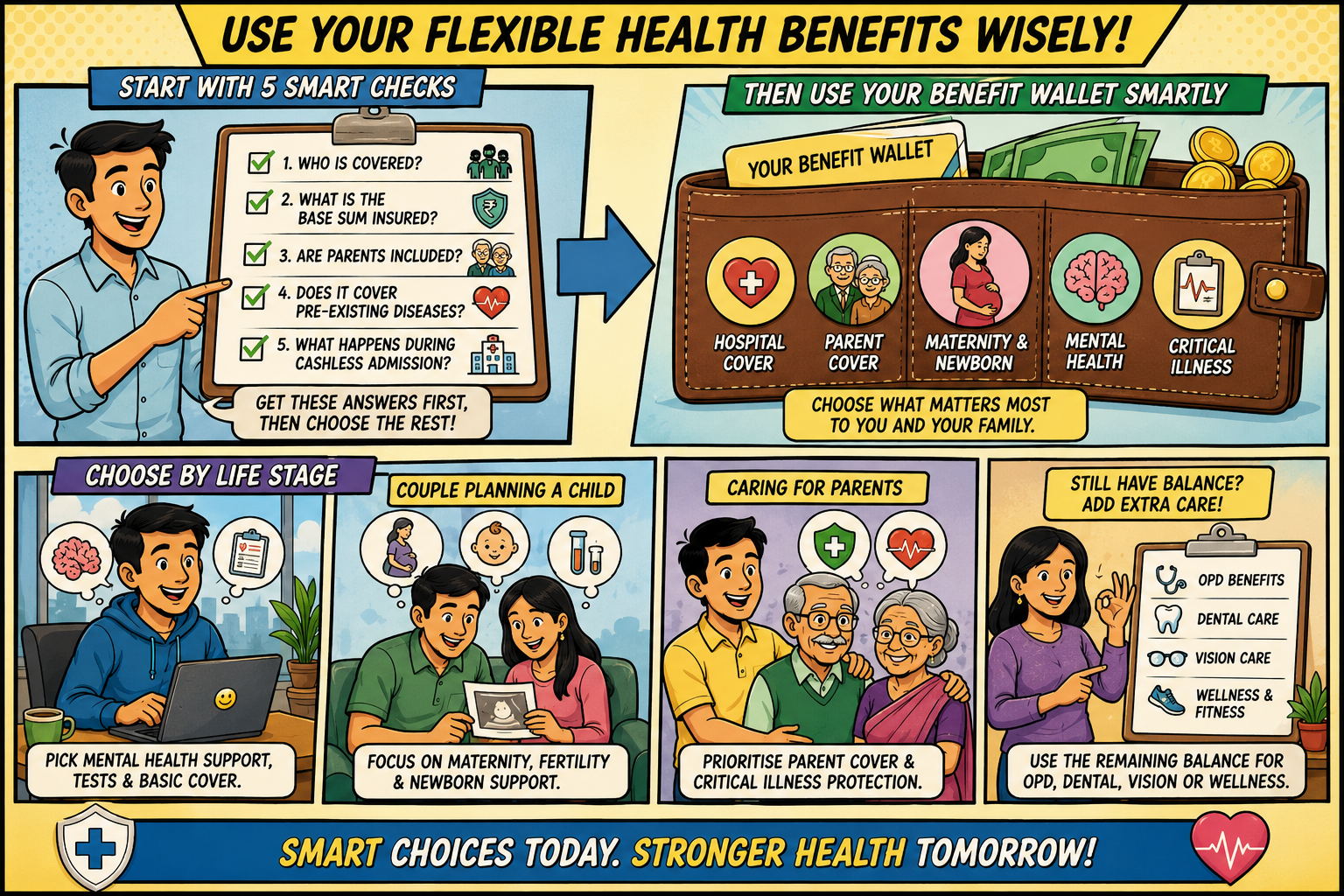
Employees should start with 5 checks. Who is covered? What is the base sum insured? Are parents included? Does the policy cover pre-existing diseases? What happens during cashless admission? These answers should come before choosing softer benefits.
After that, the benefit wallet can be used by life stage. A young worker can select therapy, tests and basic cover. A couple planning a child can look at maternity, fertility and newborn support. An employee with older parents can raise parent cover or choose critical illness protection. If money remains, OPD, dental, vision or wellness benefits can be added.
Flexible employer health plans can help Indian employees get cover that fits their age, family and medical risk. The change is useful, but only when workers read the policy before selecting benefits.
The best choice is not always the benefit that sounds most attractive on the HR portal. It is the benefit that protects the biggest financial risk. For one employee, that may be mental health support. For another, it may be maternity. For a 45-year-old supporting parents, parent cover may come first. The plan should follow the worker’s life, not the old office template.
They are workplace health benefits where employees choose cover based on their own needs.
Companies want employees to use benefits better instead of giving everyone the same policy.
Employees with dependants, parents, maternity needs, stress concerns or existing medical risks may gain more.
OPD helps, but hospitalisation, parents and critical illness cover should usually be checked first.
Some health insurance premiums may qualify under Section 80D, based on eligibility and tax regime.









.png&w=3840&q=75)


