
By continuing, you agree to LoansJagat's Credit Report Terms of Use, Terms and Conditions, Privacy Policy, and authorize contact via Call, SMS, Email, or WhatsApp
Disclaimer: The information published on LoansJagat is intended for general informational and educational purposes only and should not be considered financial, legal, or investment advice. Interest rates, loan terms, statistics, and other data may change over time and may vary by lender or source. Please verify the latest information and consult a qualified financial advisor or the respective Bank/NBFC before making any financial decisions.
Subscribe Now
About the author

Arshathul Afia
Arshathul Afia is a journalism graduate and fintech content writer with 4+ years of experience in digital publishing and research-led writing. She has written 200+ articles covering personal finance, lending, banking, digital payments, credit, insurance, and major financial developments in India. At LoansJagat, she focuses on simplifying complex fintech news, RBI updates, loan-related changes, policy developments, and industry trends for everyday readers. Her journalism background helps her approach stories with research, context, and clarity, while her SEO experience ensures content remains discoverable and relevant. She aims to make financial news easier to understand, practical, and useful for readers across India.
Related Blog Post
Simplify All Your Loans Into One Affordable EMI

Customers Served

Debt Consolidated

1200+ Reviews

Locations in India
Club all Loans & Credit Card Bills into Single EMI

Quick Apply Loan
Consolidate your debts into one easy EMI.

Takes less than 2 minutes. No paperwork.

10 Lakhs+
Trusted Customers

2000 Cr+
Loans Disbursed

4.7/5
Google Reviews

50+
Banks & NBFCs Offers
Other services mentioned in this article
Employees choosing the ₹1,800 EPF limit may receive a higher salary each month, but smaller deposits could cut the retirement balance built over decades for workers.
Key Highlights
The Ministry of Labour and Employment notified the Employees’ Provident Funds Scheme, 2026, on 29 June 2026 through G.S.R. 525(E). The scheme applies across India and replaces the framework used since 1952. Under Paragraph 18 of the Gazette of India notification, employer and employee contributions may be limited to the amount payable on the statutory wage ceiling. At the current ₹15,000 ceiling and the regular 12% rate, that amount comes to ₹1,800 a month.
For employees whose PF is calculated on a higher basic wage, the choice can alter the monthly payslip. A lower deduction leaves more cash for rent, school fees, EMIs, or medical expenses. The benefit arrives straight away. The loss takes longer to show because fewer deposits enter the EPF account and earn interest. The company's salary policy will also play a part, so the difference may not reach every employee as extra take-home pay.
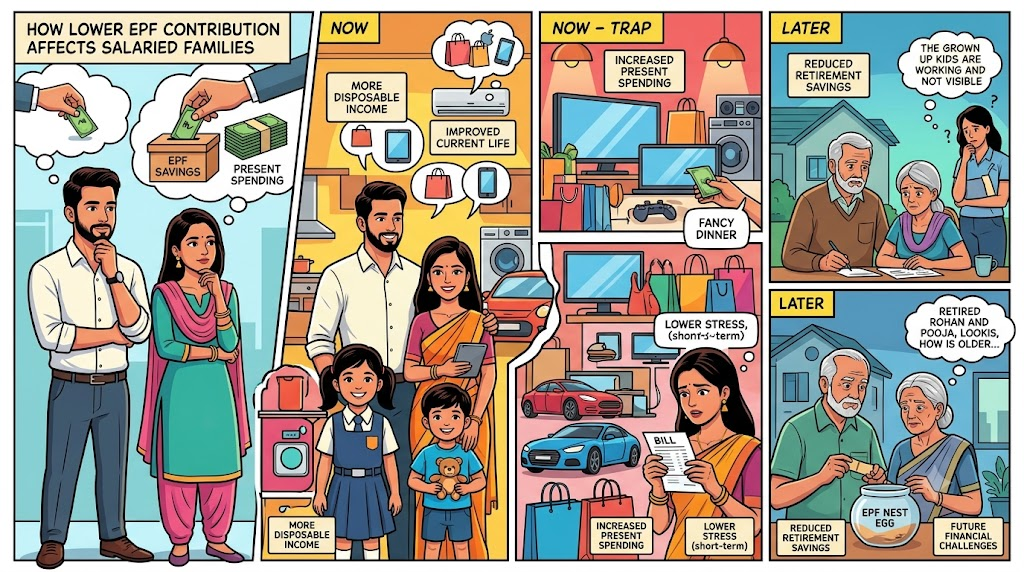
The immediate gain is easy to spot. Consider an employee with applicable monthly wages of ₹50,000. A 12% employee contribution would be ₹6,000, while a contribution restricted to the wage ceiling would be ₹1,800. The difference is ₹4,200 before any tax or payroll adjustment. That amount may help a family close an expensive personal loan or build an emergency reserve. It may also disappear into regular expenses within a few months. Both outcomes are possible.
A lower contribution can work for someone with a planned use for the money. Repaying a credit card balance, charging a high interest rate, is one such use. So is setting aside 6 months of expenses after a job change. Employees who already invest for retirement through NPS or long-term mutual fund SIPs may also prefer the added cash. Those relying mainly on EPF face a harder choice. Their monthly salary rises, yet their main retirement account receives less.
Anita Basrur, partner for direct taxation at Sudit K. Parekh & Co LLP, told ET Wealth in an article updated on 16 July 2026 that reducing EPF to ₹1,800 may raise take-home salary but can sharply reduce the final retirement corpus. She also flagged 2 other issues. The released salary may face tax, and an employee moving the money into market-linked products takes on investment risk that EPF does not carry in the same form.
Ankit Bagadia, director of business at BankBazaar, said the lower contribution may suit employees who already have a strong retirement plan and will invest the additional salary regularly. Arindam Banerjee, professor of finance at SP Jain School of Global Management, pointed to another weakness in the flat amount. A ₹1,800 contribution stays unchanged even when salary grows, unless the employee later raises it. The safer response is simple. Employees choosing a lower PF amount should create an automatic transfer for the salary difference on payday, not several days later, after bills and shopping have reduced the balance.
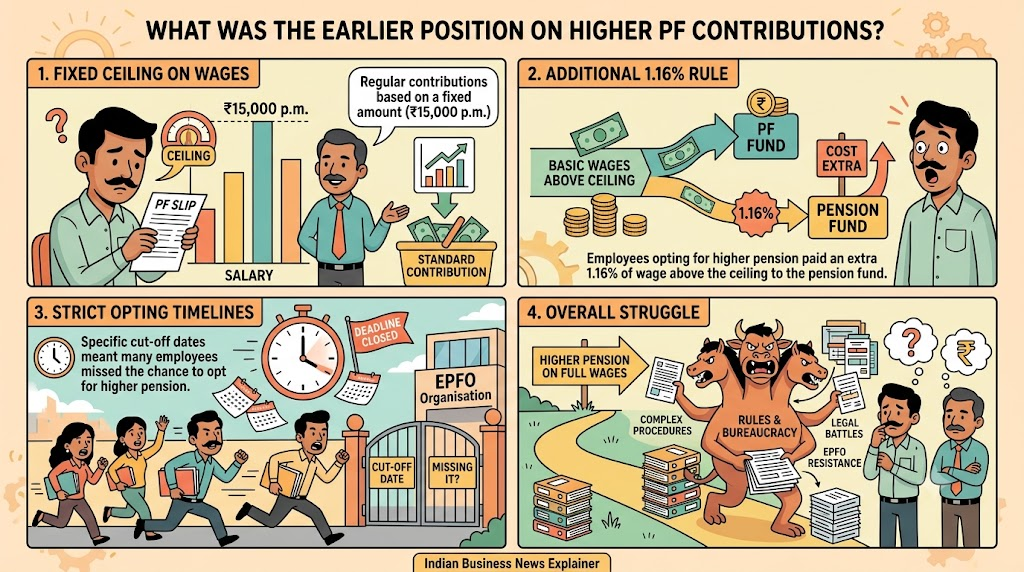
The ₹1,800 calculation is old. The wage ceiling rose from ₹6,500 to ₹15,000 on 1 September 2014, and the regular contribution rate produced the same ₹1,800 figure. Many establishments already restrict PF to that level. Others continued deducting 12% on higher basic wages because their employment contracts, trust rules, or internal benefits allowed it.
What changed in 2026 is the direct wording. Paragraph 18 says contributions are subject to the notified wage ceiling. Paragraph 19 separately allows an employee to make additional voluntary contributions on wages above it. The paragraph also permits the employee or employer to reduce or stop those extra contributions. Existing members do not leave EPF simply because their salary is above ₹15,000. Their membership continues. The choice concerns the additional deposit, not the entire PF account.
The LoansJagat review of the EPF Scheme, 2026, also points out that higher contributions often came from company arrangements before the latest notification. Its reading is useful for employees checking a salary option form. A lower deduction should be treated as a transfer from retirement savings to current income, rather than a salary hike created by the government.
For the employee earning ₹50,000 in applicable wages, that means the ₹4,200 difference needs a job from the first month. It may go towards debt, insurance, an emergency account or a long-term investment. Leaving it unassigned usually turns the choice into higher spending.
Employers will have to explain the payroll impact before accepting a request. In a fixed CTC structure, lowering PF may change the employee contribution, the employer contribution or another salary component. Some companies may retain their higher contribution as a benefit. Others may restrict their share to the statutory ceiling. An employee should ask for both calculations in writing before signing an option form.
Payroll teams must also check whether the higher deduction came from an individual request, a company-wide policy, or the rules of an exempted PF trust. The scheme allows additional contributions to be reduced or stopped, but internal forms and payroll cut-off dates can still apply. A request submitted after the monthly payroll closes may take effect from the following salary cycle.
EPFO remains focused on preserving retirement savings. The Central Board of Trustees recommended an EPF interest rate of 8.25% for FY 2025-26 at its 239th meeting in New Delhi on 2 March 2026. The Press Information Bureau published the announcement at 3:37 pm on the same date under Release ID 2234502. It said the government would formally notify the rate before EPFO credited the interest to members’ accounts.
That rate helps explain the long-term concern. Every deposit skipped today also loses the interest it could have earned over several years. The effect is small in the next salary cycle. Across 20 or 30 years, the gap can become much larger.
A salary slip gives the first answer. Employees should look at the monthly employee PF deduction and check whether it is already ₹1,800. If it is, choosing the statutory limit will not create any fresh increase in take-home pay.
The second check concerns the employer’s share. Employees should ask whether the company contributes to the full applicable wages or only up to ₹15,000. A reduction in the employer contribution can weaken the long-term benefit far more than expected.
Tax treatment needs attention as well. Employees following the old tax regime may use eligible EPF contributions within the overall Section 80C limit. Reducing the contribution may leave part of that limit unused. Under the new tax regime, the calculation is different, particularly for employer contributions.
Age also changes the answer. A worker in the first 10 years of employment has more time for contributions to earn interest. Someone close to retirement has fewer years left, though reducing deposits at that stage can still affect the final balance.
The ₹1,800 EPF option may help employees facing loan repayments, weak emergency savings or urgent household costs. It may also suit workers who already invest through another retirement route and can keep that investment running through salary changes.
For employees without a separate plan, continuing the higher contribution may remain the safer choice. Before reducing it, they should check the written payroll calculation, the employer’s contribution, and the tax effect. The extra salary should also be assigned in advance. Without that step, a useful monthly gain can quietly become a much smaller retirement account.
Has the EPF contribution rate been reduced to ₹1,800?
No. The regular contribution rate remains 12%. The ₹1,800 amount comes from applying 12% to the ₹15,000 statutory wage ceiling.
Can an employee reduce EPF contribution to ₹1,800 to increase take-home salary?
Yes, an employee earning above ₹15,000 a month may ask the employer to restrict the EPF deduction to ₹1,800, calculated as 12% of the statutory ₹15,000 wage ceiling.
Will the full difference appear in the employee’s salary?
Not necessarily. Employers may follow different CTC structures. Payroll should provide a written comparison showing the expected net salary.
Does the employer have to match contributions above ₹1,800?
No. The 2026 scheme permits an employer to match additional voluntary contributions, but it does not make matching compulsory.
Should I opt for ₹1,800 PF or 12%?
The user was asked to choose between the statutory ₹1,800 amount and 12% of basic pay. Commenters discussed compounding, mutual funds, and the effect on the monthly in-hand salary.
Can an employee stop the additional contribution later?
Paragraph 19 permits the employee or employer to reduce or stop additional voluntary contributions. The company may still require a form or payroll notice.
What should an employee do with the extra take-home salary?
The amount can be directed towards expensive debt, an emergency reserve, NPS or another long-term investment. An automatic transfer on salary day reduces the chance of accidental spending.









.png&w=3840&q=75)


