
By continuing, you agree to LoansJagat's Credit Report Terms of Use, Terms and Conditions, Privacy Policy, and authorize contact via Call, SMS, Email, or WhatsApp
Disclaimer: The information published on LoansJagat is intended for general informational and educational purposes only and should not be considered financial, legal, or investment advice. Interest rates, loan terms, statistics, and other data may change over time and may vary by lender or source. Please verify the latest information and consult a qualified financial advisor or the respective Bank/NBFC before making any financial decisions.
Subscribe Now
About the author

Arshathul Afia
Arshathul Afia is a journalism graduate and fintech content writer with 4+ years of experience in digital publishing and research-led writing. She has written 200+ articles covering personal finance, lending, banking, digital payments, credit, insurance, and major financial developments in India. At LoansJagat, she focuses on simplifying complex fintech news, RBI updates, loan-related changes, policy developments, and industry trends for everyday readers. Her journalism background helps her approach stories with research, context, and clarity, while her SEO experience ensures content remains discoverable and relevant. She aims to make financial news easier to understand, practical, and useful for readers across India.
Related Blog Post
Simplify All Your Loans Into One Affordable EMI

Customers Served

Debt Consolidated

1200+ Reviews

Locations in India
Club all Loans & Credit Card Bills into Single EMI

Quick Apply Loan
Consolidate your debts into one easy EMI.

Takes less than 2 minutes. No paperwork.

10 Lakhs+
Trusted Customers

2000 Cr+
Loans Disbursed

4.7/5
Google Reviews

50+
Banks & NBFCs Offers
Other services mentioned in this article
EPFO’s Form 121 now replaces Forms 15G and 15H for eligible TDS declarations, changing how members protect early provident fund withdrawals from deduction at source.
Form 121 became the required declaration for eligible EPF TDS claims across India from 1 April 2026, replacing Forms 15G and 15H for Tax Year 2026-27. According to Employees’ Provident Fund Organisation Circular No. WSU/TDS Issues/E-772040/2026-27/11, dated 13 April 2026, both taxpayers below 60 and those aged 60 or above must now use the consolidated document. EPFO, the Income Tax Department and the Central Board of Direct Taxes are handling different parts of the rollout.
The short-term risk is paperwork. A member may qualify for non-deduction but still face TDS after attaching an old form, entering an invalid PAN or sending the declaration after payment processing begins. A refund may later be claimed through the income-tax return, though that offers little relief when a worker needs the entire withdrawal during a job break. Over time, 1 common declaration should make filing easier and reduce confusion between the earlier age-based forms.
For employees, the biggest gain is 1 document in place of 2. A 35-year-old member and a resident senior citizen aged 65 will use Form 121, although each person must still meet the conditions prescribed for that category. The form is not compulsory for every withdrawal. It is meant for eligible residents who expect nil tax liability and want specified income paid without deduction.
The change reaches beyond a small group of early PF claimants. EPFO’s official note said financial institutions, banks and companies received around 90 lakh Form 15G declarations and about 1 crore Form 15H declarations every year during the previous 5 years. Those figures cover several types of income, not only EPF. Form 121 can also cover specified interest, rent, dividends, insurance commission and certain life insurance payments.
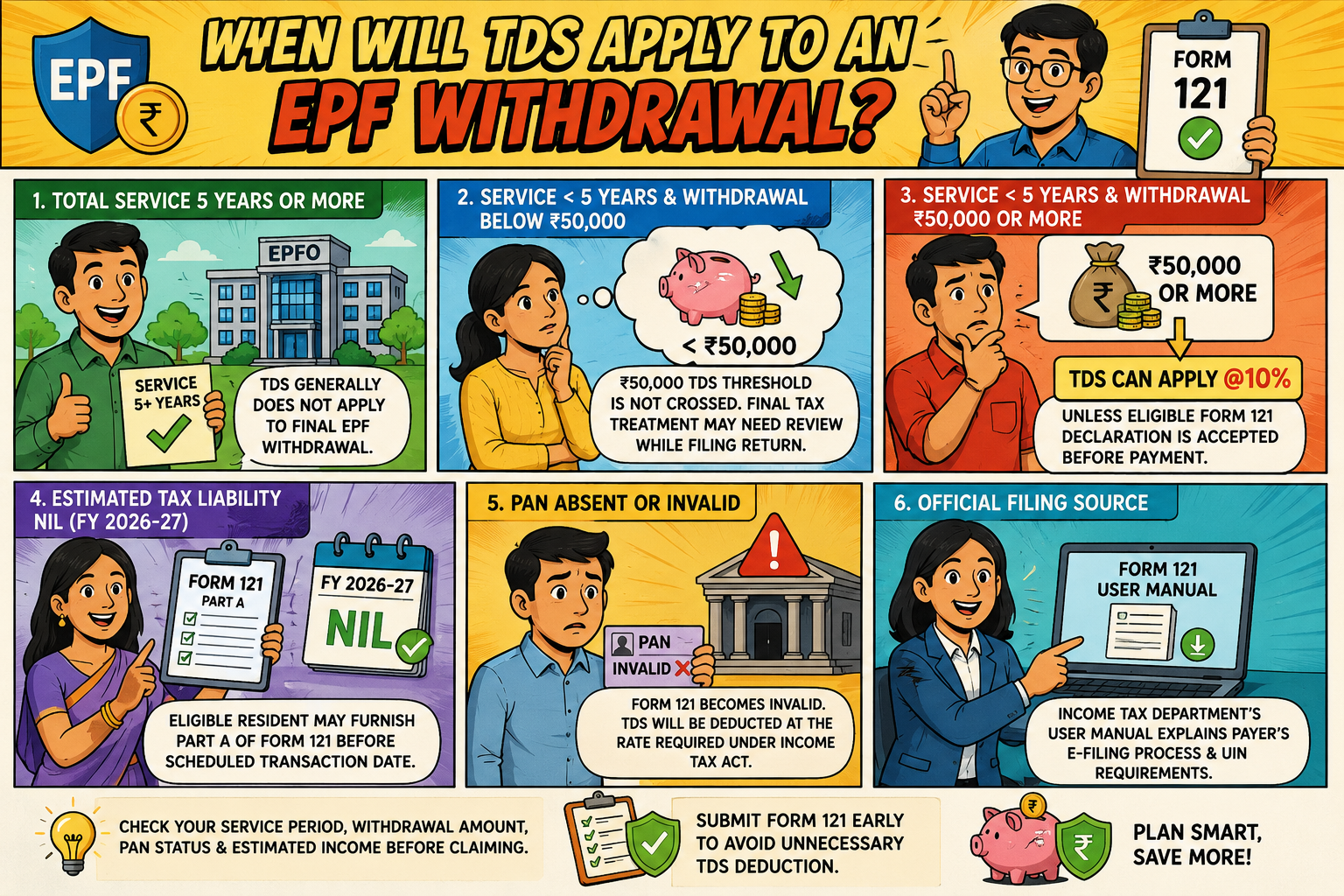
A member should first check the total service period, not merely the length of the latest job. Service completed with an earlier employer can be added when the old PF balance was transferred. The practical position is shown below.
The table deals with TDS at the payment stage. It does not decide whether the EPF withdrawal is finally taxable. A member who receives the payment without deduction may still owe tax when the annual income estimate was incorrect. In the reverse case, a person with no final tax liability may claim eligible TDS credit or a refund through the return.
Form 121 should be treated as a cash-flow safeguard, not a tax-free certificate. LoansJagat’s analysis of early EPF withdrawals points to the strain an avoidable deduction can place on salaried employees during a gap between jobs. The worker should examine the withdrawal amount, combined service and full annual income before signing the declaration. Salary received earlier in the year, bank interest, rent, dividends or taxable gains can alter the calculation.
The safer process starts before the claim is filed. The member should verify PAN in the UAN record, add service completed across transferred PF accounts and estimate income for the whole tax year. Part A must carry accurate personal and income details. A copy should be retained as well. Once EPFO credits or releases the payment, Form 121 cannot undo TDS already deducted at source.
The CBDT notified the Income Tax Rules, 2026, through G.S.R. 198(E) on 20 March 2026. The rules took effect from 1 April 2026. Rule 211 prescribed Form 121 for declarations under Section 393(6) of the Income Tax Act, 2025, bringing the earlier Form 15G and Form 15H processes under a consolidated format.
On 28 March 2026, CBDT issued Notification No. 01/CPC(TDS)/2026. It laid down the procedure for generating a unique identification number and filing Part B by the payer. EPFO followed with Circular No. WSU/TDS Issues/E-772040/2026-27/11 on 13 April 2026, directing field offices to shift to Form 121.
The transition instruction also dealt with claims already carrying an older declaration. EPFO offices were not expected to return such claims only because Form 15G or Form 15H had been attached after 1 April. Officials had to obtain Form 121 from the member and continue processing under the new procedure. Signed physical forms were allowed while the electronic facility was being prepared.
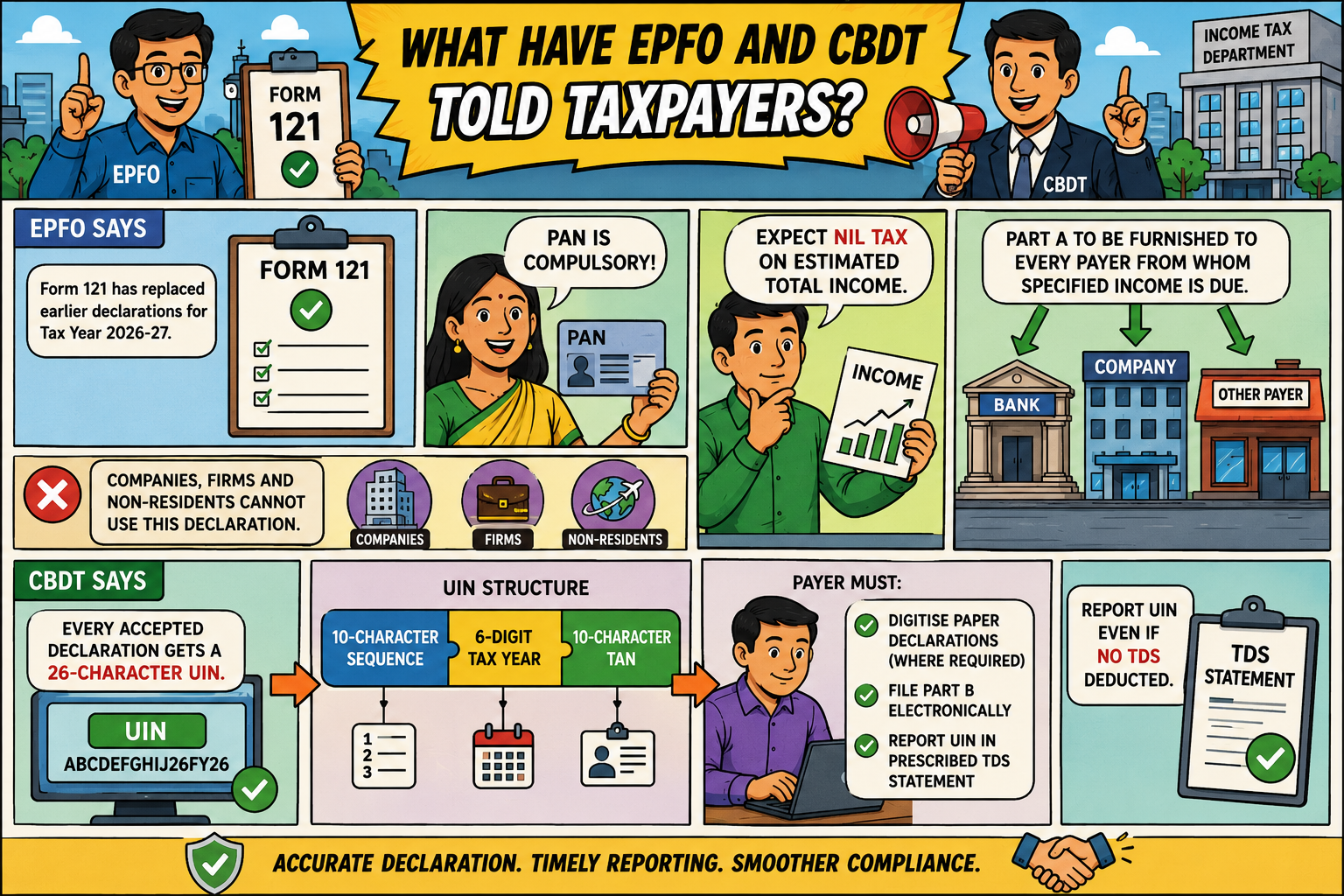
EPFO’s position is direct. Form 121 has replaced the earlier declarations for Tax Year 2026-27, PAN is compulsory, and the taxpayer must expect nil tax on estimated total income. The member must furnish Part A to every payer from whom specified income is due. Companies, firms and non-residents cannot use the declaration under the eligibility listed in the official guidance.
CBDT has placed reporting work on the payer as well. Every accepted declaration receives a 26-character UIN. It includes a 10-character sequence, the 6-digit tax year and the payer’s 10-character TAN. The payer must digitise paper declarations where required, file Part B electronically and report the UIN in the prescribed TDS statement, even when no tax was deducted.
Form 121 changes the declaration process for EPF TDS relief from 1 April 2026. It does not provide a blanket exemption. The 5-year service test, ₹50,000 threshold, PAN requirement and full-year income estimate still need attention.
Timing will decide whether the new form helps. The PAN, transferred service and projected annual income should be checked before the withdrawal claim reaches payment. An outdated form can delay processing or lead to an avoidable deduction. Form 121, filed early with accurate details, reduces that risk.
It is a declaration used by eligible taxpayers to receive specified income without TDS deduction.
No. It applies only when TDS may arise and the member meets the nil-tax conditions.
No. Form 121 applies to declarations for tax years beginning from 1 April 2026.
No. It may stop TDS, while final tax depends on service, income and available exemptions.
The member should submit it before EPFO credits or pay the amount covered by the declaration.









.png&w=3840&q=75)


