

By continuing, you agree to LoansJagat's Credit Report Terms of Use, Terms and Conditions, Privacy Policy, and authorize contact via Call, SMS, Email, or WhatsApp
Disclaimer: The information published on LoansJagat is intended for general informational and educational purposes only and should not be considered financial, legal, or investment advice. Interest rates, loan terms, statistics, and other data may change over time and may vary by lender or source. Please verify the latest information and consult a qualified financial advisor or the respective Bank/NBFC before making any financial decisions.
Subscribe Now
About the author

Arshathul Afia
Arshathul Afia is a journalism graduate and fintech content writer with 4+ years of experience in digital publishing and research-led writing. She has written 200+ articles covering personal finance, lending, banking, digital payments, credit, insurance, and major financial developments in India. At LoansJagat, she focuses on simplifying complex fintech news, RBI updates, loan-related changes, policy developments, and industry trends for everyday readers. Her journalism background helps her approach stories with research, context, and clarity, while her SEO experience ensures content remains discoverable and relevant. She aims to make financial news easier to understand, practical, and useful for readers across India.
Related News
Simplify All Your Loans Into One Affordable EMI

Customers Served

Debt Consolidated

1200+ Reviews

Locations in India
Club all Loans & Credit Card Bills into Single EMI

Quick Apply Loan
Consolidate your debts into one easy EMI.

Takes less than 2 minutes. No paperwork.

10 Lakhs+
Trusted Customers

2000 Cr+
Loans Disbursed

4.7/5
Google Reviews

50+
Banks & NBFCs Offers
EPFO’s 2026 rules allow eligible members across India to access up to 75% of PF savings after 12 months, while 25% stays protected for retirement.
The Employees’ Provident Fund Organisation has widened access to PF savings for members across India under its revised 2026 withdrawal framework. The latest official confirmation came from the Press Information Bureau on 4 August 2026, when Regional Provident Fund Commissioner-I Uttam Prakash said eligible members with 1 year of contributory service could withdraw up to 75% of their eligible PF balance. The change covers workers seeking money for illness, education, marriage, housing and special needs.
For salaried households, this creates quicker access to a large part of their long-term savings during a cash shortage. But it does not turn the entire PF account into money that can be withdrawn at any point. A 25% portion is generally protected, while complete settlement after an ordinary job exit follows a longer timeline. That may help retirement savings grow, but a worker facing an extended period without salary could find the restriction difficult.
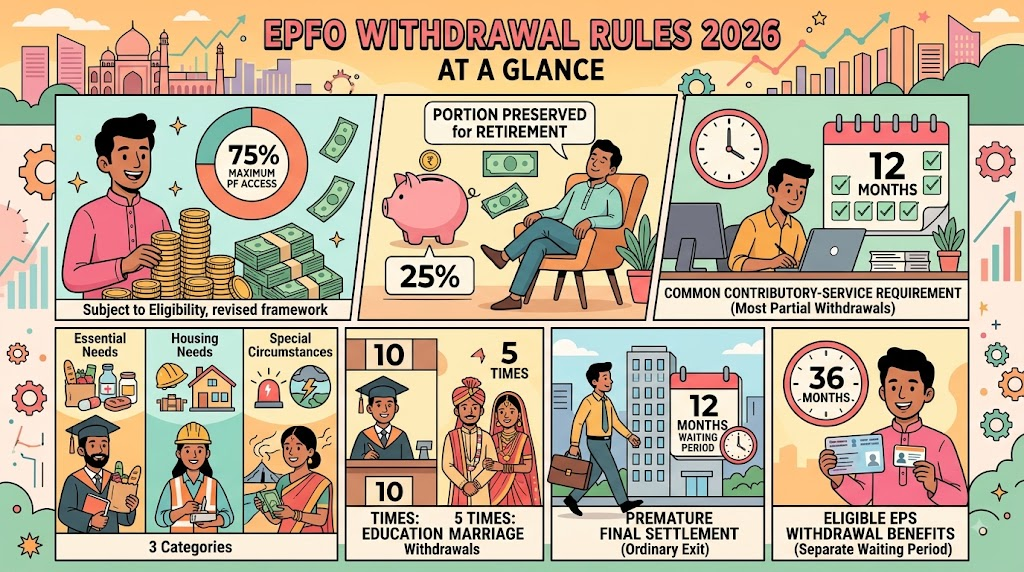
The immediate benefit is that PF money becomes easier to access without forcing employees through several different service requirements. Before the reform, withdrawal conditions changed according to the purpose, and some service requirements stretched much longer. The revised system uses a common 12-month membership condition for most partial claims.
Illness, education and marriage are grouped under essential needs, while housing and special circumstances have separate routes. The Ministry of Labour and Employment’s Year End Review 2025, published on 30 December 2025, recorded that the earlier 13 provisions had been brought into 3 groups. The change can be significant for a young salaried employee who has not spent several years in the EPF system.
A member who has completed the required contributory service may now have a route to savings for a hospital expense, education payment or housing requirement. The amount is still subject to the eligible balance, past claims and applicable withdrawal conditions. “Up to 75%” is therefore a ceiling, not a guarantee that every applicant will receive exactly 75%.
Before looking at individual situations, the main limits can be compared in 1 place.
The 29 June 2026 notification was significant as it transferred the reforms to the new statutory framework in the Code on Social Security, 2020. The G.S.R. 525(E) replaced the Employees’ Provident Fund Scheme, 1952, and put it into force. A government release dated 29 July 2026 also specifically mentioned the provisions of G.S.R. 525(E) while elaborating on the provisions under the new EPF Scheme.
The percentage sounds large, but an actual rupee example shows where both the benefit and restriction appear. A LoansJagat analysis uses an eligible PF balance of ₹4,00,000. At 75%, the member could access up to ₹3,00,000, leaving ₹1,00,000 in the account. For a household spending ₹50,000 each month, ₹3,00,000 covers roughly 6 months of expenses.
That calculation shows the trade-off more effectively than the percentage alone. A worker who finds another job within a few months receives a sizable temporary cushion without exhausting retirement savings. Someone remaining unemployed for close to 12 months could run through the accessible ₹3,00,000 much earlier. In that case, the protected ₹1,00,000 may be useful for retirement later but unavailable when the household is still coping with lost income.
EPFO officials are stressing digital processing alongside the revised withdrawal limits. In the PIB release dated 4 August 2026, Uttam Prakash urged members to keep their Universal Account Number authenticated and linked with Aadhaar, PAN and a mobile number.
EPFO reported that 84% of Form-31 advance claims nationally were being auto-settled, while 50% of Form-19 final-settlement claims were being auto-settled. These figures were released by PIB on the same date, rather than being estimates from private reports. Legal experts have focused more closely on workers who leave employment without another salary immediately available.
Soayib Qureshi, Partner at PSL Advocates & Solicitors, said in comments reported on 17 October 2025 that the longer withdrawal period could create financial pressure for households relying on PF for rent, loan repayments or medical costs during unemployment. His concern was not about partial access itself. It was about how long a worker could remain without access to the remaining corpus when a job search runs for several months.
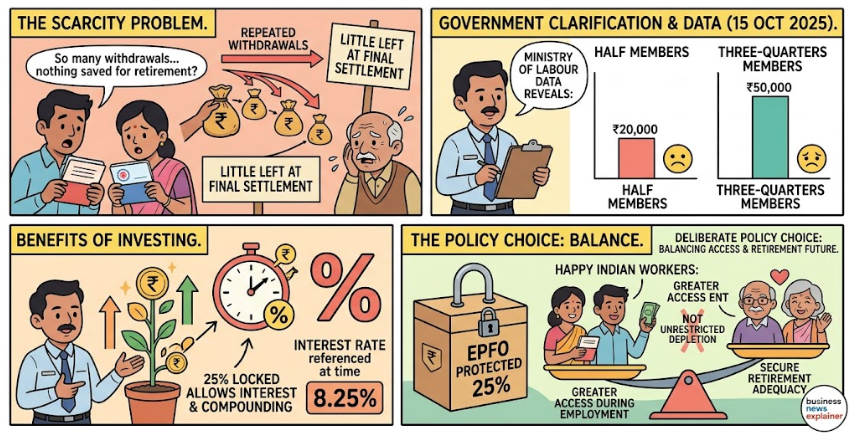
The government’s defence of the 25% provision is based on retirement adequacy. On 15 October 2025, the Ministry of Labour and Employment published its official clarification, which stated that many members had very little in their accounts at the time of withdrawal as a result of repeated withdrawals. According to data released by the government on that day, half of the members had less than ₹20,000 at final settlement, and three-quarters of the members had less than ₹50,000 at final settlement.
The Ministry argued that leaving 25% invested allows the member to continue receiving interest and compounding benefits. The EPF interest rate referred to by the government at the time was 8.25%. The policy choice is therefore deliberate: greater access during employment, but not unrestricted depletion of the retirement account.
There is still a practical weakness. A retirement buffer has value when income is stable again. During prolonged unemployment, the same buffer can look like money the member cannot use when monthly bills are arriving.
The reform began at EPFO’s 238th Central Board of Trustees meeting on 13 October 2025, chaired by Union Labour and Employment Minister Mansukh Mandaviya. The Board approved the consolidation of 13 partial-withdrawal provisions into 3 broad categories. It also backed a common 12-month service threshold instead of different requirements that could extend to several years.
The permitted frequency also changed. Education withdrawals went up to 10 during membership, and marriage withdrawals to 5. Earlier, marriage and education together had a combined limit of 3 partial withdrawals. Special-circumstance claims were simplified as well, removing the need to fit every application into older specified reasons such as natural calamity or establishment closure.
The legal transition followed in 2026. EPFO’s 239th CBT meeting on 2 March 2026 approved the new EPF, EPS and EDLI schemes aligned with the Code on Social Security, 2020. The Employees’ Provident Fund Scheme, 2026 was then notified on 29 June 2026 through G.S.R. 525(E).
The EPFO withdrawal rules of 2026 give employees much easier access to PF savings during their working years. A common 12-month membership condition, 3 broader claim categories, and access to up to 75% can reduce the need to wait years before using PF for an eligible expense.
The difficult part begins when employment ends. Access to 75% may help a household through the early months, while the protected 25% preserves retirement savings and continues earning applicable interest. Yet a long job search can stretch beyond the money available immediately.
For members, the biggest mistake would be treating every EPFO withdrawal as the same claim. A partial advance, unemployment withdrawal, final EPF settlement, and EPS withdrawal benefit have different conditions. Checking the claim type, contributory service, UAN, Aadhaar, bank details, and employment-exit record before applying can prevent unnecessary delays.
Eligible members with 12 months of contributory service can access up to 75%, subject to claim conditions.
No. The 25% is protected during applicable partial withdrawals and follows separate final-settlement conditions after employment ends.
Up to 75% may be available during unemployment, while complete settlement follows the prescribed waiting period.
The revised EPFO framework permits education-related partial withdrawals up to 10 times during a member’s service.
No. The 36-month waiting period relates to eligible EPS withdrawal benefits, not ordinary partial EPF claims.









.png&w=3840&q=75)


