
By continuing, you agree to LoansJagat's Credit Report Terms of Use, Terms and Conditions, Privacy Policy, and authorize contact via Call, SMS, Email, or WhatsApp
Disclaimer: The information published on LoansJagat is intended for general informational and educational purposes only and should not be considered financial, legal, or investment advice. Interest rates, loan terms, statistics, and other data may change over time and may vary by lender or source. Please verify the latest information and consult a qualified financial advisor or the respective Bank/NBFC before making any financial decisions.
Subscribe Now
About the author

Arshathul Afia
Arshathul Afia is a journalism graduate and fintech content writer with 4+ years of experience in digital publishing and research-led writing. She has written 200+ articles covering personal finance, lending, banking, digital payments, credit, insurance, and major financial developments in India. At LoansJagat, she focuses on simplifying complex fintech news, RBI updates, loan-related changes, policy developments, and industry trends for everyday readers. Her journalism background helps her approach stories with research, context, and clarity, while her SEO experience ensures content remains discoverable and relevant. She aims to make financial news easier to understand, practical, and useful for readers across India.
Related Blog Post
Simplify All Your Loans Into One Affordable EMI

Customers Served

Debt Consolidated

1200+ Reviews

Locations in India
Club all Loans & Credit Card Bills into Single EMI

Quick Apply Loan
Consolidate your debts into one easy EMI.

Takes less than 2 minutes. No paperwork.

10 Lakhs+
Trusted Customers

2000 Cr+
Loans Disbursed

4.7/5
Google Reviews

50+
Banks & NBFCs Offers
Other services mentioned in this article
The EPFO wage ceiling hike delay keeps payroll costs unchanged, but employees near ₹25,000 lose a wider compulsory PF cover for now.
Key Highlights
Delaying the EPFO wage ceiling change means employees making ₹15,000–₹25,000 stand to lose the most. These employees could have come under mandatory PF after this change. This has been postponed for now.
Different employees are affected differently. Some may see their paychecks take home a bigger amount, while others are giving up a better retirement savings option. This is especially harsh for employees who do not save outside of their PF.
It has been alleged that the Centre has frozen the plan of elevating the EPFO wage ceiling from ₹15,000 to ₹25,000. According to Moneycontrol, the plan has been frozen to not burden employers with PF obligations while they are trying to adjust to the new labor codes.
This is a joint decision of the central government, the employees' MP, EPFO, the employers, and employees whose wages are pegged to the ₹15,000 wage ceiling. The immediate effect is that companies will have to spend less on employee PF, and employees whose wages are in the ₹15,000 to ₹25,000 band will see their salaries go up. The longer-term impact is that employees will have to wait longer for the compulsory PF.

The pause hits workers who earn just above the present wage ceiling. Under the existing EPF structure, employees drawing wages up to ₹15,000 per month are covered mandatorily, while employees above that level may not automatically enter the statutory net at the time of joining. The Ministry of Labour and Employment, through PIB, said on July 24, 2023, that employees contribute 12% of wages and employers also contribute 12%.
If the ceiling had moved to ₹25,000, many more workers in factories, retail chains, logistics firms, offices, hotels and service units could have come under mandatory EPF cover. Their monthly take-home pay may have reduced because of a higher PF deduction. Still, the retirement pool would have grown month after month. That is the part many workers miss when only the salary-slip deduction is discussed.
For an employee earning around ₹22,000 or ₹24,000, the delay can feel useful in the present month. Rent, fuel, school fees and loan EMIs take cash first. But for someone without separate long-term savings, the missed PF contribution can become a future gap. The loss does not hurt on payday. It appears later, when the employee checks retirement savings after 10 or 15 years.
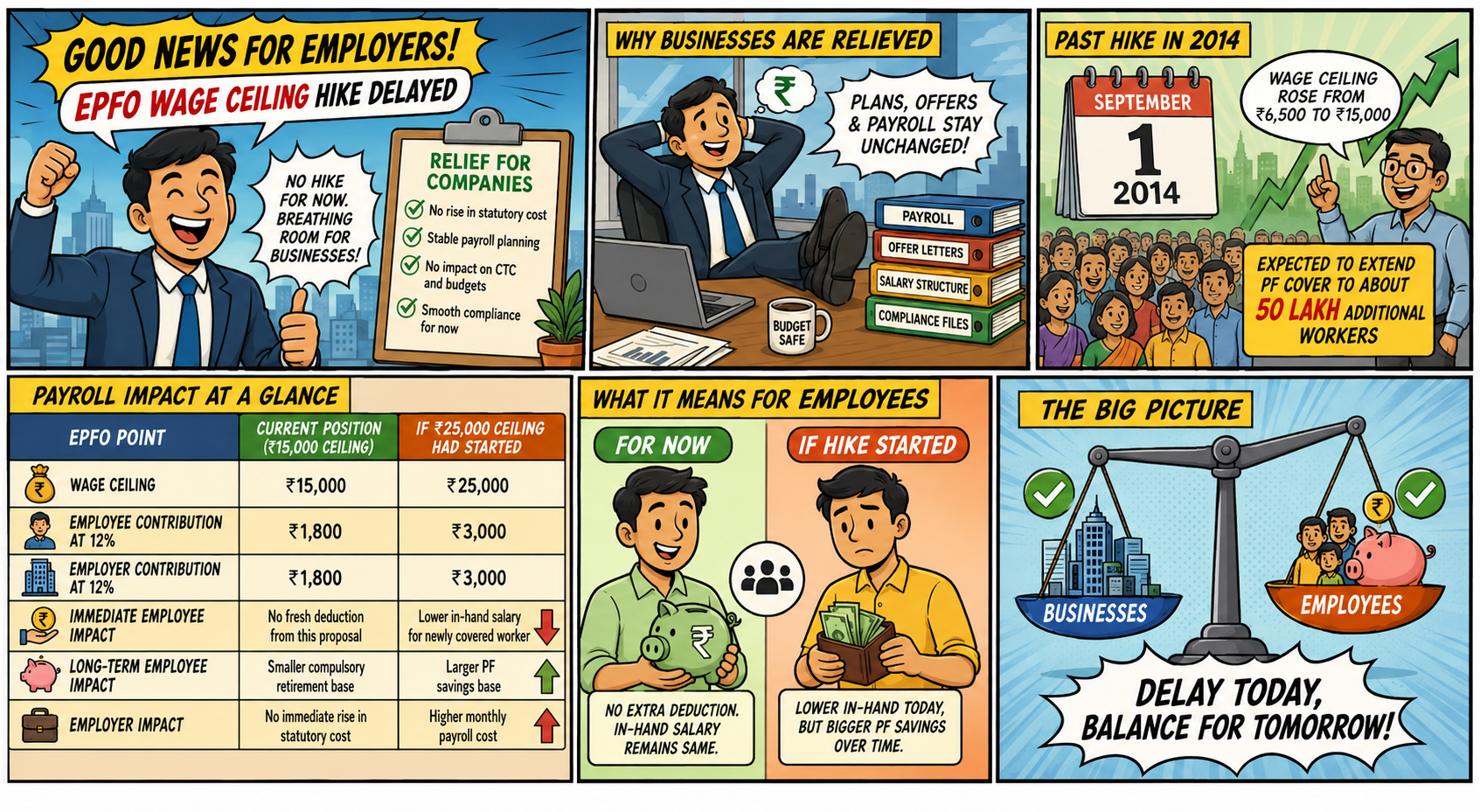
Companies get immediate breathing room because their statutory contribution does not rise for now. At present, the common mandatory PF calculation is linked to the ₹15,000 wage ceiling. A higher ceiling would have changed monthly payroll cost, cost-to-company breakups, offer letters, salary structures and compliance files.
The last major rise shows why employers track this closely. In 2014, the wage ceiling moved from ₹6,500 to ₹15,000 with effect from September 1, 2014. The Press Information Bureau said on September 8, 2014, that the move was expected to extend PF cover to about 50 lakh additional workers. A similar rise now would again touch the employer cost and employee deduction at the same time.
Before the table, the payroll difference should be read in simple terms. The proposal was not only a legal edit. It would have changed the monthly amount deducted and contributed for each eligible employee.
The table clarifies the reason for the pause. A price increase of ₹1,800 to ₹3,000 for each side would not impact all companies equally, but it would negatively affect labor-intensive companies quickly. Staffing firms, labor-intensive manufacturing, retail, and service firms that employ large numbers of lower-wage workers will require new budgets.
The wage ceiling issue gained fresh attention in January 2026. News On AIR reported on January 6, 2026, that the Supreme Court directed the central government and EPFO to decide within 4 months on revising the wage ceiling under the Employees’ Provident Fund Scheme.
The petition noted that for approximately eleven years, the ceiling remained at ₹15,000. Given this, the proposed ceiling of ₹25,000 was closely monitored by the employee, trade union, and employer communities. Such a proposal was considered to be a possible response to the years of increasing salaries in the large metropolitan cities, where even the lowest-level monthly salaries frequently exceed ₹15,000.
The previous history is important as well. The ceiling was increased to ₹15,000 from ₹6,500 in 2014. Since then, the formal wage ceiling has not kept pace with the cost of living, including rent, food, school fees, and transportation. This is the reason that the labor parties demand a new limit, while the employers request time and concerted discussions.
Experts usually look at this issue from 2 sides. The first side is social security. A higher EPFO wage ceiling can bring more workers into compulsory retirement savings. It can also improve pension-linked protection and insurance-linked cover for employees who may not save regularly on their own.
The second side is affordability. A higher ceiling cuts the monthly take-home salary for newly covered employees and raises employer costs at the same time. That is why the timing becomes tricky. A sudden change can disturb payroll budgets, especially when companies are already preparing for labour code implementation.
A practical route would be a phased rollout. The government can notify a future date, give companies a transition period, and ask employers to explain salary slip changes before higher deductions begin. Employees should also get a simple option sheet from HR showing current PF, proposed PF, in-hand salary change and long-term retirement benefit.
According to LoansJagat, workers should read the salary slip before reacting. The LoansJagat EPF explainer published on July 7, 2026, explains that ₹15,000 at 12% gives a monthly statutory contribution of ₹1,800. If an employee already contributes above the statutory cap, the reported delay may not change the monthly salary at all. If the employer contributes only up to the cap, the worker should ask whether voluntary PF is allowed.
The EPFO ₹25,000 wage ceiling hike has been delayed, not cancelled. Companies get cost relief for now. Employees keep more monthly cash if they fall near the proposed wage band, but many also lose a chance to enter wider compulsory PF cover.
Any real updates should be sent through official communication. Until then, the current ceiling stands at ₹15,000. Employees should be checking their payslips and should ask their HR about PF calculations and should not believe that the reported delays are equal for all.
What is the update on the EPFO wage ceiling?
The revision to the UP EPFO Wage Ceiling, which proposed to increase the ceiling to ₹25,000, is currently on hold. The existing limit remains, and employees waiting for an enhancement to PF coverage will have to wait for the next official update.
What is the current EPFO wage ceiling?
For now, the statutory EPFO wage ceiling remains ₹15,000 per month. This is the figure payroll teams still use while calculating mandatory PF coverage.
How much is the monthly PF contribution at ₹15,000?
At the present ceiling, 12% comes to ₹1,800 a month from the employee’s side. The employer also puts in a contribution, though the final split can depend on the salary structure and rules followed by the company.
Who will be affected by the delay?
Workers earning between ₹15,000 and ₹25,000 may miss wider compulsory PF cover for now.
Why are companies relieved?
Companies avoid an immediate rise in statutory payroll cost and compliance work.









.png&w=3840&q=75)


