
Disclaimer: The information published on LoansJagat is intended for general informational and educational purposes only and should not be considered financial, legal, or investment advice. Interest rates, loan terms, statistics, and other data may change over time and may vary by lender or source. Please verify the latest information and consult a qualified financial advisor or the respective Bank/NBFC before making any financial decisions.
Subscribe Now
About the author

Arshathul Afia is a journalism graduate and fintech content writer with 4+ years of experience in digital publishing and research-led writing. She has written 200+ articles covering personal finance, lending, banking, digital payments, credit, insurance, and major financial developments in India. At LoansJagat, she focuses on simplifying complex fintech news, RBI updates, loan-related changes, policy developments, and industry trends for everyday readers. Her journalism background helps her approach stories with research, context, and clarity, while her SEO experience ensures content remains discoverable and relevant. She aims to make financial news easier to understand, practical, and useful for readers across India.
Related News
Simplify All Your Loans Into One Affordable EMI

Customers Served

Debt Consolidated

1200+ Reviews

Locations in India
Club all Loans & Credit Card Bills into Single EMI

Quick Apply Loan
Consolidate your debts into one easy EMI.

Takes less than 2 minutes. No paperwork.

10 Lakhs+
Trusted Customers

2000 Cr+
Loans Disbursed

4.7/5
Google Reviews

50+
Banks & NBFCs Offers
Other services mentioned in this article
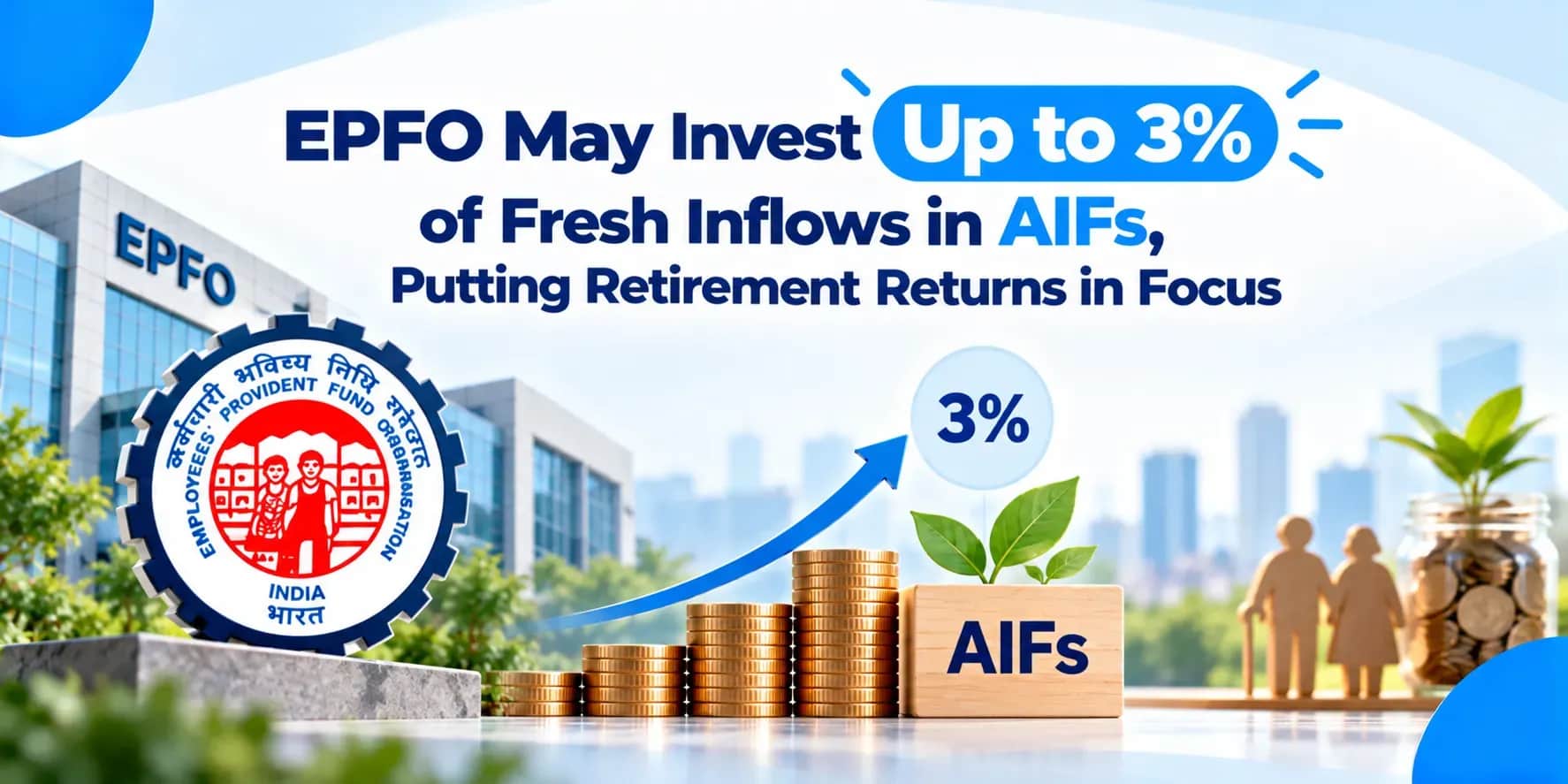
EPFO is considering AIF investments from fresh annual inflows, bringing potential returns and investment risks into focus for salaried employees ahead of a reported review.
Key Highlights
The Employees’ Provident Fund Organisation (EPFO) is preparing guidelines for investments in alternative investment funds (AIFs), journalist Shiva Rajora’s 29 October 2026 report said. The proposed allocation covers Category I and Category II AIFs regulated by the Securities and Exchange Board of India (SEBI). EPFO’s investment committee discussed it on 22 October 2026.
For salaried employees across India, the proposal concerns how EPFO invests retirement savings and earns the income supporting annual interest payments. The plan remains under consideration, with the reported allocation linked to fresh accretions rather than EPFO’s entire accumulated corpus.
The 2021 framework already permitted EPFO to invest in eligible AIFs, though it had not made such investments, according to the report. The current proposal concerns starting those investments under operational guidelines that remain subject to approval. Category I AIFs include venture capital, SME and infrastructure funds. Category II includes private equity and debt funds. EPFO would invest through pooled funds, giving its portfolio exposure to businesses and projects selected by professional managers.
The October report linked the discussions to a September 2026 communication from the Department for Promotion of Industry and Internal Trade seeking EPFO’s participation in Startup India Fund of Funds 2.0. It identified the National Investment and Infrastructure Fund and SIDBI’s fund-of-funds route as options under consideration.
For an EPF member, the distinction is between EPFO’s investment earnings and the interest credited to an individual account. An AIF’s gain would form part of EPFO’s overall financial position. It would not pass directly into members’ balances as a separate return. The trustees recommend the annual EPF rate, which requires government approval.
EPFO notified 8.25% for FY 2025–26, according to the government news release dated 1 July 2026. The earlier EPF interest-credit update concerns that annual exercise. The AIF proposal addresses a different stage: how EPFO deploys money before assessing its earnings and recommending interest.
The Labour Ministry’s April 2021 Monthly Progress Report records amendments dated 29 April 2021 that added eligible Category I and II AIF units to the investment pattern. A government release dated 3 February 2023, item 50, also records the earlier permission.
EPFO’s portfolio-manager tender dated 27 June 2025 reproduces the investment pattern. The reported allocation and existing ceiling serve different purposes.
Fresh accretions include uninvested balances and receipts such as contributions, investment income and maturity proceeds, reduced by obligatory outgo. The allocation cannot be calculated solely from monthly salary deductions. The ministry’s April 2021 progress report also specifies fund eligibility, exposure limits and restrictions on overseas investments.
Shrikant Goyal, Managing Director of Getfive Funds, supported diversification in comments published on 30 October 2026. “If implemented prudently, this could help diversify its portfolio while channelling capital into India’s growth story,” he said.
For employees, the allocation ceiling alone offers an incomplete measure of risk. Fund selection determines which businesses receive capital, while the exit process determines when gains become available as cash. A small allocation can limit exposure without making the underlying investments safe.
EPFO’s proposed AIF allocation concerns retirement fund management, with potential earnings weighed against private-market risks. Existing permission provides the framework; the reported proposal concerns its use. For salaried employees, the relevant test is how investment income supports retirement savings over time, after accounting for losses, costs and the period required to recover capital.
The reported proposal applies to EPFO’s fresh annual accretions. It does not allocate 3% of each employee’s existing PF balance separately. EPFO manages investments at fund level under the applicable investment pattern.
No. EPFO’s overall earnings and financial obligations influence the annual interest decision. The trustees recommend a rate for government approval. An AIF’s performance would contribute to the wider portfolio rather than determine members’ interest on its own.
EPFO must follow its investment pattern and subscriber-focused safeguards. Private-market investments carry loss and liquidity risks, even within allocation limits. The proposed AIF exposure should therefore be assessed through its eligibility conditions, fund selection and oversight.
EPF pays an annually declared interest rate, but EPFO’s underlying portfolio includes more than debt instruments. Members assessing their retirement holdings should distinguish the EPF account’s interest mechanism from the assets EPFO holds to generate income.
The reports dated 29–30 October 2026 describe the allocation as under consideration. Existing government permission for eligible AIF investments dates back to April 2021; that permission and approval of the reported allocation are separate decisions.
Start your journey today
Apply Now*T&C apply











