
By continuing, you agree to LoansJagat's Credit Report Terms of Use, Terms and Conditions, Privacy Policy, and authorize contact via Call, SMS, Email, or WhatsApp
Disclaimer: The information published on LoansJagat is intended for general informational and educational purposes only and should not be considered financial, legal, or investment advice. Interest rates, loan terms, statistics, and other data may change over time and may vary by lender or source. Please verify the latest information and consult a qualified financial advisor or the respective Bank/NBFC before making any financial decisions.
Subscribe Now
About the author

Arshathul Afia
Arshathul Afia is a journalism graduate and fintech content writer with 4+ years of experience in digital publishing and research-led writing. She has written 200+ articles covering personal finance, lending, banking, digital payments, credit, insurance, and major financial developments in India. At LoansJagat, she focuses on simplifying complex fintech news, RBI updates, loan-related changes, policy developments, and industry trends for everyday readers. Her journalism background helps her approach stories with research, context, and clarity, while her SEO experience ensures content remains discoverable and relevant. She aims to make financial news easier to understand, practical, and useful for readers across India.
Related Blog Post
Simplify All Your Loans Into One Affordable EMI

Customers Served

Debt Consolidated

1200+ Reviews

Locations in India
Club all Loans & Credit Card Bills into Single EMI

Quick Apply Loan
Consolidate your debts into one easy EMI.

Takes less than 2 minutes. No paperwork.

10 Lakhs+
Trusted Customers

2000 Cr+
Loans Disbursed

4.7/5
Google Reviews

50+
Banks & NBFCs Offers
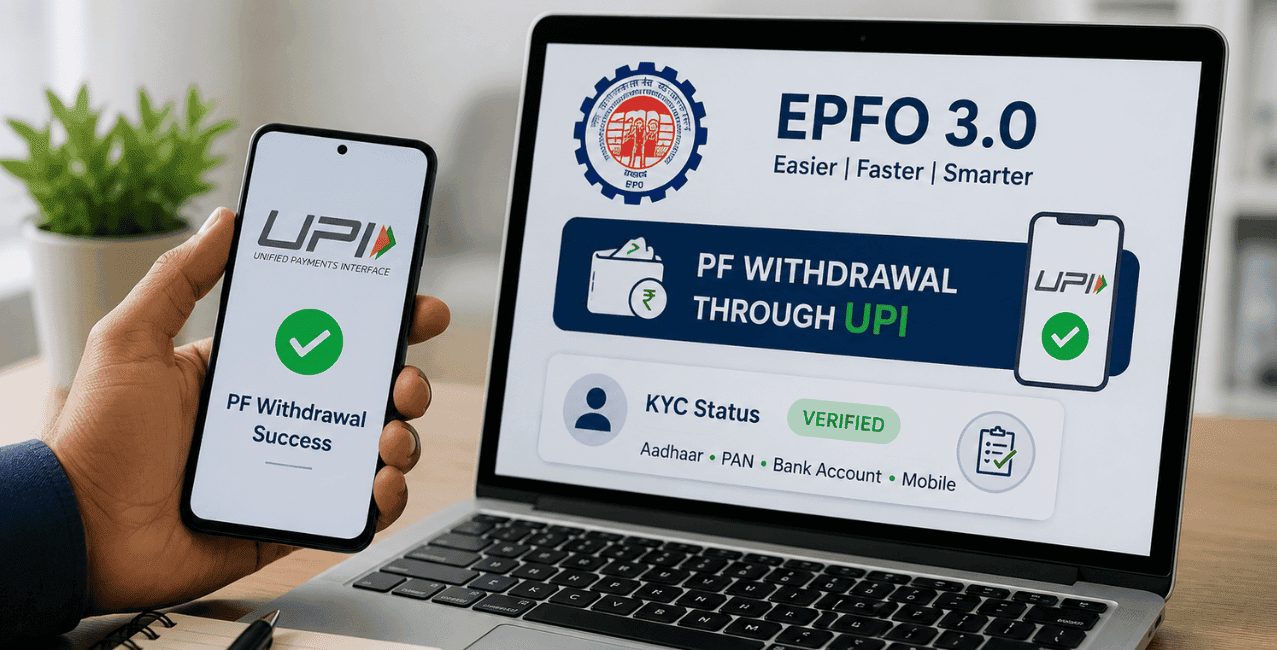
EPFO members may soon file PF claims through BHIM, but the service remains unavailable until the organisation issues final nationwide operating instructions for public use.
For salaried workers, the immediate gain could be fewer filing steps and quicker access during illness, unemployment or another permitted need. Over time, the service may reduce EPFO office visits and payments to unofficial agents. There are drawbacks. An Aadhaar mismatch, an inactive bank account or an incomplete employment record could still stop a claim. Fraudsters may also circulate fake activation links before EPFO opens the genuine facility.
A familiar mobile route may help members who use UPI every day but struggle with the EPFO portal. A garment worker in Tiruppur, a security guard in Noida or an employee who returned home after losing a job could avoid moving across several web pages. The approved sum would enter a verified bank account. It would not stay in a separate PF wallet.
The impact may be stronger in small towns and industrial belts where an office visit costs travel money and a working day. BHIM could shorten the route from claim submission to payment after approval. It cannot override PF withdrawal rules. EPFO must still verify identity, account ownership, service details and the selected claim category before releasing retirement savings.
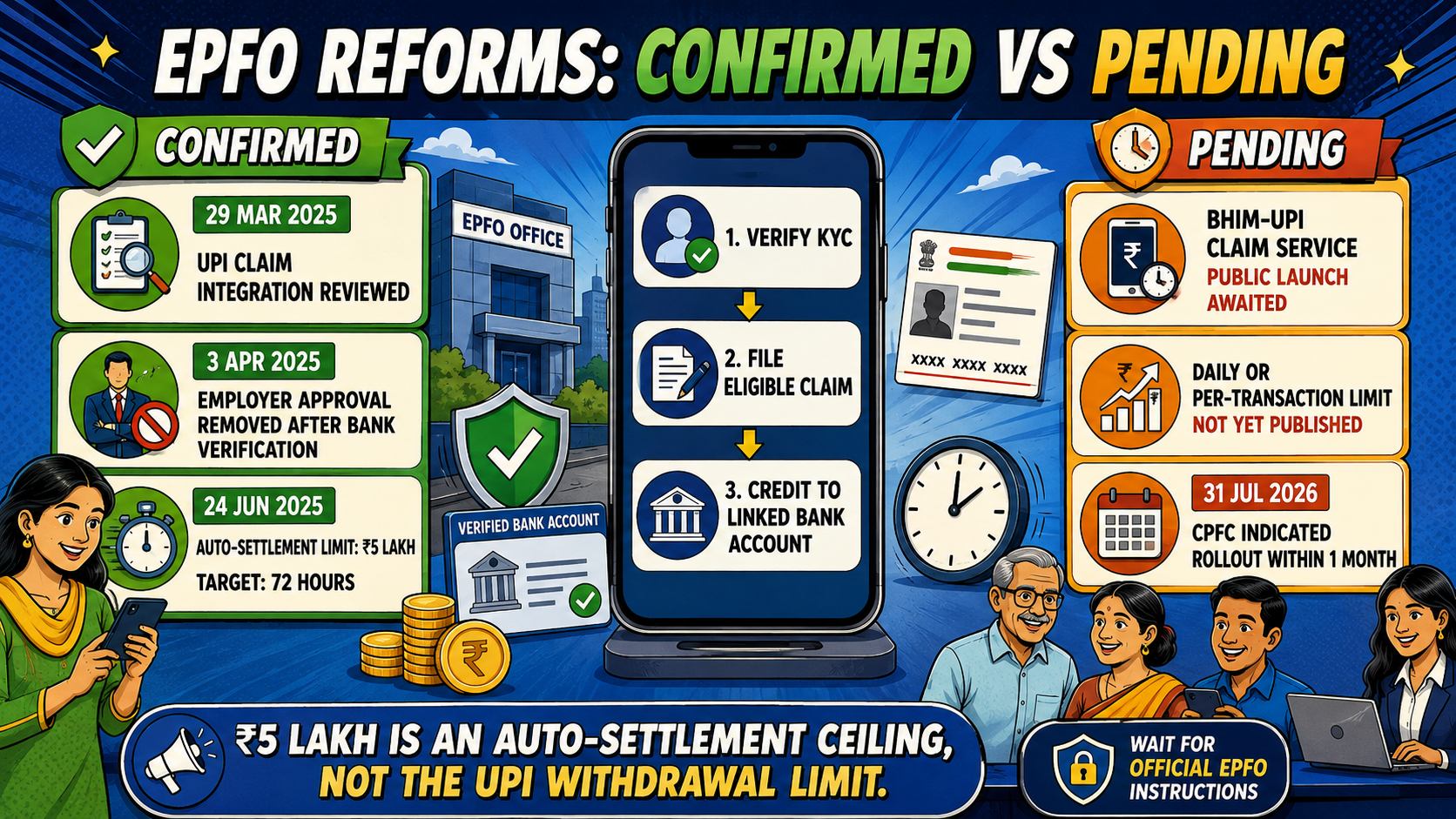
Several digital changes are already active, while BHIM-based withdrawal remains pending. The table separates implemented reforms from reported features so members do not act on an option that has not opened.
The ₹5 lakh ceiling applies to automatic processing of eligible advance claims. It is not the UPI withdrawal limit, and it does not permit every member to take out ₹5 lakh. Figures circulating on social media should remain outside financial planning until EPFO publishes its operating instructions.
Siddharth Maurya, Founder and Managing Director of Vibhavangal Anukulakara Private Limited, told India Today on 3 June 2026 that workers should review Aadhaar linkage, PAN information, bank details, their registered mobile number and nomination records. Pratik Vaidya, Managing Director and Chief Vision Officer of Karma Management Global Consulting Solutions Private Limited also pointed to service history and exit dates after a job change.
The practical fix begins before an emergency. Members should compare their name and date of birth with Aadhaar, confirm that the seeded bank account remains active and test access to the UAN login. LoansJagat’s analysis is straightforward: a shorter BHIM form will not produce a quicker payment when the records behind it are faulty. EPFO should also show a specific rejection reason and 1 tracking number across BHIM, EPFO and the bank.
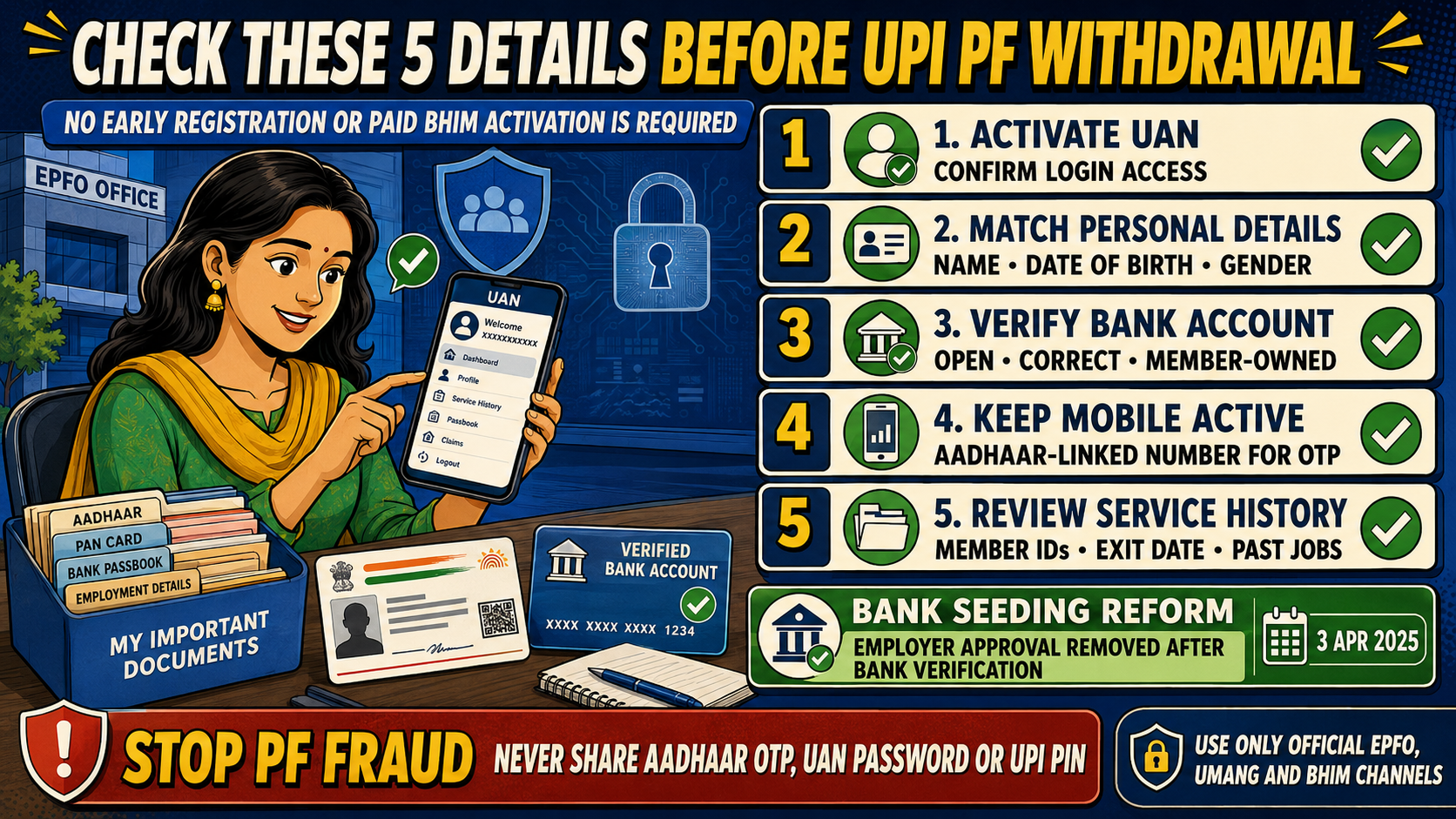
EPFO has not asked members to register early or pay for BHIM activation. The waiting period can still be used well:
EPFO eased bank seeding on 3 April 2025. Its Labour Ministry release, ID 2118168, said 4.83 crore of 7.74 crore monthly contributing members had seeded bank accounts at that time. The reform removed employer approval after bank verification. EPFO also stopped requiring a cheque leaf or attested passbook image with a standard online claim.
No genuine PF credit requires a member to tell a caller the Aadhaar OTP, UAN password or UPI PIN. Messages offering early access, guaranteed approval or paid account correction should be ignored. Members should use the official EPFO website, UMANG and the authorised BHIM app after the formal launch.
EPFO’s Executive Committee first reviewed the UPI proposal at its 113th meeting in Srinagar on 28 March 2025. The official note published the following day said C-DAC was developing application interfaces with the State Bank of India and the National Payments Corporation of India under CITES 2.01. The aim was immediate credit of approved claims through the UPI payment system.
On 24 June 2025, EPFO raised the auto-settlement ceiling for eligible illness, education, marriage and housing advances. That improved the existing process. It did not launch BHIM withdrawal or establish a UPI cap.
Expected rollout periods later moved from April to June and then August 2026. A major claims-system migration also brought complaints about login failures, missing older account details and slower processing. Krishnamurthi’s 31 July statement narrowed the expected period to 1 month, but members still need an EPFO notice before treating the service as active.
Krishnamurthi told IANS that members would submit claims through BHIM and receive approved money in the UPI-linked bank account. Labour Minister Mansukh Mandaviya said on 31 July 2026 that UPI withdrawal remained under consideration while EPFO moved towards digital claims and automatic account transfers. Both statements point towards implementation, but neither created a member deadline.
Saumya Ramakrishnan, Partner at Bombay Law Chambers, told NDTV Profit on 18 June 2026 that authentication and fraud prevention would be the real test. Easier withdrawal can help during a genuine cash shortage. It can also expose retirement savings when identity checks fail or encourage repeated withdrawals. EPFO needs strong verification, visible limits and a usable complaint route for rejected claims and failed credits.
EPFO 3.0 UPI PF withdrawal appears closer after the Central Provident Fund Commissioner’s 31 July 2026 statement. It is still not a live nationwide service, and there is no KYC deadline attached to the expected rollout. Members should use the available time to review their UAN, Aadhaar, bank account, mobile number and employment history.
BHIM may shorten the journey from an eligible claim to bank credit. Its success will depend on published limits, firm security checks and quick correction of failed requests. Until EPFO issues the formal notification, unofficial activation links and fixed withdrawal figures should not be trusted.
No. EPFO indicated a possible rollout within 1 month of 31 July 2026, but public instructions remain pending.
No. Approved money is expected to enter the verified bank account connected to the member’s UPI profile.
No. ₹5 lakh is the existing auto-settlement ceiling for qualifying advances, not a notified UPI payment limit.
No. Members must continue using currently available EPFO claim channels until BHIM access receives an official launch notice.
EPFO has not fixed a nationwide date. The latest CPFC indication points to a period ending around 31 August 2026.








.png&w=3840&q=75)


