By continuing, you agree to LoansJagat's Credit Report Terms of Use, Terms and Conditions, Privacy Policy, and authorize contact via Call, SMS, Email, or WhatsApp
Disclaimer: The information published on LoansJagat is intended for general informational and educational purposes only and should not be considered financial, legal, or investment advice. Interest rates, loan terms, statistics, and other data may change over time and may vary by lender or source. Please verify the latest information and consult a qualified financial advisor or the respective Bank/NBFC before making any financial decisions.
Subscribe Now
About the author

Arshathul Afia
Arshathul Afia is a journalism graduate and fintech content writer with 4+ years of experience in digital publishing and research-led writing. She has written 200+ articles covering personal finance, lending, banking, digital payments, credit, insurance, and major financial developments in India. At LoansJagat, she focuses on simplifying complex fintech news, RBI updates, loan-related changes, policy developments, and industry trends for everyday readers. Her journalism background helps her approach stories with research, context, and clarity, while her SEO experience ensures content remains discoverable and relevant. She aims to make financial news easier to understand, practical, and useful for readers across India.
Related Blog Post
Simplify All Your Loans Into One Affordable EMI

Customers Served

Debt Consolidated

1200+ Reviews

Locations in India
Club all Loans & Credit Card Bills into Single EMI

Quick Apply Loan
Consolidate your debts into one easy EMI.

Takes less than 2 minutes. No paperwork.

10 Lakhs+
Trusted Customers

2000 Cr+
Loans Disbursed

4.7/5
Google Reviews

50+
Banks & NBFCs Offers
Other services mentioned in this article
EPFO has completed the FY2025-26 interest-credit exercise at 8.25%, giving provident fund members an earlier annual account update than they received last year.
The Employees’ Provident Fund Organisation has finished processing interest for FY2025-26 at 8.25%. The exercise was completed by July 15, 2026, according to a senior EPFO official quoted by The Indian Express on July 16. The report placed the coverage at nearly 35 crore member accounts. A few days earlier, Union Labour and Employment Minister Dr Mansukh Mandaviya had said that nearly 34 crore EPF accounts, involving more than ₹1.44 lakh crore in interest, were being processed through EPFO’s new centralised system. The government statement was published by
For employees, the immediate change is fairly simple. Their FY2025-26 interest should now form part of the provident fund balance. Some passbooks may show the entry later than others, especially after such a large account-processing exercise. That can create confusion for members checking the portal every day. Over a longer period, the July exercise will also be watched as an early test of EPFO’s new national database, particularly for claims, transfers and account corrections.
The annual credit raises the accumulated PF balance of eligible members. It does not arrive as a separate payment in the employee’s bank account. The amount remains inside the provident fund account and forms part of the retirement corpus, subject to EPFO rules on transfer, withdrawal and settlement.
A practical example explains the issue better. An employee who changed jobs during FY2025-26 may have contributions linked with more than 1 Member ID under the same UAN. That person should not check only the latest employer’s passbook and assume the annual entry is missing. Older balances and transfer status need to be reviewed too.
Employees can also use the interest update as a reason to compare their PF passbook with salary slips. Monthly deposits should match the contribution history. A missing employer deposit is a different problem from a delayed annual interest entry, and the 2 should not be treated as the same issue.
For most members, the quicker processing is positive. EPFO completed the exercise far earlier than the previous year’s full cycle, according to the official quoted after the July 15 completion. Still, speed alone will not solve record errors. An incorrect date of exit, an old bank account or a mismatch in Aadhaar details can still affect later claims.
Dr Mansukh Mandaviya said EPFO’s new Centralised IT Enabled Services, or CITES, would automate several parts of account processing. The July 8 government update said the system would support annual interest processing and carry out checks on withdrawal claims before they reached field offices.
That could help with a common problem. A member may submit a claim without meeting a withdrawal condition or with incomplete account details. Under the new setup, the system is intended to flag such gaps earlier rather than allowing the request to travel further through the process before it is returned.
Members should still check their own records. Aadhaar details, bank information, mobile number and employment entries should match the UAN profile. Those who changed jobs should verify whether the previous employer entered the correct date of exit. Old PF balances should also be transferred where required.
The LoansJagat coverage of the EPFO 8.25% interest exercise also points to an easily missed detail. The figure of 34 crore accounts should not be read as 34 crore individual active workers. One employee can have account records connected with different employers over a working career. Older and inactive records are also part of the wider database.
That distinction is useful when reading the headline figures. The number of EPF accounts and the number of people contributing in a particular month are not interchangeable.
The more useful test will come over the next few months. Members will notice whether claim returns reduce, job-change transfers move faster and passbook records become easier to follow. Those day-to-day results will tell employees more than a technology announcement on its own.
The FY2025-26 process started several months before the money appeared in annual ledgers.
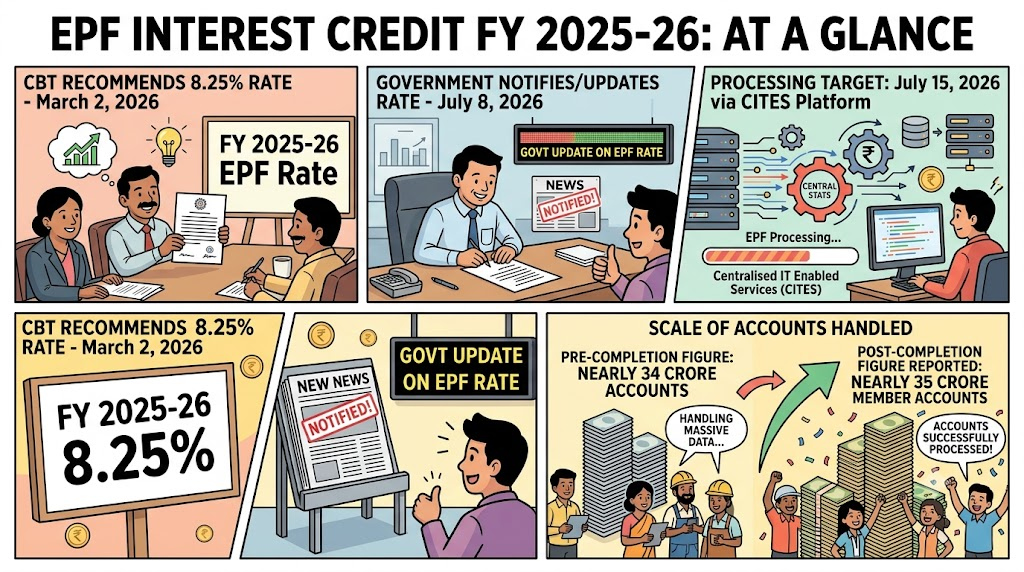
On March 2, 2026, the Central Board of Trustees held its 239th meeting in New Delhi, chaired by Dr Mansukh Mandaviya. The Board recommended an annual EPF interest rate of 8.25% for FY2025-26. The Press Information Bureau published the decision on the same date.
A recommendation from the CBT does not immediately result in a passbook entry. Government approval and EPFO’s annual accounting process have to follow. That gap explains why members knew the proposed rate in March but had to wait until July for the large-scale credit exercise.
Around the same period, EPFO was preparing a major technology migration. Its regional databases were being moved into a centralised national setup, and several online facilities were temporarily disrupted during the late-June upgrade.
The sequence is easier to follow in the timeline below.
The timeline also separates 2 events that are often combined in social media posts. Approval of the 8.25% rate came first. Posting that interest across member ledgers was a later operational exercise.
Technology appears to have played a large part.
EPFO previously handled account records through databases spread across regional offices. Before the FY2025-26 exercise, the organisation moved those records into a centralised national system. A senior EPFO official quoted by The Indian Express on July 16 said 123 regional databases had been migrated.
Field officers then compared balances between the old and new ledgers after migration, according to the same official. That checking step was important. Moving millions of records quickly would have little value if the closing balances in the new system did not match the older ledger records.
The official said this was the first time the annual interest exercise had been completed by July 15. For FY2024-25, the complete process reportedly ran until September 2025.
That is a noticeable improvement in timing, though one early cycle is not enough to judge the entire platform. Interest posting is one large annual task. PF claims and corrections create different operational pressures throughout the year.
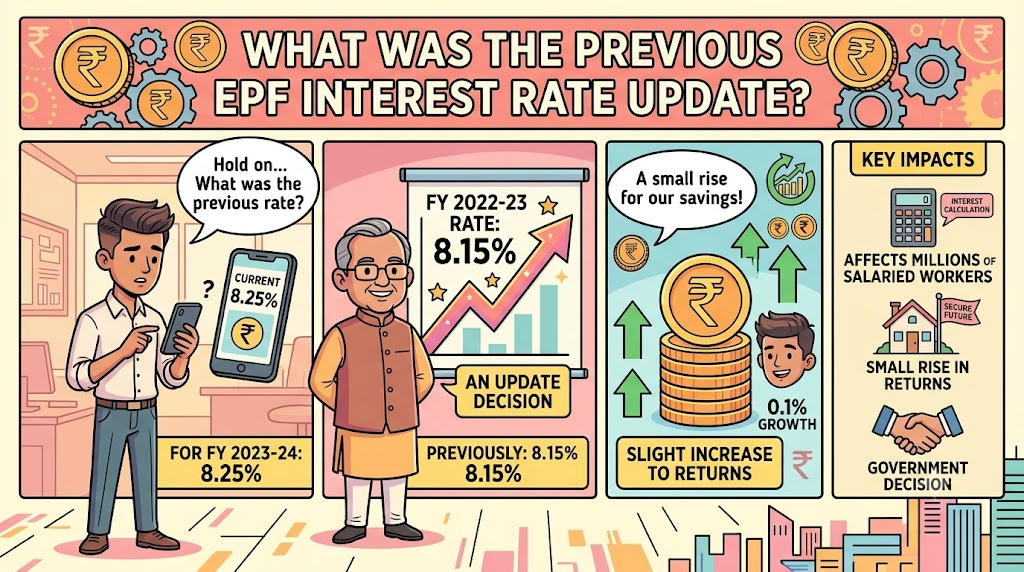
Members had known the proposed rate since March. The CBT chose 8.25% for FY2025-26, keeping the rate unchanged from FY2024-25.
The next major development came in June, when EPFO moved ahead with its database consolidation and system upgrade. Member services faced temporary disruption during that work. Passbook access, claims and other online functions were among the services affected during the migration period.
By July 8, the focus had moved from migration to annual interest. Dr Mansukh Mandaviya announced that nearly 34 crore accounts were expected to be processed by July 15. The reported completion followed a week later.
Members who saw temporary portal problems around late June and early July therefore need to separate the 2 issues. The technology migration affected access to some services. The annual interest exercise was the accounting task that followed on the new setup.
Dr Mansukh Mandaviya has described the centralised system as a way to automate account work and check claims before they reach EPFO offices. The government expects those checks to identify missing details and eligibility problems earlier.
A senior EPFO official offered a more operational view after the exercise. The official told The Indian Express that old and new ledger balances were compared after migration and that the annual interest process was completed by July 15.
For employees, the benchmark is less technical. A member changing jobs wants the old balance transferred without weeks of confusion. Someone filing a permitted withdrawal wants to know early if a document or account detail is wrong. A retiree expects the ledger to show the correct balance before settlement.
Those are ordinary cases, but they are where the new system will be tested hardest.
EPFO’s FY2025-26 annual interest exercise has put 8.25% into the spotlight again, but the timing is probably the more useful development for members. The process was reported as completed by July 15 after the organisation shifted its account records to a centralised database.
Employees should now check their passbooks rather than rely only on alerts or headline figures. The 34 crore and nearly 35 crore numbers describe account coverage at different stages of the exercise, not a headcount of active employees.
The next few months will show how well the new system performs outside the annual interest cycle. Claims, PF transfers and correction requests will provide the harder test.
Yes. The FY2025-26 interest exercise at 8.25% was reported as completed by July 15, 2026.
The approved rate is 8.25%.
The July 8 government update referred to nearly 34 crore accounts being processed. Reporting after completion described coverage at nearly 35 crore member accounts.
Members can check the latest EPF passbook through EPFO’s digital services or UMANG using their UAN-linked account details.
The member should first check all UAN-linked Member IDs, recent passbook entries, and KYC details. A late display does not automatically mean the annual interest was lost.









.png&w=3840&q=75)


