.png&w=3840&q=65)
By continuing, you agree to LoansJagat's Credit Report Terms of Use, Terms and Conditions, Privacy Policy, and authorize contact via Call, SMS, Email, or WhatsApp
Disclaimer: The information published on LoansJagat is intended for general informational and educational purposes only and should not be considered financial, legal, or investment advice. Interest rates, loan terms, statistics, and other data may change over time and may vary by lender or source. Please verify the latest information and consult a qualified financial advisor or the respective Bank/NBFC before making any financial decisions.
Subscribe Now
About the author

Arshathul Afia
Arshathul Afia is a journalism graduate and fintech content writer with 4+ years of experience in digital publishing and research-led writing. She has written 200+ articles covering personal finance, lending, banking, digital payments, credit, insurance, and major financial developments in India. At LoansJagat, she focuses on simplifying complex fintech news, RBI updates, loan-related changes, policy developments, and industry trends for everyday readers. Her journalism background helps her approach stories with research, context, and clarity, while her SEO experience ensures content remains discoverable and relevant. She aims to make financial news easier to understand, practical, and useful for readers across India.
Related Blog Post
Simplify All Your Loans Into One Affordable EMI

Customers Served

Debt Consolidated

1200+ Reviews

Locations in India
Club all Loans & Credit Card Bills into Single EMI

Quick Apply Loan
Consolidate your debts into one easy EMI.

Takes less than 2 minutes. No paperwork.

10 Lakhs+
Trusted Customers

2000 Cr+
Loans Disbursed

4.7/5
Google Reviews

50+
Banks & NBFCs Offers
Other services mentioned in this article
EPFO has verified bank details for 1.18 lakh dormant PF accounts, bringing its claim-free refund pilot for balances up to ₹1,000 closer to an August rollout.
The Employees’ Provident Fund Organisation is preparing to move one of its smaller but long-pending claim categories out of the usual filing process. A July 27, 2026 update said bank details of 1.18 lakh subscribers had been verified for an auto-refund exercise covering eligible inoperative PF accounts with balances of ₹1,000 or less. C-DAC is working on the software changes, while August-end has been reported as the target for completing the technology work.
For a retired worker who left ₹600 in an old PF account 8 or 10 years ago, filing another claim may feel like more trouble than the amount is worth. That is the gap EPFO is trying to remove. The risk is mostly in old records. A closed bank account, mismatched Aadhaar details, incomplete KYC or a deceased-member case can stop an automatic payment even after the account enters the pilot.
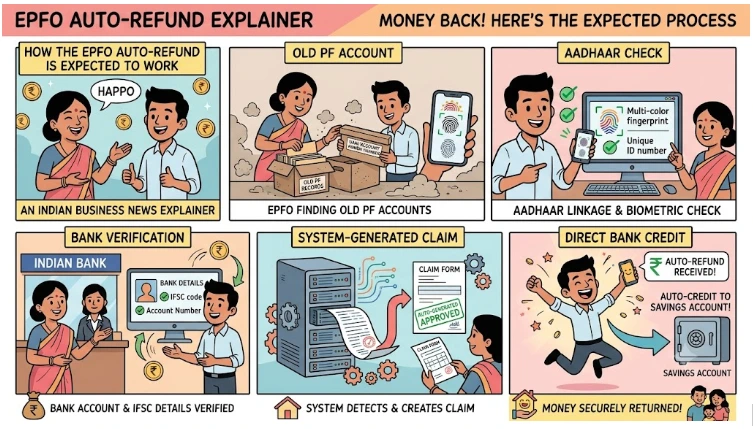
The proposed process removes the need for an eligible member to start a fresh claim. EPFO can identify the account, verify the Aadhaar-linked bank details and generate the settlement from its own system. For small leftover balances, this can save repeated portal logins, office visits and follow-up requests.
A typical case could involve a worker who changed employment years ago and transferred most of the PF balance but left ₹450 in an older account. That amount can remain untouched simply because the worker never returned to complete another withdrawal. Under the pilot, EPFO would try to settle such eligible balances directly once the required checks are finished.
The Employees’ Provident Fund Organisation explains in its official FAQ that inoperative status is linked to the absence of contributions for the prescribed period after retirement, permanent migration abroad or death. The FAQ also advises employed members to transfer old PF balances instead of leaving separate accounts behind.
There is another likely benefit for the claim system. Very small, straightforward accounts need not compete with higher-value claims involving medical withdrawals, retirement settlements, nominee cases or service-record disputes. That could reduce some low-value processing work at field offices.
The policy decision came from EPFO’s Central Board of Trustees. At its 239th meeting on March 2, 2026, chaired by Union Labour and Employment Minister Dr Mansukh Mandaviya, the Board approved automatic initiation of settlement for selected inoperative accounts holding ₹1,000 or less.
The government’s stated aim was to return long-pending balances without making members file another claim or provide another round of documents where identity and bank details had already been verified. That sounds simple on paper. The difficult part comes before payment, because EPFO has to be certain that the bank account still belongs to the correct person and remains active.
The July update said penny-drop verification was being used for bank checks. Cases involving deceased subscribers also need separate handling because money cannot simply be credited without confirming the person legally entitled to receive it.
Members therefore have a fairly basic task before the system goes live. Aadhaar, UAN and bank information should match. An old salary account that was closed years earlier can create a failed credit. Incorrect spelling in a name or an outdated bank record can do the same.
A July 9, 2026 report from LoansJagat also examined EPFO’s centralised 2.01 technology shift and the use of automated pre-validation. That becomes relevant here because an auto-refund depends heavily on checking member data before the system creates the claim.
The useful test will come after launch. Faster software alone will not solve an account with incorrect KYC. The pilot works only when verification, claim generation, and bank credit happen without pushing the member back into a manual correction process.
EPFO had been working on old inoperative accounts before the July verification figure appeared. The major policy step came in March, when the Central Board approved the first automatic-settlement pilot.
The Press Information Bureau release dated March 2, 2026 said the initial phase would cover around 1.33 lakh accounts carrying nearly ₹5.68 crore. Those accounts formed the first selected group for automatic credit to Aadhaar-seeded, EPFO-linked bank accounts.
The sequence below shows how the programme has moved from approval to verification. The stages are separate, which is important because verification does not mean the money has already been paid.
The 1.18 lakh figure therefore should not be described as 1.18 lakh completed refunds. It refers to bank verification. The March figure, meanwhile, relates to the larger group selected for the first phase.
Earlier discussions had identified a much wider pool of small-balance inoperative accounts, but EPFO did not move all of them directly into the first automatic-payment batch. A controlled first phase gives the organisation room to test failed bank transfers, incorrect records and nominee-related cases before widening the process.
August is relevant because the refund model needs a feature that the ordinary claim process does not usually rely on. The system must create the claim itself.
In the usual route, a member initiates a withdrawal, and EPFO processes it after checking the request. Here, the sequence changes. EPFO first identifies an eligible account, completes verification, and then triggers settlement without waiting for the member to file. That is a bigger operational change than the ₹1,000 limit may suggest.
Consider a former factory employee who retired several years ago and has ₹850 left in an old account. If Aadhaar and bank records are valid, the new process could settle the amount without asking that person to return to the portal. If the bank account has been closed, however, automation reaches a dead end until the record is corrected.
This is why August should be treated as a software target, not a guaranteed payment date for every subscriber in the verified group. Some accounts may move quickly. Others will still need correction.
The first few batches will also show whether automatic settlement produces fewer complaints or merely shifts them from claim filing to KYC correction. That result will influence how quickly EPFO can consider accounts carrying balances above ₹1,000.
The Central Board has already indicated that a successful first phase could support expansion to higher-balance inoperative accounts. No automatic refund for those accounts has been formally rolled out yet. That distinction should remain intact.
The immediate programme is narrow. It deals with small balances, verified identity details and a defined group of inoperative accounts. Expanding the same model to larger sums would require tighter safeguards because the financial impact of a wrong transfer rises sharply once balances move beyond a few hundred rupees.
The pilot can still produce useful results even if expansion takes time. EPFO will get data on how many bank accounts fail verification, how many records require correction and how often members need to step back into the process manually. Those figures will probably tell more about the system than the first refund total.
EPFO’s small-balance auto-refund pilot has now moved from Board approval into bank verification and software preparation. The latest reported figure of 1.18 lakh verified subscribers shows that a large part of the first batch has reached the account-check stage.
For members, the change removes a fairly common irritation: filing another claim for a PF balance that may be smaller than a monthly utility bill. Yet automatic settlement depends on old records being usable. Aadhaar details, UAN information, and the linked bank account still have to line up.
The August target will show whether EPFO can turn that verified data into actual payments without sending members back through the old claim route. That will decide how far the model can go next.
Employees can transfer the old PF balance to the current UAN-linked account through EPFO’s online transfer facility.









.png&w=3840&q=75)


