

By continuing, you agree to LoansJagat's Credit Report Terms of Use, Terms and Conditions, Privacy Policy, and authorize contact via Call, SMS, Email, or WhatsApp
Disclaimer: The information published on LoansJagat is intended for general informational and educational purposes only and should not be considered financial, legal, or investment advice. Interest rates, loan terms, statistics, and other data may change over time and may vary by lender or source. Please verify the latest information and consult a qualified financial advisor or the respective Bank/NBFC before making any financial decisions.
Subscribe Now
About the author

Arshathul Afia
Arshathul Afia is a journalism graduate and fintech content writer with 4+ years of experience in digital publishing and research-led writing. She has written 200+ articles covering personal finance, lending, banking, digital payments, credit, insurance, and major financial developments in India. At LoansJagat, she focuses on simplifying complex fintech news, RBI updates, loan-related changes, policy developments, and industry trends for everyday readers. Her journalism background helps her approach stories with research, context, and clarity, while her SEO experience ensures content remains discoverable and relevant. She aims to make financial news easier to understand, practical, and useful for readers across India.
Related News
Simplify All Your Loans Into One Affordable EMI

Customers Served

Debt Consolidated

1200+ Reviews

Locations in India
Club all Loans & Credit Card Bills into Single EMI

Quick Apply Loan
Consolidate your debts into one easy EMI.

Takes less than 2 minutes. No paperwork.

10 Lakhs+
Trusted Customers

2000 Cr+
Loans Disbursed

4.7/5
Google Reviews

50+
Banks & NBFCs Offers
EPFO has explained when retired members’ provident fund balances become inoperative, warning that missed withdrawal deadlines can stop further interest despite the money remaining claimable later.
The Employees’ Provident Fund Organisation has explained when an EPF balance stops earning interest after retirement. The rule affects members across India who leave their savings with EPFO instead of withdrawing them immediately. For retirement before 55, interest generally continues until age 58. For retirement on or after 55, the account can become inoperative 36 months after retirement. Once that happens, fresh interest stops, although the accumulated balance remains claimable.
EPFO’s 20 August 2026 advisory used retirement at 50, 55, 58 and 70 to show how the deadline moves. The short-term risk is a missed claim window. Over several years, an inoperative balance may lose growth while household costs keep increasing. Retirees, therefore, need to check their recorded exit date, age and UAN history before deciding how long to retain the money.
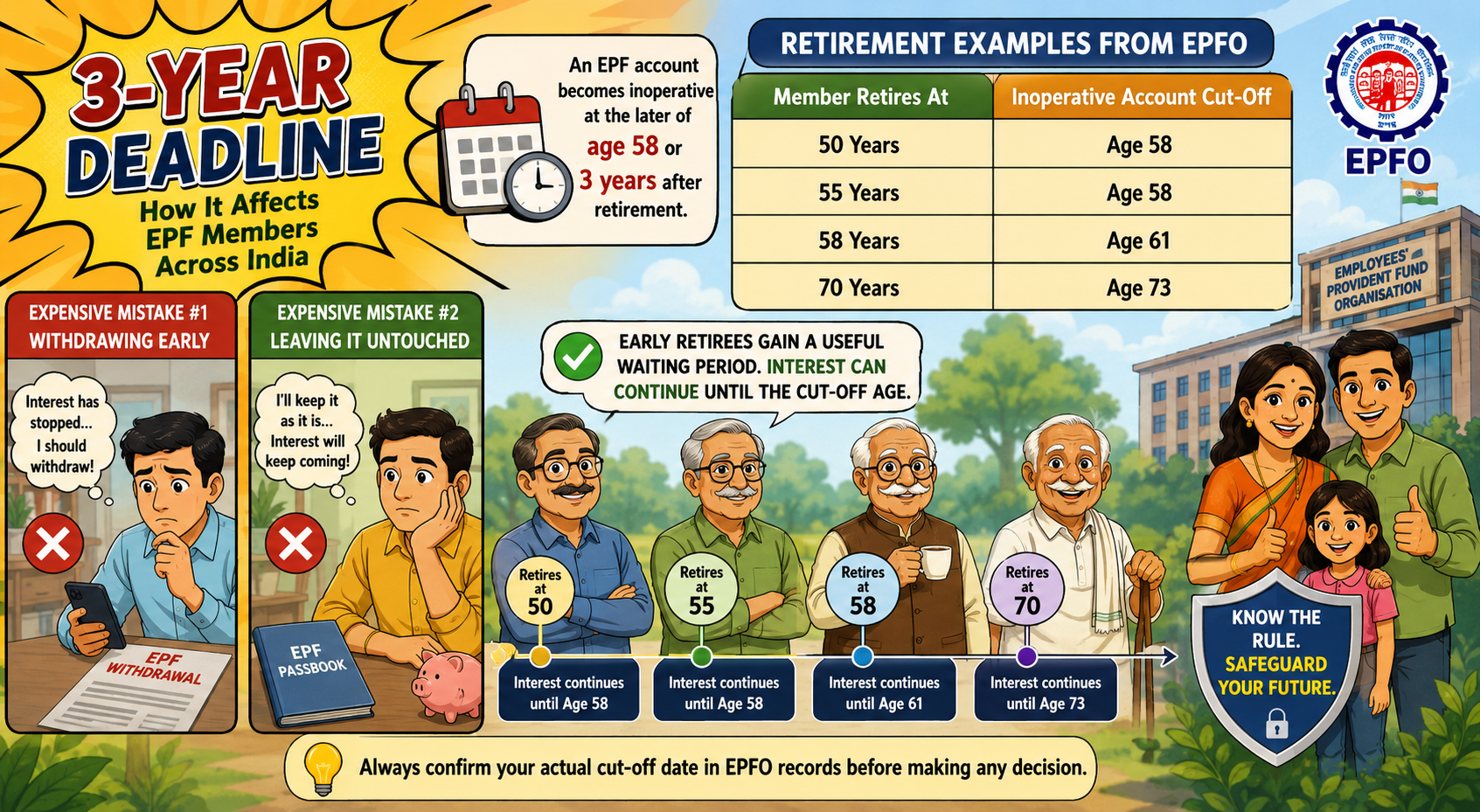
The clarification can prevent 2 expensive mistakes. Some employees withdraw after leaving a job because they think interest has ended. Others leave the balance untouched for years after retirement, expecting fresh interest. The correct date depends on retirement age and when the money became payable.
Early retirees gain a useful waiting period. A person retiring at 50 does not normally lose EPF interest at 53 simply because contributions stopped for 3 years. Interest can continue until 58. That gap may help someone searching for another job, arranging family finances or completing an old PF transfer. The rule avoids forcing younger members into a hurried withdrawal.
EPFO’s 4 examples show that age 58 is not the only cut-off. The source and results are placed together below.
The working rule is straightforward. An EPF account generally becomes inoperative at the later of age 58 or 3 years after retirement. Someone retiring at 58 may therefore receive interest until 61. A person working until 70 can have a cut-off at 73. The member should confirm the actual date in EPFO records before acting.
EPFO told members on 20 August 2026 to know when their provident fund stops earning interest and plan withdrawals wisely. The statement does not require every retiree to withdraw on the retirement date. A member may retain the balance during the eligible interest period. But the choice needs a deadline, especially where retirement income is limited and the EPF corpus forms a large part of household savings.
The response starts with 4 checks: retirement date, last contribution, previous member IDs and KYC status. Aadhaar, PAN, bank details and the UAN-linked mobile number should match current records. Corrections should begin before the expected inoperative date, not during the final month.
LoansJagat’s view is that an old EPF balance should be treated as an active retirement asset, not forgotten salary history. The inoperative date works like a financial deadline. A member who wants to retain the money with EPFO can do so during the eligible period, while someone nearing the cut-off should compare withdrawal needs and available retirement options before interest ends.
Job changers face a different task. LoansJagat’s explanation of EPFO’s revised PF transfer process shows how recent changes reduced employer routing for many eligible transfers. That can shorten follow-ups, but members still need to verify the result in the passbook. An application submission is not proof that the old balance has reached the current member ID.
For borrowers, using EPF money to close a loan may cut interest outgo but also reduce retirement savings. The choice should consider the loan rate, pension, medical costs and other available funds.
The phrase “no contribution for 3 years” is often quoted without the retirement condition. That shortened version can mislead anyone below 55. A resignation, temporary job loss or career break does not by itself make the account inoperative after 36 months. For an early retiree, the balance generally earns interest until 58 under the age-based treatment explained by EPFO.
After joining another EPF-covered establishment, the older balance should move under the current UAN. A transfer keeps contribution history together and reduces later paperwork. An untracked member ID can still cause trouble when employment dates or personal details differ.
Retirement on or after 55 starts a different clock. If the member does not claim the amount within 36 months from the relevant retirement date, the balance may enter the inoperative category. Similar treatment can apply where money remains unclaimed after permanent migration abroad or the member’s death. A nominee or legal heir can still claim the balance later, though fresh interest may already have stopped.
The present rule grew from a November 2016 amendment to the former EPF Scheme, 1952. It protected younger members from losing interest after a 3-year contribution gap. The Employees’ Provident Fund Scheme, 2026, later replaced the older framework while retaining inoperative-account provisions.
EPFO then shifted attention towards returning small balances. At the 239th Central Board of Trustees meeting on 2 March 2026, the Board approved a pilot for Aadhaar-verified inoperative accounts containing ₹1,000 or less. The Press Information Bureau release dated 2 March 2026 said about 1.33 lakh accounts holding nearly ₹5.68 crore would enter the 1st phase. Eligible payments were planned for linked, Aadhaar-seeded bank accounts without fresh paperwork.
A later parliamentary reply showed the wider scale. Rajya Sabha Unstarred Question No. 570, answered on 23 July 2026, recorded ₹9,330.56 crore in inoperative EPF accounts as of 31 March 2026. Minister of State for Labour and Employment Shobha Karandlaje said EPFO was using social media outreach and Nidhi Aapke Nikat 2.0 camps to inform employers and workers.
The government does not officially call these balances “unclaimed EPF accounts." It records them as inoperative accounts. That status stops future interest but does not cancel ownership or erase the amount.
A retired member can still file a settlement claim. After death, a nominee or legal heir may seek payment. Incomplete KYC can delay identity, employment and bank verification.
Read Also: Senior Citizen FD Rates Touch 8.5%: These Banks Are Offering the Highest Returns in August 2026
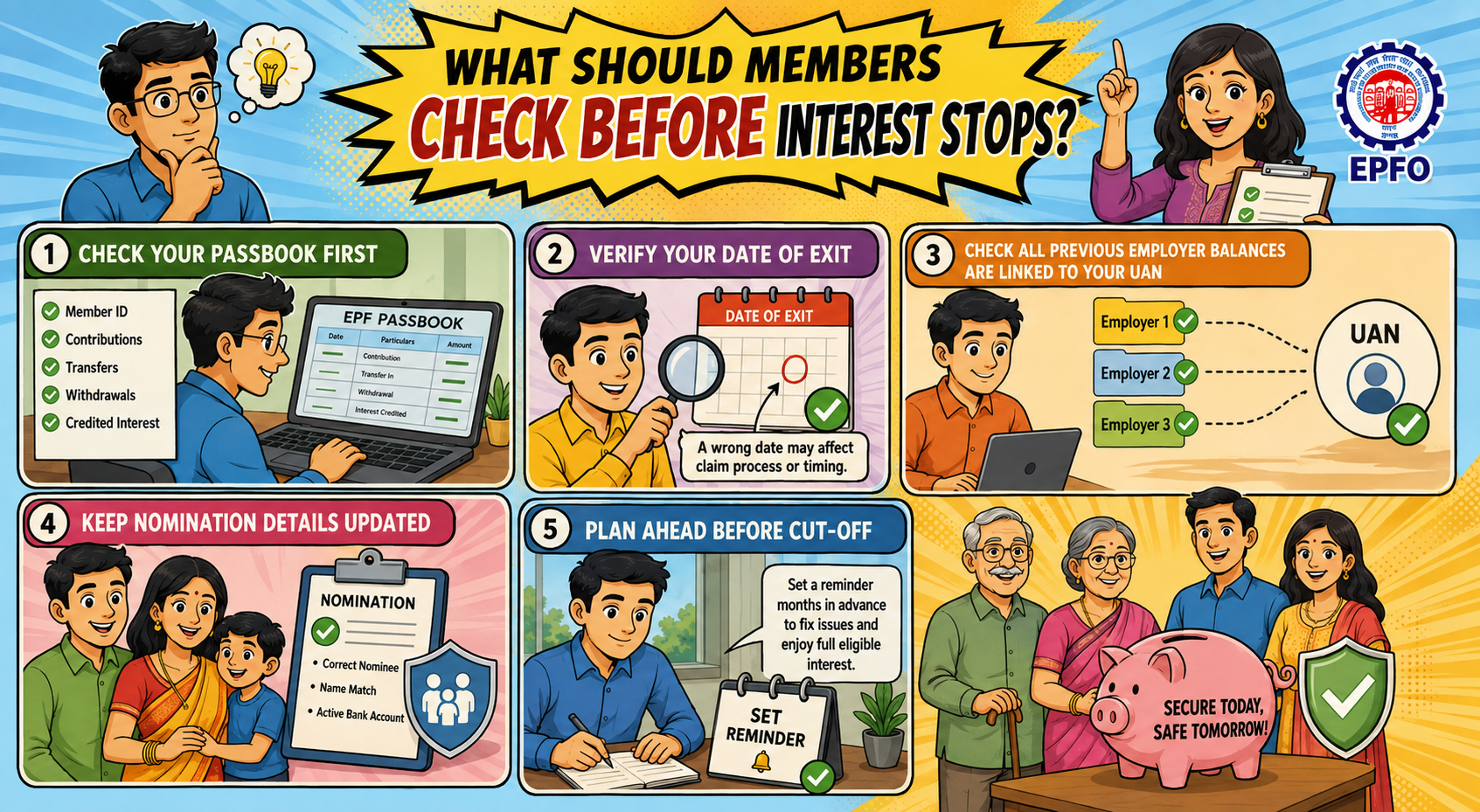
The passbook should be checked first. It shows the member ID, contributions, transfers, withdrawals and credited interest. The recorded date of exit needs a second look because a wrong date may affect the claim route or timing. Members should also check whether balances from earlier employers appear under the current UAN.
Nomination deserves attention before retirement, not after a family emergency. An outdated nominee, name mismatch or inactive bank account can slow payment. A retiree who plans to keep the corpus with EPFO should set a reminder several months before the expected cut-off. That leaves time for corrections without sacrificing the final eligible interest period.
EPFO’s retirement examples turn a confusing rule into dates that members can follow. Retirement at 50 may allow interest until 58. Retirement at 58 can extend it to 61. Working longer shifts pushes the deadline further, yet the 36-month period still ends.
Members should review their passbook, combine old balances, update KYC and prepare the correct claim before the account becomes inoperative. The money remains payable after that date. Its growth stops. For a retiree depending on a limited corpus, that difference can become costly within a few years.
No. The eligible period depends on the member’s retirement age and the applicable 36-month rule.
EPFO’s example places the inoperative cut-off at age 61, which is 3 years after retirement.
No. Members should transfer the old balance and confirm its arrival under the current UAN.
Yes. The balance remains claimable, although EPFO stops crediting fresh interest after the cut-off.
The nominee should check KYC, bank details and nomination records before filing the prescribed death claim.









.png&w=3840&q=75)


