Disclaimer: The information published on LoansJagat is intended for general informational and educational purposes only and should not be considered financial, legal, or investment advice. Interest rates, loan terms, statistics, and other data may change over time and may vary by lender or source. Please verify the latest information and consult a qualified financial advisor or the respective Bank/NBFC before making any financial decisions.
Subscribe Now
About the author

Arshathul Afia is a journalism graduate and fintech content writer with 4+ years of experience in digital publishing and research-led writing. She has written 200+ articles covering personal finance, lending, banking, digital payments, credit, insurance, and major financial developments in India. At LoansJagat, she focuses on simplifying complex fintech news, RBI updates, loan-related changes, policy developments, and industry trends for everyday readers. Her journalism background helps her approach stories with research, context, and clarity, while her SEO experience ensures content remains discoverable and relevant. She aims to make financial news easier to understand, practical, and useful for readers across India.
Related News
Simplify All Your Loans Into One Affordable EMI

Customers Served

Debt Consolidated

1200+ Reviews

Locations in India
Club all Loans & Credit Card Bills into Single EMI

Quick Apply Loan
Consolidate your debts into one easy EMI.

Takes less than 2 minutes. No paperwork.

10 Lakhs+
Trusted Customers

2000 Cr+
Loans Disbursed

4.7/5
Google Reviews

50+
Banks & NBFCs Offers
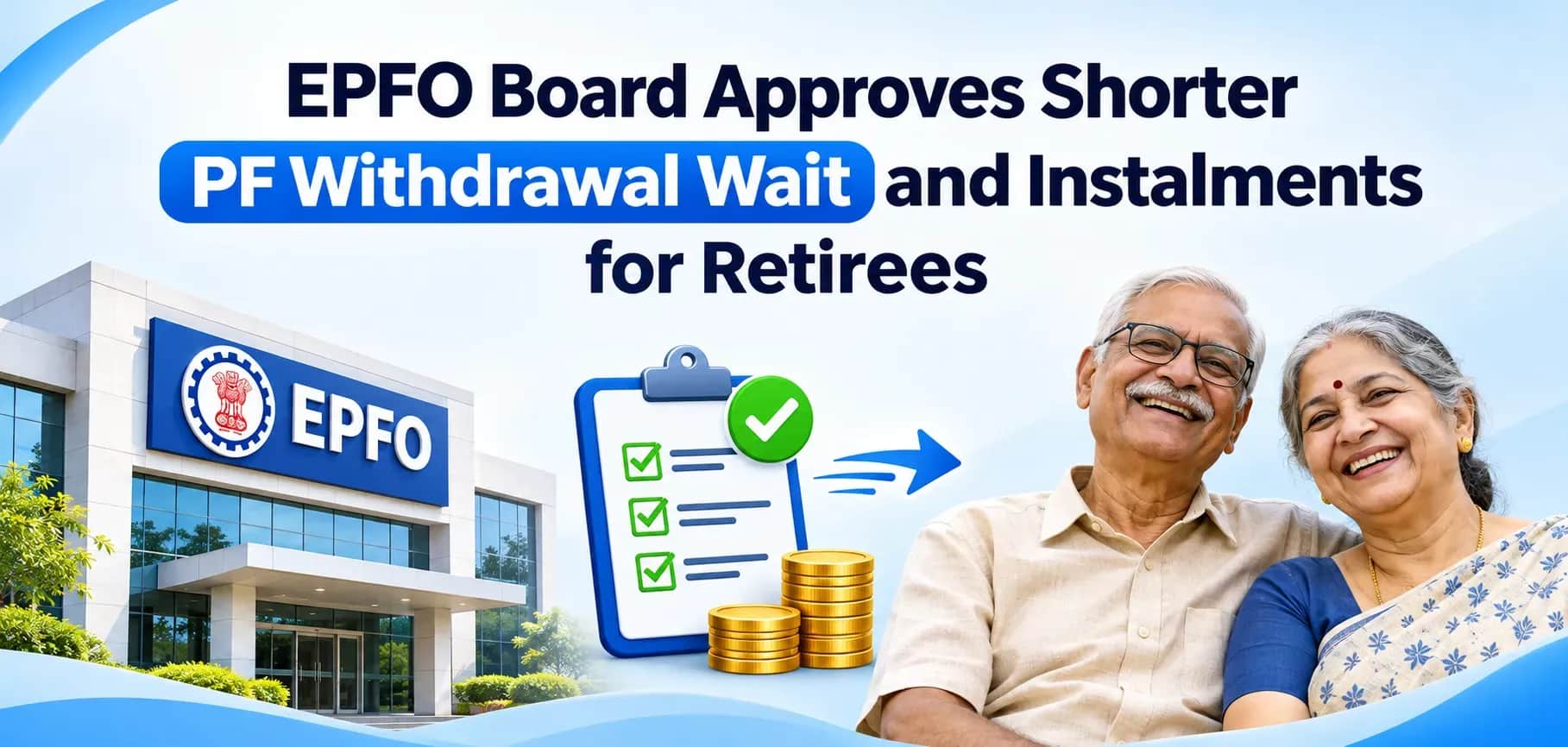
The board backed a two-month wait for final provident fund claims after job loss and a voluntary plan that would let retirees draw their savings in instalments.
Key Highlights
The Employees’ Provident Fund Organisation (EPFO) approved changes on 19 November 2026 that affect when workers can take out their provident fund savings and how retirees can draw them down. Union Labour and Employment Minister Mansukh Mandaviya chaired the Central Board of Trustees’ 240th meeting in New Delhi.
The shorter wait reverses a decision taken in October 2025, when the board extended the interval for premature final settlement from two months to 12. The retirement proposal tackles a different question. A member who needs only part of the money on retirement could leave the rest in the fund and draw it at regular intervals.
The EPFO board approved a shorter wait for final provident fund settlement after job loss and a lower minimum balance for partial withdrawals. The board’s announcement gave no effective date for the shorter wait.
Members who retire at age 58 can withdraw their full EPF balance. Separately, members with at least 10 years of eligible service can qualify for a monthly EPS pension, ordinarily payable from age 58.
Read also: EPFO Approves PF Instalments for Retirees as 3% AIF Plan Awaits Decision
A retiree could schedule regular withdrawals from the provident fund or take part of the balance upfront and receive the rest in instalments. A third option under discussion would let the retiree draw only the interest. Money left in the account would continue to earn interest at the prevailing EPF rate.
Participation would be voluntary. A member who starts taking instalments could stop the plan and withdraw the remaining balance. If a member dies during the payout period, the nominee or eligible dependant could take the balance or continue receiving the scheduled withdrawals.
EPFO estimates that about 6.32 lakh members above 55 with more than ₹5 lakh in provident fund savings could be the main beneficiaries at first. EPFO manages nearly ₹32 lakh crore for over 34 crore members, including more than 8 crore active contributors.
The proposal goes for legal vetting before the Ministry of Labour and Employment finalises and notifies amendments to the provident fund scheme. An official put that process at about two months. A corresponding amendment to the Income Tax Act is being taken up with the Ministry of Finance.
The board also discussed a way for people to make voluntary contributions linked to their Universal Account Number (UAN) outside an employer’s payroll. The proposal would also allow small payments from third parties, such as customer tips, to go into those accounts. That could give gig, platform and domestic workers another way to build retirement savings.
The trustees agreed in principle to allow EPFO to invest up to 3% of fresh inflows in eligible Alternative Investment Funds within its overall investment ceiling. The initial focus would be on the National Investment and Infrastructure Fund and Startup India Fund of Funds 2.0, which the Small Industries Development Bank of India manages.
The board also backed amendments to the Employees’ Deposit-Linked Insurance Scheme, 2026. Eligible establishments would have six months to renew expired exemptions and could receive relief from contributions, interest and penal damages for the verified transitional period.
The board’s decision would let workers who have lost their jobs claim their full provident fund balance sooner once the shorter waiting period takes effect. Retirees would have a separate choice about how quickly to draw their savings, with interest continuing on the money they leave in the fund. The retirement payout plan still needs a scheme notification. Members preparing a claim or planning their retirement income can check the effective date and conditions once the revised rules are published.
The plan is voluntary. Eligible retirees can still take their full provident fund balance in one payment or choose scheduled withdrawals under the new plan.
Under the instalment option, the balance left in the provident fund would continue to earn interest at the prevailing EPF rate between the scheduled withdrawals.
If a member dies during the payout period, the nominee or eligible dependant can choose to continue receiving instalments or withdraw the remaining balance outright.
Members can select ‘Know Your UAN’ on the member portal to find their number. Use ‘Forgot Password’ to reset the password for an active account.
The board approved the final settlement after two months without covered employment. Members applying before the revised rule takes effect are subject to the current rules.
Start your journey today
Apply Now*T&C apply