By continuing, you agree to LoansJagat's Credit Report Terms of Use, Terms and Conditions, Privacy Policy, and authorize contact via Call, SMS, Email, or WhatsApp
Disclaimer: The information published on LoansJagat is intended for general informational and educational purposes only and should not be considered financial, legal, or investment advice. Interest rates, loan terms, statistics, and other data may change over time and may vary by lender or source. Please verify the latest information and consult a qualified financial advisor or the respective Bank/NBFC before making any financial decisions.
Subscribe Now
About the author

LoansJagat Team
‘Simplify Finance for Everyone.’ This is the common goal of our team, as we try to explain any topic with relatable examples. From personal to business finance, managing EMIs to becoming debt-free, we do extensive research on each and every parameter, so you don’t have to. Scroll up and have a look at what 15+ years of experience in the BFSI sector looks like.
Related News
Simplify All Your Loans Into One Affordable EMI

Customers Served

Debt Consolidated

1200+ Reviews

Locations in India
Club all Loans & Credit Card Bills into Single EMI

Quick Apply Loan
Consolidate your debts into one easy EMI.

Takes less than 2 minutes. No paperwork.

10 Lakhs+
Trusted Customers

2000 Cr+
Loans Disbursed

4.7/5
Google Reviews

50+
Banks & NBFCs Offers
Other services mentioned in this article
EPFO members may face slower PF claim processing for 2 weeks after a system upgrade, as services restart with extra verification checks.
Key Highlights
EPFO members across India may see slower PF claim settlement for the next 2 weeks after the Employees’ Provident Fund Organisation completed a major database consolidation and software upgrade. The update affects salaried employees, pensioners, employers, and workers who depend on PF money during medical needs, job change, education payments, house repair, or final settlement after leaving service.
According to the Employees’ Provident Fund Organisation, member and employer services have been made live in a phased manner after the upgrade. Claims and service requests will pass through additional verification during the post-migration period. That is the main news. The rules have not changed, but the waiting time may stretch for some members.
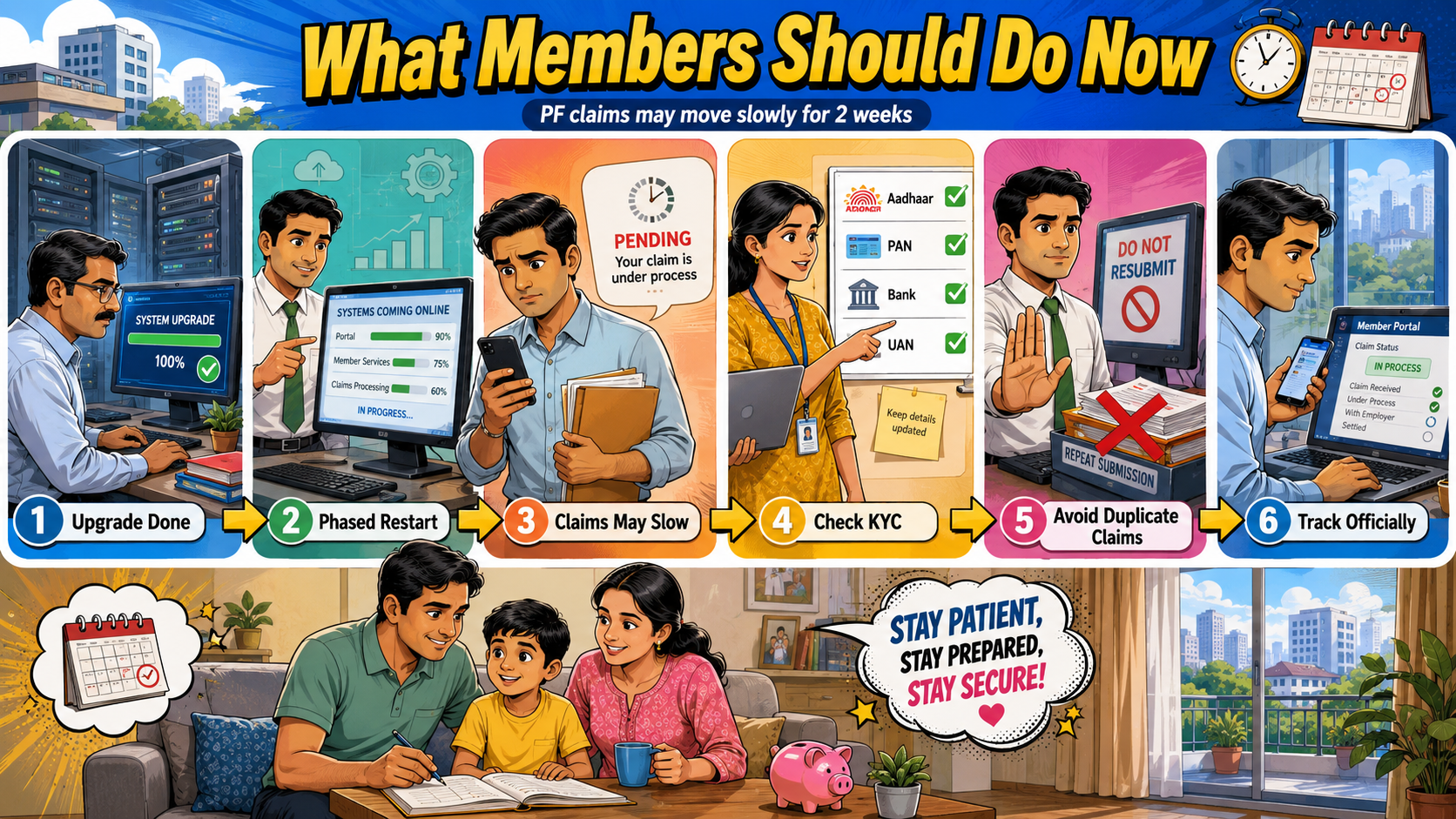
Before filing a PF claim, members should check the small details that usually cause trouble. UAN, Aadhaar, PAN, bank account, mobile number and exit date should match the EPFO record. An old IFSC code, a closed account or one spelling difference in the name can hold the claim for review.
Filing again and again will not help. It may only add another layer of checks. For the next 2 weeks, members needing PF money for hospital bills, rent, school fees or a job change should file once, keep the claim ID safely, and track it through EPFO, UMANG or the official grievance route.
The delay can affect workers who use PF money as an emergency fund. A medical advance may be needed before a surgery. A final settlement may be linked to the rent deposit after a job loss. A housing withdrawal may already be planned around a payment date. For such families, PF is not a distant retirement entry. It is cash support when salary alone does not cover the pressure.
There is also a good side, though members may not feel it on day 1. Extra checks can reduce wrong payments, failed bank transfers, rejected claims, and repeated correction requests. Many PF claims get delayed because of small errors, such as name mismatch, old bank account, wrong IFSC, missing exit date, or Aadhaar not matching the UAN profile. If the new system catches these gaps early, later rejection may be reduced.
Members should not rush into filing repeated claims. That can create more backend checks. A better step is to check the record first, then apply once. UAN should be active. Aadhaar, PAN, and bank details should match. The employer should have updated the exit date where final settlement or transfer is involved. These basic checks save time, and in PF claims, small details can decide whether the file moves or stops.
Before filing, members can use the following checklist. It is simple, but it covers the common reasons behind claim delay.
After checking these points, workers should track the claim through EPFO, UMANG, or official grievance options. Paid agents and random message links should be avoided. Sharing OTP, UAN password, Aadhaar details, or bank data with unknown persons can create bigger trouble than a delayed claim.
The present update is a backend technology change. EPFO has consolidated databases and upgraded software applications linked to the claim processing system. A member may see the portal working, but that does not mean every request will move at the old pace immediately. Large public systems need a stabilisation window after migration.
This is why the 2-week period is important. Claims may be accepted online, but validation may take extra time. Employer filings may also move carefully. Pension-linked services and member records may pass through additional checks. The aim is accuracy, but members waiting for money may only notice the delay.
The Press Information Bureau had earlier reported on 6 February 2025 that EPFO crossed the 5 crore claim settlement mark for the first time in its history. It said EPFO processed over 5.08 crore claims in FY 2024-25. That earlier speed created high expectations. So when the upgraded system slows during restart, the user experience becomes a real public issue.
There is another reason this update is being watched closely. PF is linked to India’s monthly cash planning. A member with a personal loan EMI, credit card bill, rent payment, or medical bill may apply for a PF advance to avoid expensive borrowing. If claim settlement slows, that person may have to use savings, borrow from family, or take a short-term loan. That is where the system upgrade reaches household finances.
*T&C Apply
Before this upgrade, EPFO had already been shifting towards faster digital claim settlement. The government had announced higher automation, fewer manual checks in transfer claims, and quicker settlement for eligible advance requests. The big direction was simple. Cut paperwork, reduce employer dependence, and let members complete more work online.
On 24 June 2025, the Ministry of Labour and Employment said EPFO had raised the auto-settlement limit for advance claims from Rs. 1 lakh to Rs. 5 lakh. That move was meant to help members receive funds faster during urgent needs. Earlier claim categories, such as illness, education, marriage, and housing, had already seen more digital processing.
The new upgrade has arrived in the same reform chain. It is not a rollback. It is a pause-like stage during a larger digital shift. Members may face slower service now, but if the database consolidation works properly, future claim checks may become less painful.
LoansJagat’s EPFO explainer also reads this change from a household finance angle. According to LoansJagat, PF members should keep KYC and bank details updated because claim filing, e-passbook access, employer filings, UAN-linked work, and PF transfer requests now run through the upgraded system.
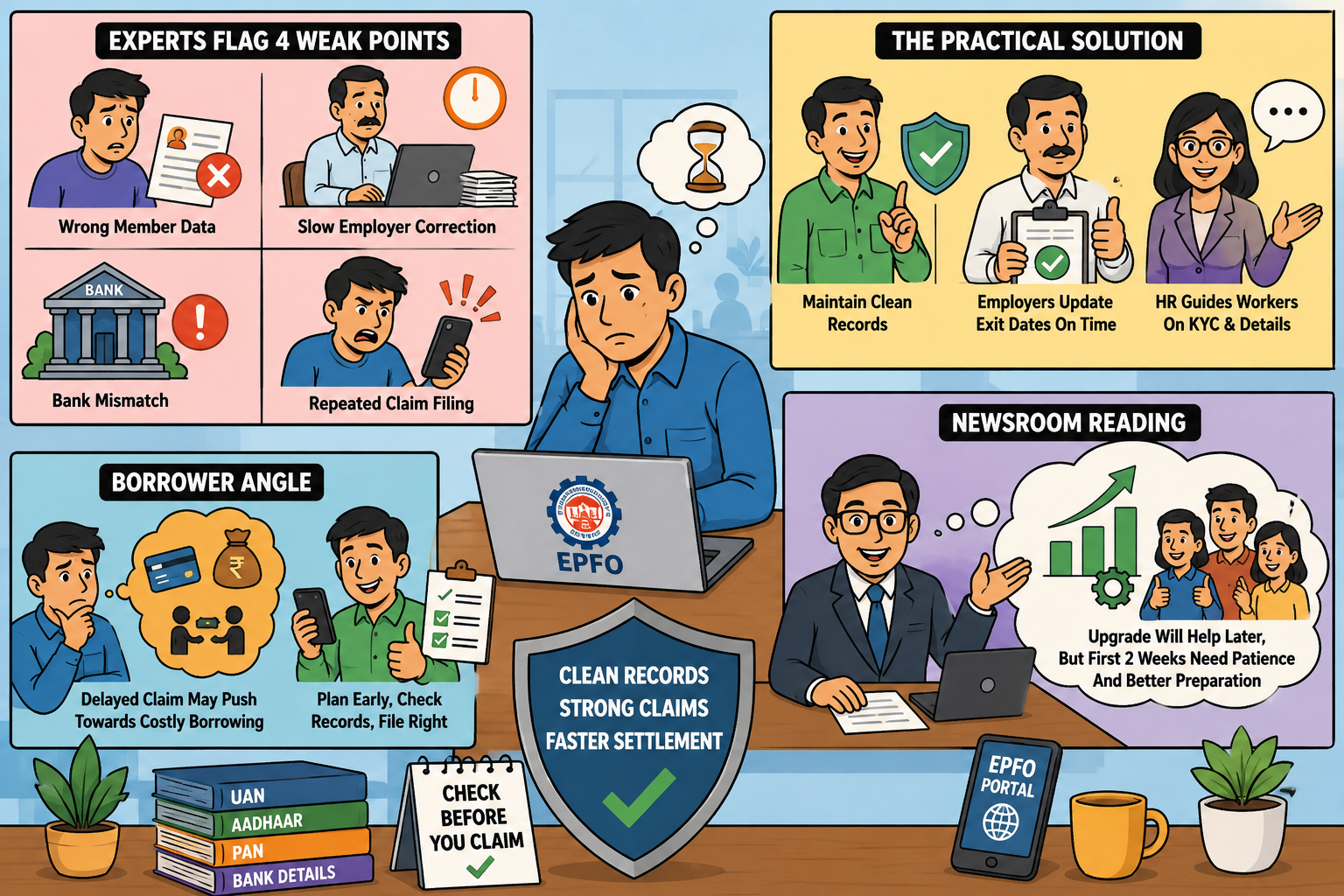
Payroll consultants and PF advisers usually flag 4 weak points after any system migration. First, wrong member data. Second, slow employer correction. Third, bank mismatch. Fourth, repeated claim filing by anxious members. These are not dramatic problems, but they create long queues.
The practical solution is to record hygiene before claim filing. Members should not wait for rejection to fix KYC. Employers should update exit dates on time. HR teams should guide workers when UAN, Aadhaar, PAN, or bank details do not match. This saves everyone a second round of work.
There is also a borrower angle here. Many salaried Indians use PF advances to avoid taking costly credit during a temporary cash gap. A delayed claim may push some users towards credit cards, personal loans, or informal borrowing. That is avoidable if members plan early and file only after checking records.
The newsroom reading is direct. EPFO’s upgraded system may help members later, but the first 2 weeks need patience and better preparation. A clean claim has a better chance of moving once the system stabilises.
EPFO has said on its official portal that it completed a major database consolidation and software upgrade to improve service delivery and member experience. It also said member and employer services are live in a phased manner after the upgrade.
Union Labour and Employment Minister Dr. Mansukh Mandaviya had earlier announced, through PIB on 6 February 2025, that EPFO crossed the 5 crore claim settlement mark for the first time. The statement linked the improvement to reforms such as auto-settlement, simplified member profile changes, smoother PF transfers, and better KYC compliance.
For members, the stakeholder message is not complicated. The system is back, but early processing may be slower. Employers should keep filings correct. Workers should avoid duplicate requests. HR teams should help employees fix records before claim filing.
EPFO’s 2-week PF claim delay is a short-term problem linked to a large technology upgrade. Members may face slower service, but the claim rules have not changed.
The safer action is to file only after checking KYC, bank details, UAN status, Aadhaar, PAN, and exit records. Once the system settles, the upgrade may help EPFO process claims with fewer errors and fewer avoidable rejections.
Why Are EPFO Claims Delayed After The Upgrade?
EPFO claims may take longer because the upgraded system is using extra verification during the first 2 weeks after migration.
Has EPFO Changed PF Withdrawal Rules?
No. The present update is about system processing, not a change in PF withdrawal rules.
Should members file the same claim again?
No. Duplicate claims can create more checks and may delay the request further.
What Should Members Check Before Filing A PF Claim?
Members should check UAN, Aadhaar, PAN, bank account, IFSC, mobile number, and the employer-updated exit date.
Can A Wrong Bank Account Delay PF Payment?
Yes. A wrong account number, old IFSC, closed account, or name mismatch can block payment after approval.
Will the upgrade help members later?
Yes, if the system stabilises well, it may reduce claim errors, wrong records, and repeated manual corrections.









.png&w=3840&q=75)



