By continuing, you agree to LoansJagat's Credit Report Terms of Use, Terms and Conditions, Privacy Policy, and authorize contact via Call, SMS, Email, or WhatsApp
Disclaimer: The information published on LoansJagat is intended for general informational and educational purposes only and should not be considered financial, legal, or investment advice. Interest rates, loan terms, statistics, and other data may change over time and may vary by lender or source. Please verify the latest information and consult a qualified financial advisor or the respective Bank/NBFC before making any financial decisions.
Subscribe Now
About the author

LoansJagat Team
‘Simplify Finance for Everyone.’ This is the common goal of our team, as we try to explain any topic with relatable examples. From personal to business finance, managing EMIs to becoming debt-free, we do extensive research on each and every parameter, so you don’t have to. Scroll up and have a look at what 15+ years of experience in the BFSI sector looks like.
Related News
Simplify All Your Loans Into One Affordable EMI

Customers Served

Debt Consolidated

1200+ Reviews

Locations in India
Club all Loans & Credit Card Bills into Single EMI

Quick Apply Loan
Consolidate your debts into one easy EMI.

Takes less than 2 minutes. No paperwork.

10 Lakhs+
Trusted Customers

2000 Cr+
Loans Disbursed

4.7/5
Google Reviews

50+
Banks & NBFCs Offers
Other services mentioned in this article
Key Insights
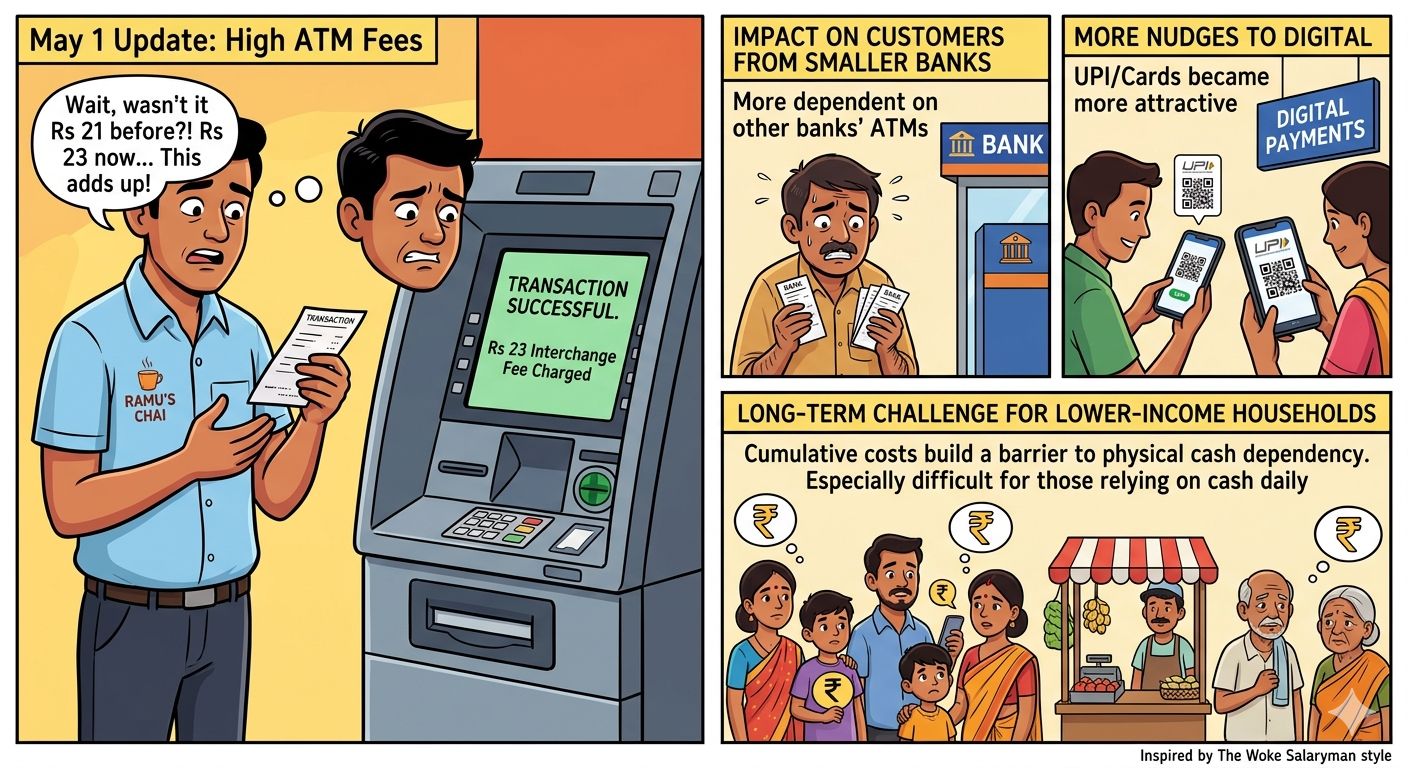
India became more expensive from May 1, as the Reserve Bank of India raised interchange fees because withdrawing cash from ATMs.
An ATM interchange fee is a charge one bank pays another for providing ATM services.
This fee is usually passed on to customers once they cross their free transaction limit. The Rs 2 increase, from Rs 21 to Rs 23 per transaction, may appear small in isolation.
ATMs after exhausting free transactions, it adds up meaningfully over the year but for a household that regularly uses them.
The increase in charges will apply nationwide and is expected to impact customers particularly from smaller banks.
On larger financial institutions for ATM infrastructure and related services, making them more vulnerable to rising costs.
This nudges more users toward digital payment alternatives in the short term.
If charges keep rising every few years, the cumulative cost of cash dependency becomes a real barrier for lower-income households who rely on physical cash for daily transactions over the longer term.
The table below captures the key rules, limits, and costs associated with ATM usage in India under the revised RBI framework effective May 1, 2026.
Read More - Indian Bank ATM Withdrawal Limit
Bank customers in metro cities, including Mumbai, Delhi, Chennai, Kolkata, Bengaluru, and Hyderabad, are entitled to three free transactions per month at other banks' ATMs.
In non-metro locations, this limit remains five free transactions per month. The free limits have not changed. Only the per-transaction charge after these limits has risen.
Also Read - Cardless Cash Withdrawal
For India's urban middle class with smartphones and UPI access, this fee hike may have little daily impact.
The concern is for working-class Indians in smaller towns, semi-urban areas, and states with low digital payment penetration.
ATMs, once seen as a revolutionary banking service, have been struggling in India with the rise of digital payments.
Government data shows that digital payments in India were valued at Rs 952 lakh crore in FY14, jumping to Rs 3,658 lakh crore by FY23.
*T&C Apply
The positive side is real. Higher interchange fees give banks and white-label operators better economics for maintaining ATMs in remote and rural areas.
Operators pull machines out of underserved locations entirely without viable revenue.
A small fee increase that keeps ATMs running in a village is better than zero fees and no ATM at all.
The RBI decided to revise these charges following requests from white-label ATM operators, who argued that rising operational expenses were affecting their business.
The costs of maintaining an ATM include cash logistics, hardware maintenance, site rentals, security, and software updates.
These costs have risen sharply since the last fee revision, making the hike a structural necessity rather than a policy choice.
Analysts tracking retail banking costs point out that the Rs 23 fee is still below what many other countries charge for equivalent ATM usage outside the home bank network.
The RBI's approach of maintaining a generous free transaction limit while raising the overage charge keeps the system fair for occasional users while making frequent cash-only users bear a modest cost.
The increase in ATM fees in India is a modest measure with a definite objective – ensuring that the cash infrastructure stays financially sustainable. For users dependent on ATMs, judicious use of free transactions and adopting the UPI system for everyday transactions should continue to be the optimal strategy.
What is ATM Withdrawals To Get Costlier From May 1?
Effective May 1, 2025, the Reserve Bank of India (RBI) increased ATM transaction charges to ₹23 per transaction (plus taxes) once free monthly limits are exceeded, up from the previous ₹21.
What are the charges for ATM transactions in India?
As of May 1, 2025, RBI guidelines stipulate a charge of ₹23 per transaction (plus taxes) for ATM withdrawals exceeding the free monthly limits.









.png&w=3840&q=75)



