
By continuing, you agree to LoansJagat's Credit Report Terms of Use, Terms and Conditions, Privacy Policy, and authorize contact via Call, SMS, Email, or WhatsApp
Disclaimer: The information published on LoansJagat is intended for general informational and educational purposes only and should not be considered financial, legal, or investment advice. Interest rates, loan terms, statistics, and other data may change over time and may vary by lender or source. Please verify the latest information and consult a qualified financial advisor or the respective Bank/NBFC before making any financial decisions.
Subscribe Now
About the author

Arshathul Afia
Arshathul Afia is a journalism graduate and fintech content writer with 4+ years of experience in digital publishing and research-led writing. She has written 200+ articles covering personal finance, lending, banking, digital payments, credit, insurance, and major financial developments in India. At LoansJagat, she focuses on simplifying complex fintech news, RBI updates, loan-related changes, policy developments, and industry trends for everyday readers. Her journalism background helps her approach stories with research, context, and clarity, while her SEO experience ensures content remains discoverable and relevant. She aims to make financial news easier to understand, practical, and useful for readers across India.
Related News
Simplify All Your Loans Into One Affordable EMI

Customers Served

Debt Consolidated

1200+ Reviews

Locations in India
Club all Loans & Credit Card Bills into Single EMI

Quick Apply Loan
Consolidate your debts into one easy EMI.

Takes less than 2 minutes. No paperwork.

10 Lakhs+
Trusted Customers

2000 Cr+
Loans Disbursed

4.7/5
Google Reviews

50+
Banks & NBFCs Offers
Other services mentioned in this article
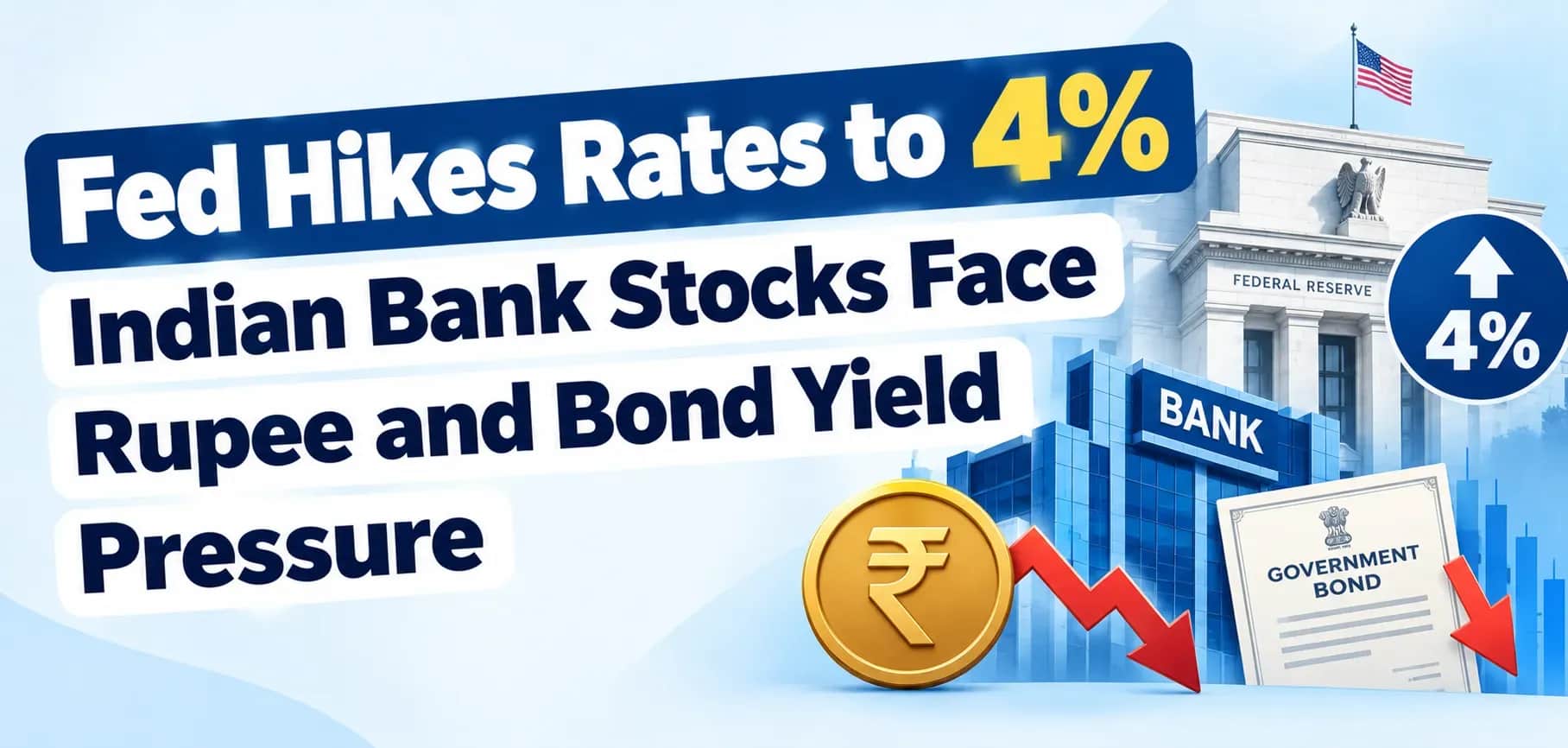
Fed’s 25 bps rate hike has raised pressure on the rupee and bond yields, putting Indian bank stocks under closer investor watch this week again.
Key Highlights
The Federal Reserve announced on 16th September 2026 an increase in the target range for the Federal Funds rate by 25 basis points to a range of 3.75% to 4%. The Fed stated that this action would help reduce the inflation level and help attain its 2% inflation target. The FOMC vote was 12-0.
India, on its part, need not worry about an immediate increase in EMIs. The rupee/USD exchange rate, along with foreign portfolio flows and the level of interest on Government of India bonds, will help determine the cost of funds and EMI levels. The cost of imports and foreign currency-denominated borrowings will increase with an increase in the dollar and yields.
A rate hike in September ended a more than three-year streak without an increase. The Fed increased the target range by 0.25% to 3.75% to 4.00%. It kept its policy of aggressive liquidity drainage, saying that inflation remained elevated.
Updated projections kept investors alert. Policymakers’ median projection placed the federal funds rate at 4.1% at the end of 2026. That does not guarantee another increase, but it keeps further tightening in view.
Indian shares offered a useful early check. Banking and financial stocks helped the wider market recover on 17 September, even as the stronger dollar and rate outlook limited gains. Early banking trade was uneven, with PSU banks stronger and private banks slightly weaker.
The main numbers behind the story are easier to read together.
The table illustrates how unwise it can be for Indian households to base their inflation outlook solely on developments related to the Fed. Indian CPI data released by the Ministry of Statistics & Programme Implementation on 14 September 2026 showed August inflation stood at 4.82% and 5.95% for food. The data is available in the CPI bulletin released on the same date. The direction of the INR can also impact inflation, as it can affect the cost of imported goods. Oil and food inflation, domestic demand and other factors will determine what the actual inflation will be.

For someone paying a home loan or personal loan in India, nothing in the US decision changes the EMI by itself. Indian banks still price loans using local funding costs, deposit rates, borrower risk, credit score, loan type and their own pricing policies. The Fed becomes relevant when a stronger dollar and higher global yields make funding more expensive or push domestic market rates upward.
Savers may benefit if deposit competition stays firm, although each bank sets its own pricing. Borrowers should look at the written offer rather than react to the headline. A June 2026 LoansJagat comparison showed starting personal loan rates across 6 large private banks ranging from 8.95% to 10.99%. That gap existed at the same time, showing how lender pricing and fees can outweigh a single overseas policy announcement.
Borrowers should compare the rate, processing fee, prepayment charge and total repayment before signing. A Fed hike cannot tell a customer which Indian loan is cheaper. That is where the borrower-level impact differs sharply from the market headline.
The rupee is one of the fastest channels through which US policy reaches India. It closed near 95.955 per dollar on 16 September after touching 95.975 during the session. After the hike, traders continued to watch the 96-per-dollar mark. Higher US yields can attract money towards dollar assets and pressure emerging-market currencies.
For banks, a weaker rupee can raise the cost of foreign currency liabilities and can hurt companies with large unhedged overseas borrowings. The effect depends on each lender’s funding structure, customer profile and foreign currency exposure.
Bond yields create another pressure point. When market yields rise, bond prices fall. Banks hold large debt portfolios, so securities carried at market-linked values can show valuation changes. Higher lending yields can support interest income if loan pricing adjusts faster than deposit costs. Those forces can move in opposite directions.
Investors are therefore separating banks by deposit strength, funding profile and loan book. Lenders more dependent on wholesale or overseas borrowing can face a tougher adjustment.
The warning signs were visible at the previous meeting. On 29 July 2026, the FOMC kept the rate at 3.50%-3.75%, but the vote was 9-3. Beth Hammack, Neel Kashkari and Lorie Logan dissented because they preferred a 25 bps increase. Inflation was already described as elevated against the 2% goal, with energy among the sectors affected by supply shocks.
June looked more settled. In 2026, the vote was unanimous to keep rates at 3.50%-3.75%. By July, three of the FOMC members indicated that they wanted rates to increase. In September, all 12 members of the FOMC voted to increase rates. The changes show the shifting perspective of members of the FOMC due to the high and prolonged inflation as well as the increase in the international prices of energy.
September's rise in rates was the first since July 26, when the Fed increased the target range to 5.25%-5.50%. With further cuts to 3.50%-3.75%, September 2026 is the first time rates have trended upward since then.

Anuj Gupta, a SEBI-registered research analyst, said that the recent 25 bps hike is likely to put additional near-term pressure on the equity markets, as it increases the likelihood of a stronger US dollar and rising bond yields. Gupta said that he expects the recent rate hikes to ultimately benefit the banks, as higher rates improve the margins and returns on banks’ disbursements.
Seema Srivastava, Senior Research Analyst at SMC Global Securities, described the banking effect as 2-sided. Higher bond yields, tighter liquidity and expensive external borrowing can hurt treasury and funding books. Banks with stronger deposit bases and floating-rate loan books, however, may be better placed if lending rates remain elevated.
Borrowers do not need to refinance simply because the Fed moved by 25 bps. Checking the reset clause, actual rate, remaining tenure, processing fee and prepayment cost shows whether switching lenders saves money.
The Fed’s return to rate hikes has created another global pressure point for Indian banking, but the first market response shows why broad conclusions can mislead. Indian bank stocks did not move in one direction. Financial shares supported the wider market even as the rupee and bond yields remained under pressure.
For households, the useful approach is practical. Watch the actual loan rate, fees and repayment terms rather than a US headline. For bank investors, the next signals are the rupee, bond yields, deposit pricing, loan growth and further guidance from the Fed. Those indicators will show whether September becomes the start of a longer tightening phase or remains a smaller adjustment in the rate cycle.
No. A US rate increase does not directly reset an Indian home loan. Any change depends on the lender’s benchmark, funding cost and the terms written into the loan agreement.
Increased US interest rates mean increased dollar strength and foreign investment outflows, resulting in an increase in global bond yields. These can ultimately impact a bank’s funding costs and treasury values, as well as alter demand and supply for loans and bank stocks.
They can help some lenders if loan yields rise faster than deposit costs. The benefit is not uniform. Deposit strength, loan composition and treasury exposure can produce different results across banks.
A recent Indian investing discussion asked whether stocks, bonds, gold or the rupee would react first. Currency and bond markets often respond quickly to dollar strength and global yields, while the effect on bank earnings develops more slowly.
Not automatically. A borrower should compare current Indian offers, fees, repayment tenure and eligibility. Delaying only because the Fed raised rates may not result in a cheaper loan later.









.png&w=3840&q=75)


