
By continuing, you agree to LoansJagat's Credit Report Terms of Use, Terms and Conditions, Privacy Policy, and authorize contact via Call, SMS, Email, or WhatsApp
Disclaimer: The information published on LoansJagat is intended for general informational and educational purposes only and should not be considered financial, legal, or investment advice. Interest rates, loan terms, statistics, and other data may change over time and may vary by lender or source. Please verify the latest information and consult a qualified financial advisor or the respective Bank/NBFC before making any financial decisions.
Subscribe Now
About the author

Arshathul Afia
Arshathul Afia is a journalism graduate and fintech content writer with 4+ years of experience in digital publishing and research-led writing. She has written 200+ articles covering personal finance, lending, banking, digital payments, credit, insurance, and major financial developments in India. At LoansJagat, she focuses on simplifying complex fintech news, RBI updates, loan-related changes, policy developments, and industry trends for everyday readers. Her journalism background helps her approach stories with research, context, and clarity, while her SEO experience ensures content remains discoverable and relevant. She aims to make financial news easier to understand, practical, and useful for readers across India.
Related News
Simplify All Your Loans Into One Affordable EMI

Customers Served

Debt Consolidated

1200+ Reviews

Locations in India
Club all Loans & Credit Card Bills into Single EMI

Quick Apply Loan
Consolidate your debts into one easy EMI.

Takes less than 2 minutes. No paperwork.

10 Lakhs+
Trusted Customers

2000 Cr+
Loans Disbursed

4.7/5
Google Reviews

50+
Banks & NBFCs Offers
Other services mentioned in this article
August 1 moves many Indian taxpayers into belated ITR filing, where late fees, interest, delayed refunds, and lost tax benefits may follow after July 31.
The last date for filing a regular ITR for salaried employees, pensioners and other taxpayers whose ITR due date is July 31 has arrived from August 1, 2026. Late returns will be accepted for AY 2026-27.
However, late filing may result in an additional fee pursuant to Section 234F, interest on unpaid tax, and restrictions on the extension of certain losses. The
The ₹5,000 mentioned in the headline is not charged to every late filer. It is the maximum fee that may apply in eligible cases after the July 31 deadline. Taxpayers with total income up to ₹5 lakh generally face a lower fee of ₹1,000. If a taxpayer has an income of less than ₹5 lakh, the fee has been capped at ₹1,000, where the income is. If a person who has not paid self-assessment tax also has unpaid tax, they may be liable for interest. Late returns can also jeopardize the carry-over of business or capital losses as well. That future tax loss could be greater than the fee for the investor.
The first impact will be felt by people who assumed that no tax payable meant no return was required. A salaried employee may have enough TDS to cover the final liability and still be required to file because total income crossed the applicable exemption limit. Once July 31 passes, the absence of tax dues does not automatically remove the late-filing fee. A refund claimant also loses time because processing starts only after filing and verification.
Loss-making investors face another risk. Consider a taxpayer who sold listed shares at a loss during FY 2025-26 and planned to use that loss against gains in a future year. Filing after the due date may stop the carry-forward, subject to the rules for that loss. The immediate fee might be ₹1,000 or ₹5,000. The lost tax set-off could be higher. December 31 should not be treated as a free extension. It is a late window with conditions attached.
August 31 does not replace July 31 for all non-audit taxpayers. The later date covers eligible business or professional cases and specified trusts under the staggered calendar announced for 2026. ITR-4 is available to qualifying resident individuals, HUFs and firms other than LLPs that use presumptive taxation and meet the form conditions. A consultant eligible under Section 44ADA may fall within that group. A salaried employee with capital gains cannot select ITR-4 merely to gain another month.
Return form and audit status must be checked together. Someone who changed jobs and received 2 Form 16s should confirm that both salaries appear. A shop owner using presumptive taxation should still check bank interest, rental income and TDS credits. Picking the wrong form can trigger a defective-return notice or leave income unreported.
The current calendar can be reduced to the following working guide.
The table is a guide, not a substitute for the form rules. Foreign assets, directorships, unlisted shares, business receipts and the type of capital gain can change the required return. Choosing a later deadline first and fitting the return around it is the wrong order.
Tax practitioners usually begin with reconciliation, not the upload button. Form 16 should be matched with Form 26AS and the Annual Information Statement. Bank interest needs a separate check because a person may hold several accounts or fixed deposits. Capital gains should be matched with broker statements. Rental income, freelance receipts and income from a previous employer are also easy to miss when the return is pre-filled.
Verification needs the same attention. The current period is 30 days from filing. A return uploaded before the due date but verified after the permitted period can be treated as filed on the verification date, bringing late-filing consequences. The LoansJagat filing review, published on July 22, 2026, listed AIS mismatches, property income, capital gains, tax-regime choice, wrong forms and delayed verification as common errors. Its borrower-focused reading is relevant. A defective or delayed return can complicate a home loan or business loan file when the lender asks for the latest ITR acknowledgement and income computation.
The separate filing deadlines came from the Union Budget 2026-27, presented by Finance Minister Nirmala Sitharaman on February 1, 2026. A Press Information Bureau release issued at 12:52 pm that day confirmed that taxpayers using ITR-1 and ITR-2 would continue to follow the July 31 deadline. It suggested that cases of business and trusts, other than audits, be scheduled for August 31. That announcement caused the 2 dates to become confusing.
The previous assessment year was different. The regular (non-audit) deadline was extended from July 31, 2025 to September 15, 2025 due to changes in the forms and filing utilities for AY 2025-26. Others were hoping for the same in 2026. No extension was announced for ITR-1 & ITR-2 before the 31st July cut-off. The tax department mailed reminders on July 9, July 17, and July 27, and a July 25 reminder that with no tax, it means no filing.
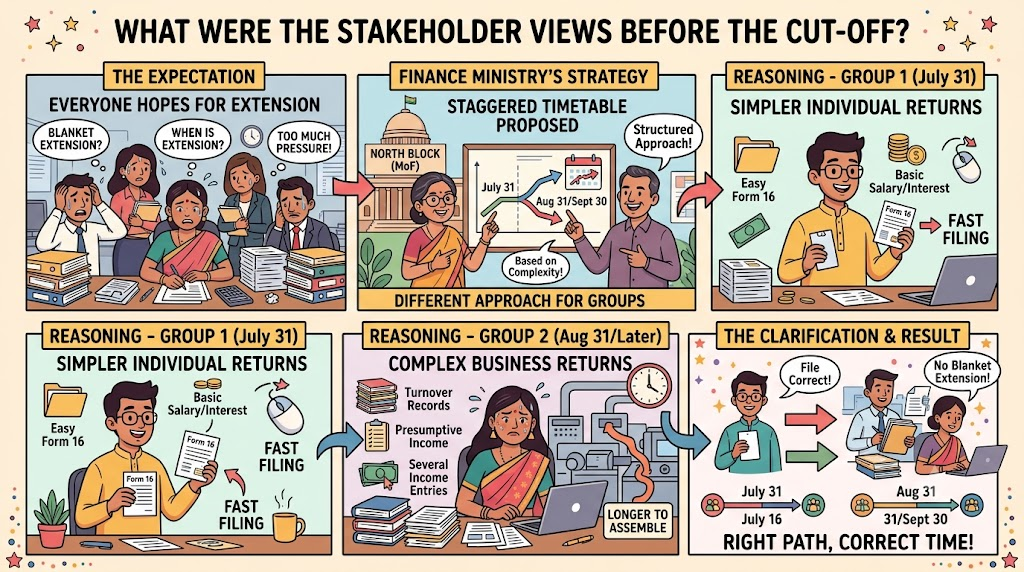
The Finance Ministry backed a staggered timetable, keeping simpler individual returns on July 31 and giving selected business cases another month. Business returns can involve turnover records, presumptive-income calculations and several income entries that take longer to assemble than a basic salary return. The later date was meant for that group, not as a blanket extension.
The Income Tax Department pushed early filing and accuracy. Tax preparers had a narrower warning: last-night filing produces avoidable errors. A person with 2 employers may miss 1 salary entry. An investor may copy the broker’s net profit without reporting the required capital-gain details. A landlord may overlook municipal tax or co-ownership information. For borrowers, inconsistent income figures can also invite more lender questions. LoansJagat’s editorial view is that no taxpayer should enter rounded or invented income merely to produce an acknowledgement for a loan application.
The first step is to confirm whether July 31 applied. An eligible ITR-4 filer may still have until August 31. Others should prepare a belated return without waiting for December. The taxpayer should download AIS and Form 26AS, collect every Form 16, review bank interest certificates, check broker statements and calculate any self-assessment tax. Where tax remains due, payment should be made before filing.
Verification should be completed immediately after upload. Aadhaar OTP, net banking and other approved routes are available, depending on access. The acknowledgement should be saved with the tax computation and payment challan. A return containing an error may be revised within the permitted period, but that should not become an excuse for careless filing. A checked return filed slightly later is safer than a rushed return made from incomplete records.
August 1, 2026 changes the position for most ITR-1 and ITR-2 filers who missed July 31. They can still submit an AY 2026-27 return, though it will be belated. The fee can reach ₹5,000, interest may apply on unpaid tax, and certain loss carry-forward benefits may be affected. Refunds may also take longer.
Eligible ITR-4 and specified non-audit cases are still under the regular window till 31st August. For taxpayers who are behind, they should now concentrate on getting their income reported correctly, tax reconciliation, and timely verification. The outer belated-return date for the ordinary situation is December 31, not the preferred filing date.
The Section 234F fee can reach ₹5,000. Total income not exceeding ₹5 lakh is capped at ₹1000.
Yes. A belated return can typically be filed until December 31, 2026, or the earlier date of assessment.
Eligible individuals who have filed ITR-4 and specified non-audit business or professional cases or certain trusts can avail of the later date.
If the income exceeds the applicable exemption threshold or if there is any other filing condition, it is still required to be filed.
The validation must be done within 30 days. Consequences may arise if it is delayed because the filing date may be impacted by verification.










.png&w=3840&q=75)


