Disclaimer: The information published on LoansJagat is intended for general informational and educational purposes only and should not be considered financial, legal, or investment advice. Interest rates, loan terms, statistics, and other data may change over time and may vary by lender or source. Please verify the latest information and consult a qualified financial advisor or the respective Bank/NBFC before making any financial decisions.
Subscribe Now
About the author

Arshathul Afia is a journalism graduate and fintech content writer with 4+ years of experience in digital publishing and research-led writing. She has written 200+ articles covering personal finance, lending, banking, digital payments, credit, insurance, and major financial developments in India. At LoansJagat, she focuses on simplifying complex fintech news, RBI updates, loan-related changes, policy developments, and industry trends for everyday readers. Her journalism background helps her approach stories with research, context, and clarity, while her SEO experience ensures content remains discoverable and relevant. She aims to make financial news easier to understand, practical, and useful for readers across India.
Related News
Simplify All Your Loans Into One Affordable EMI

Customers Served

Debt Consolidated

1200+ Reviews

Locations in India
Club all Loans & Credit Card Bills into Single EMI

Quick Apply Loan
Consolidate your debts into one easy EMI.

Takes less than 2 minutes. No paperwork.

10 Lakhs+
Trusted Customers

2000 Cr+
Loans Disbursed

4.7/5
Google Reviews

50+
Banks & NBFCs Offers
Foreign investors hold substantial stakes in HDFC Bank and ICICI Bank as Jefferies examines potential LTCG relief and its implications for India's overseas equity flows.
Key Highlights
Jefferies is examining whether lower long-term capital gains tax would draw foreign investment into India. HDFC Bank and ICICI Bank feature in that discussion. The banks' shareholding statements for 30 September 2026 show overseas investors hold nearly half of HDFC Bank and just over half of ICICI Bank.
Jefferies' strategy report dated 28 October 2026 connects possible relief with stronger foreign investor sentiment, equity inflows and support for the rupee. It also identifies a constraint: lower tax collections would affect government revenue. The discussion concerns taxes paid by investors on their gains, rather than a reduction in the banks' operating taxes.
Indian shareholders continue to face the prevailing capital gains rules. Qualifying equity LTCG attracts a 12.5% base rate above the applicable ₹1.25 lakh annual threshold, while qualifying short-term gains attract 20%. Surcharge and cess apply separately. The tax treatment depends on how long the shares were held and which transaction conditions apply. A company's foreign shareholding does not determine that treatment.
For borrowers, a different calculation applies. A bank loan EMI depends on the outstanding principal, interest rate and repayment period. Equity LTCG taxes the shareholder's realised gain. The practical implication is that an investor tax concession cannot be treated as an EMI reduction. A change in the value of HDFC Bank or ICICI Bank shares does not itself rewrite a customer's loan contract.
“Banks are our key preference,” Jefferies said when assessing sectors that have faced substantial foreign selling. Its strategy favours large-cap shares over mid-caps. HDFC Bank and ICICI Bank therefore feature in a wider discussion about foreign investment returning to established Indian companies, rather than a tax concession directed at either lender. Jefferies links the potential benefit to improved investment flows.
The brokerage discusses a general capital gains rate reduction, an FPI-specific LTCG cut and calculating foreign investors' gains in US dollar terms. A rate cut changes the tax charged on a gain; a dollar-based calculation changes how that gain is measured. Jefferies says the government would need to weigh relief against the revenue forgone.
HDFC Bank's September disclosure records foreign ownership under its foreign investment limits statement. ICICI Bank provides the corresponding figure in Table VI of its shareholding filing. Both figures use the same reporting date.
These figures measure aggregate foreign ownership, which is broader than FPI holdings alone. An FPI-specific concession concerns a defined investor category, while these figures describe the banks' wider overseas shareholding.
With consultations for the upcoming Union Budget underway, Nirmala Sitharaman said the government was open to suggestions on removing LTCG tax. She spoke in New Delhi on 13 October 2026, noting that domestic and foreign investors had been discussing capital gains taxation and securities transaction tax.
Sitharaman said welfare, education and healthcare spending would remain protected under the government's fiscal approach. Investor requests for tax relief therefore form part of a debate that also covers public spending. Jefferies also identifies the cost of relief for the exchequer.
Transfers from 23 July 2024 came under the revised capital gains provisions. The Finance (No. 2) Act, 2024, introduced the revised capital gains provisions, increasing the long-term capital gains tax rate on qualifying equity investments from 10% to 12.5% and raising the annual exemption threshold from ₹1 lakh to ₹1.25 lakh. On 24 July 2024, the Central Board of Direct Taxes (CBDT) published FAQs under Release ID 2036604 to explain the proposed changes.
Those changes provide the background to the present debate. For HDFC Bank and ICICI Bank shareholders, the relevant distinction remains between the tax on an investment gain and the operating performance of the bank itself.
Foreign ownership puts HDFC Bank and ICICI Bank firmly within the LTCG discussion. Jefferies' argument centres on investment flows, while Sitharaman's remarks place tax suggestions within Budget consultations. For shareholders, capital gains taxation and bank earnings remain separate considerations. For borrowers, the relevant terms remain those of the loan contract.
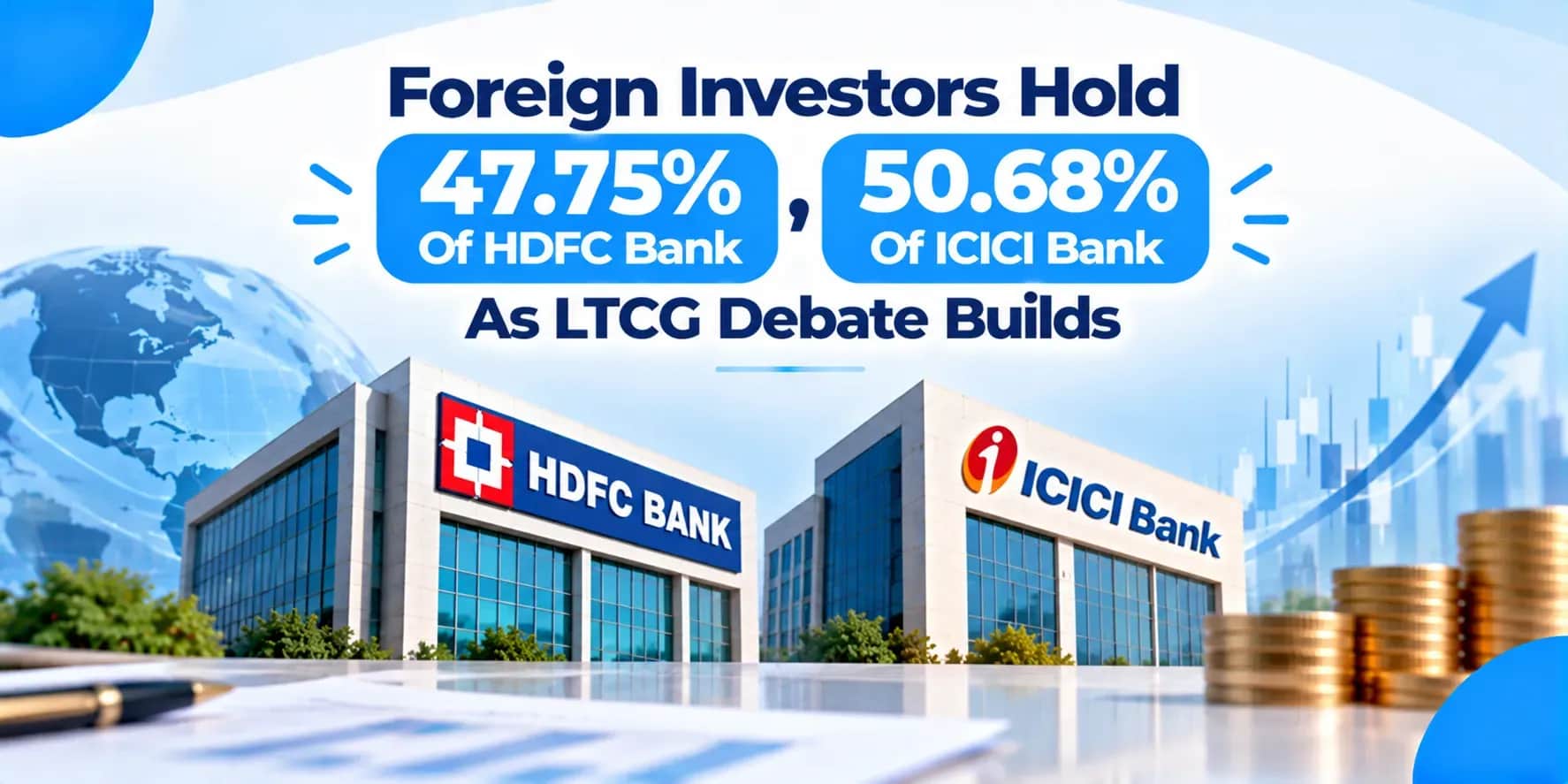
At 30 September 2026, aggregate foreign ownership stood at 47.75% in HDFC Bank and 50.68% in ICICI Bank, according to the banks' respective September shareholding disclosures.
No. Aggregate foreign ownership is a broader measure. FPI holdings refer to a particular investor category, so the figures should not be presented as interchangeable.
An equity LTCG concession concerns shareholders' investment gains. Home loan EMIs follow the borrowing contract, including its principal, interest rate and repayment period.
LTCG is a tax on qualifying long-term gains from selling shares. Applicable equity gains above ₹1.25 lakh attract a 12.5% base rate, subject to conditions.
Jefferies discusses both a broader tax reduction and an FPI-specific concession. These are policy alternatives; the ownership figures alone do not establish which approach is preferable.
Start your journey today
Apply Now*T&C apply