
By continuing, you agree to LoansJagat's Credit Report Terms of Use, Terms and Conditions, Privacy Policy, and authorize contact via Call, SMS, Email, or WhatsApp
Disclaimer: The information published on LoansJagat is intended for general informational and educational purposes only and should not be considered financial, legal, or investment advice. Interest rates, loan terms, statistics, and other data may change over time and may vary by lender or source. Please verify the latest information and consult a qualified financial advisor or the respective Bank/NBFC before making any financial decisions.
Subscribe Now
About the author

Arshathul Afia
Arshathul Afia is a journalism graduate and fintech content writer with 4+ years of experience in digital publishing and research-led writing. She has written 200+ articles covering personal finance, lending, banking, digital payments, credit, insurance, and major financial developments in India. At LoansJagat, she focuses on simplifying complex fintech news, RBI updates, loan-related changes, policy developments, and industry trends for everyday readers. Her journalism background helps her approach stories with research, context, and clarity, while her SEO experience ensures content remains discoverable and relevant. She aims to make financial news easier to understand, practical, and useful for readers across India.
Related News
Simplify All Your Loans Into One Affordable EMI

Customers Served

Debt Consolidated

1200+ Reviews

Locations in India
Club all Loans & Credit Card Bills into Single EMI

Quick Apply Loan
Consolidate your debts into one easy EMI.

Takes less than 2 minutes. No paperwork.

10 Lakhs+
Trusted Customers

2000 Cr+
Loans Disbursed

4.7/5
Google Reviews

50+
Banks & NBFCs Offers
Other services mentioned in this article
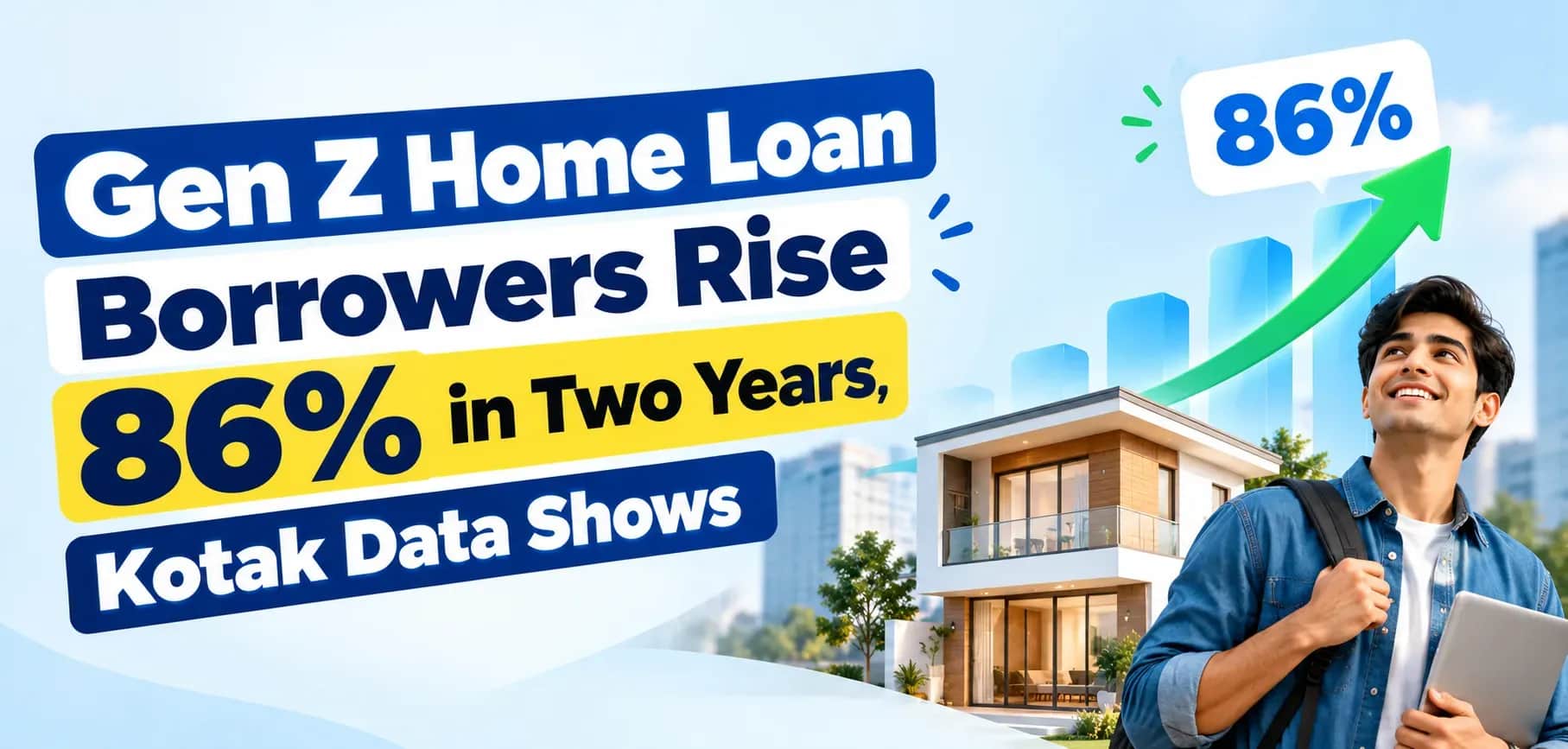
Kotak’s home-loan borrowers aged 25–30 rose 86% between FY24 and FY26, showing that younger salaried Indians are entering property ownership sooner and in larger numbers.
Key Highlights
Kotak data reported on 23 September 2026 shows that borrowers aged 25–30 became the fastest-growing younger cohort in the bank’s individual home-loan book between FY24 and FY26. The India-focused figures cover Kotak customers, with Nakul Saxena, Head of Home Loans at Kotak Mahindra Bank, linking the change to career progress, rising incomes and dual-income households.
For young Indian buyers, the immediate gain is a longer working period to repay a loan and build ownership. The risk also begins earlier. A 20-year or 30-year schedule can restrict job moves, savings and family spending when income slows.
The 25–30 group added 1,056 borrowers over 2 financial years, moving from 1,234 in FY24 to 2,290 in FY26. Kotak’s 30–45 cohort grew 26% during the same period, which left the younger group expanding far faster from its smaller starting base.
The following table uses the figures published on 23 September 2026. It keeps the comparison to Kotak’s individual home-loan borrowers and does not treat the bank’s portfolio as an all-India borrower census.
The 3-percentage-point rise shows that younger borrowers gained weight inside Kotak’s book. The dataset represents Kotak’s portfolio, so its conclusion stays at lender level: the bank saw a sharp age shift among its borrowers during FY24–FY26.
An earlier purchase can give a salaried buyer more repayment years before retirement. It may also replace rent with an asset-linked monthly payment, particularly when a buyer chooses a smaller home, a peripheral location or a Tier 2 city within the available budget.
The trade-off is heavy. Stamp duty, registration, interiors and maintenance arrive alongside the down payment, while a floating-rate loan can change the EMI or tenure. Young applicants also face career switches, relocation and postgraduate study, so property choice and cash reserves deserve attention.
India’s housing-finance base has widened over the past decade. The Economic Survey 2025–26, presented on 29 January 2026, reported that outstanding individual housing loans rose from about ₹10 lakh crore at the end of March 2015 to more than ₹37 lakh crore at the end of March 2025. Their share of GDP increased from 8% to over 11%.
Public housing support has expanded besides commercial credit. A government update published on 17 September 2025 said PMAY had sanctioned over 1.2 crore houses and handed over nearly 94 lakh, while PMAY-U 2.0 planned support for 1 crore more urban families.
Kotak attributes the movement to earlier career progress, higher income, joint household earnings and a willingness to begin with a home that fits the present budget. Digital property searches and online loan applications have also reduced the work required at the discovery stage, even though legal checks and final approval still need careful review.
The earlier LoansJagat report, updated on 25 May 2026, placed younger demand alongside digital applications and interest from Tier 2 and Tier 3 cities. The LoansJagat view is that age alone cannot define readiness. A young borrower is better placed when the EMI leaves room for emergency savings, insurance and regular investing after purchase costs.
That reading adds a borrower test to Kotak’s growth data. A lender can approve an application based on income, credit history and property checks, but approval does not confirm that the household can carry every ownership cost for 20 years or longer.
“What is changing is the age at which people are taking that decision,” Nakul Saxena said in the report published on 23 September 2026. Kotak’s home-loan head also pointed to growing earnings, double-income families and purchases made within current budgets rather than waiting for a larger property later.
Union Housing and Urban Affairs Minister Manohar Lal gave the wider policy view at a housing-finance conference in New Delhi on 13 February 2026. An official release issued that day said he called for housing finance to become more accessible, affordable and inclusive, backed by transport-linked housing and better data on available homes.
For lenders, the workable response is stricter affordability discussions before sanction. For borrowers, the safer process includes comparing the total interest cost, processing and legal fees, reset terms, insurance conditions and prepayment rules. Buyers should also verify title records, approvals, possession terms and construction progress before signing.
Kotak’s 86% rise gives a specific signal: more of its 25–30-year-old customers entered home ownership between FY24 and FY26. Earlier ownership can extend the repayment window and help families acquire a home sooner, yet the benefit depends on a manageable property price and enough cash left after purchase.
India’s wider housing-credit expansion and public housing programmes support the direction of travel. Still, Kotak’s dataset describes one lender. For each young buyer, the better result will come from a smaller affordable commitment, verified property papers and room in the monthly budget for life beyond the EMI.
Kotak’s count of borrowers aged 25–30 rose from 1,234 in FY24 to 2,290 in FY26. The 86% figure describes growth within Kotak’s individual home-loan book.
No. Kotak’s figures show a younger shift among one bank’s borrowers. An all-India measure would combine comparable age data from banks, housing-finance companies, regions and borrower types.
Age 25 is not automatically early if income is stable, the down payment is ready and the EMI permits emergency savings. The property must also suit likely work and family plans.
A buyer facing job uncertainty should keep a separate repayment reserve and avoid using every liquid investment for the down payment. A smaller loan can reduce pressure during an income break.
Applicants should compare the interest structure, full tenure cost, fees, prepayment conditions and insurance terms. They should verify the property’s title, approvals and possession record through qualified legal review.









.png&w=3840&q=75)


