
By continuing, you agree to LoansJagat's Credit Report Terms of Use, Terms and Conditions, Privacy Policy, and authorize contact via Call, SMS, Email, or WhatsApp
Disclaimer: The information published on LoansJagat is intended for general informational and educational purposes only and should not be considered financial, legal, or investment advice. Interest rates, loan terms, statistics, and other data may change over time and may vary by lender or source. Please verify the latest information and consult a qualified financial advisor or the respective Bank/NBFC before making any financial decisions.
Subscribe Now
About the author

LoansJagat Team
‘Simplify Finance for Everyone.’ This is the common goal of our team, as we try to explain any topic with relatable examples. From personal to business finance, managing EMIs to becoming debt-free, we do extensive research on each and every parameter, so you don’t have to. Scroll up and have a look at what 15+ years of experience in the BFSI sector looks like.
Related News
Simplify All Your Loans Into One Affordable EMI

Customers Served

Debt Consolidated

1200+ Reviews

Locations in India
Club all Loans & Credit Card Bills into Single EMI

Quick Apply Loan
Consolidate your debts into one easy EMI.

Takes less than 2 minutes. No paperwork.

10 Lakhs+
Trusted Customers

2000 Cr+
Loans Disbursed

4.7/5
Google Reviews

50+
Banks & NBFCs Offers
Other services mentioned in this article
SEBI has changed how gold and silver ETFs calculate NAV. From 1 April 2026, valuation shifts from LBMA benchmarks to Indian exchange polled spot prices.
Gold and silver ETFs in India track bullion prices, but their NAV depends on how mutual funds value the physical gold and silver held in custody. Till now, valuation has largely referenced LBMA benchmark prices and then applied Indian adjustments like INR conversion and local levies.
SEBI has now directed mutual funds to use domestic spot prices published by recognised Indian stock exchanges, based on polled spot prices used for settlement of physically delivered bullion derivatives. The regulator’s aim is a valuation method that mirrors Indian market discovery more closely and reduces variation in NAV computation across fund houses.
Read More - Gold Loans Race Ahead As Banks Shift To Secured Credit
What Changes From 1 April 2026 For Gold And Silver ETFs?
SEBI’s circular, titled “Valuation of physical Gold and Silver held by mutual fund schemes” dated 26 February 2026, mandates the shift effective 1 April 2026. The circular number is HO/(68)2026-IMD-POD-2/I/5780/2026, and it is available on SEBI’s website under Legal → Circulars (Feb 2026).
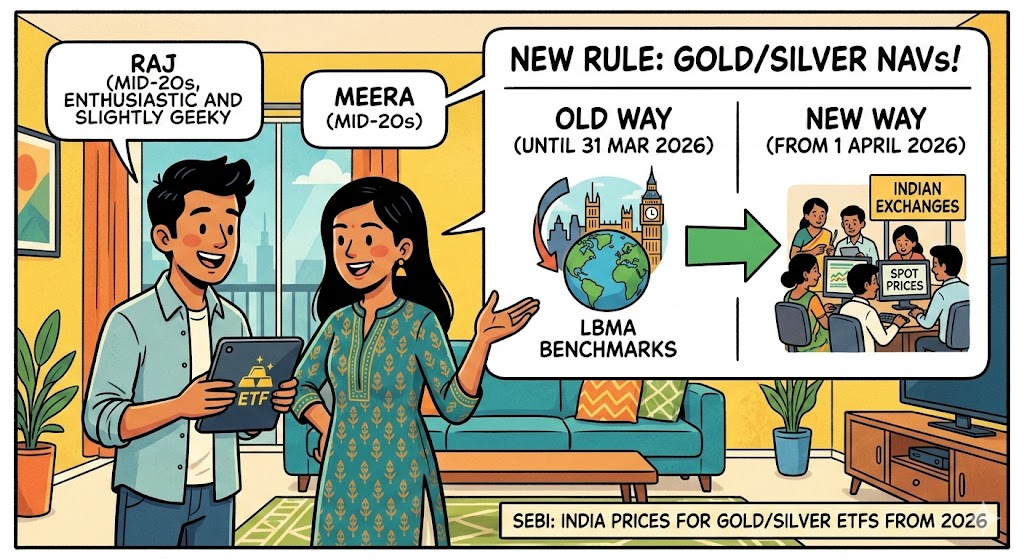
For investors, this is a back-end change but it can alter day-to-day NAV behaviour. Instead of taking LBMA prices and building up a domestic value using layered adjustments, AMCs will use the polled spot prices published by recognised Indian stock exchanges. Reports also note that AMFI, in consultation with SEBI, will prescribe a uniform implementation policy, so valuation stays standardised across the industry.
Before the comparison table, here is the simplest way to read the change.
After the shift, NAVs may feel more “local” during phases when Indian bullion trades at a premium or discount to global benchmarks, because the reference itself becomes domestic. (Reuters)
The conversation around precious metal ETFs has been active since 2025, driven by sharp investor interest. In June 2025, gold and silver ETFs saw ₹4,085 crore net inflows, with ₹2,080 crore into gold ETFs and ₹2,005 crore into silver ETFs, as reported by Business Standard. That level of flows put a spotlight on how ETFs are valued and how closely NAV reflects the domestic bullion market.
LoansJagat also flagged a regulatory consultation angle earlier. In its report dated 19 July 2025, it stated SEBI had proposed moving valuation to domestic spot prices and that public feedback was open until 6 August 2025. This context matters because the final circular in February 2026 follows that direction, now with a fixed implementation date.
Also Read - Gold Loans Surge 125%: Why Budget 2026 May Focus On Tier-2, Tier-3 Credit Access
Before the timeline table, this is the clean sequence of what happened.
*T&C Apply
After the announcement, multiple explainers across outlets pointed out that the shift is away from “international benchmark first” pricing and towards India’s own exchange-led spot discovery.
SEBI’s direction, as reported widely, is that domestic exchange spot prices should improve alignment with Indian market conditions and create a more consistent valuation framework for bullion held by mutual fund schemes.
Industry updates also say AMFI will standardise the implementation policy in consultation with SEBI, signalling fewer valuation differences across AMCs once the rule starts.
Market-facing commentary expects narrower gaps between NAV and domestic trading cues for bullion-backed funds.
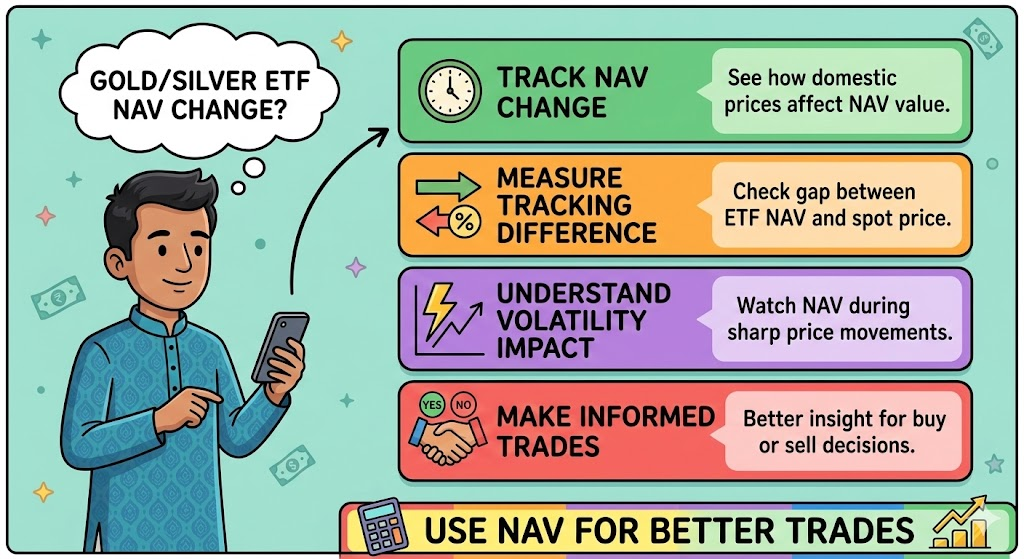
From 1 April 2026, gold and silver ETFs in India will compute NAV using domestic exchange polled spot prices, not LBMA benchmarks. Investors should track NAV behaviour around the transition, especially for tracking difference during volatile bullion phases.
Related Financial News | |||









.png&w=3840&q=75)



