By continuing, you agree to LoansJagat's Credit Report Terms of Use, Terms and Conditions, Privacy Policy, and authorize contact via Call, SMS, Email, or WhatsApp
Disclaimer: The information published on LoansJagat is intended for general informational and educational purposes only and should not be considered financial, legal, or investment advice. Interest rates, loan terms, statistics, and other data may change over time and may vary by lender or source. Please verify the latest information and consult a qualified financial advisor or the respective Bank/NBFC before making any financial decisions.
Subscribe Now
About the author

LoansJagat Team
‘Simplify Finance for Everyone.’ This is the common goal of our team, as we try to explain any topic with relatable examples. From personal to business finance, managing EMIs to becoming debt-free, we do extensive research on each and every parameter, so you don’t have to. Scroll up and have a look at what 15+ years of experience in the BFSI sector looks like.
Related News
Simplify All Your Loans Into One Affordable EMI

Customers Served

Debt Consolidated

1200+ Reviews

Locations in India
Club all Loans & Credit Card Bills into Single EMI

Quick Apply Loan
Consolidate your debts into one easy EMI.

Takes less than 2 minutes. No paperwork.

10 Lakhs+
Trusted Customers

2000 Cr+
Loans Disbursed

4.7/5
Google Reviews

50+
Banks & NBFCs Offers
Other services mentioned in this article
A loan default case in Andhra Pradesh has now grown into an alleged fake-document and mule-account fraud, with authorities seizing assets worth ₹7 crore.
Key Takeaways
What happened: Neelam Pavan Kumar was arrested for allegedly using forged documents and mule accounts to secure loans of around ₹5 crore since 2019.
Previous update: India has seen similar mule-account crackdowns in 2026, including fraud trails worth ₹77 crore and ₹547 crore, along with cases involving nearly 10,000 accounts.
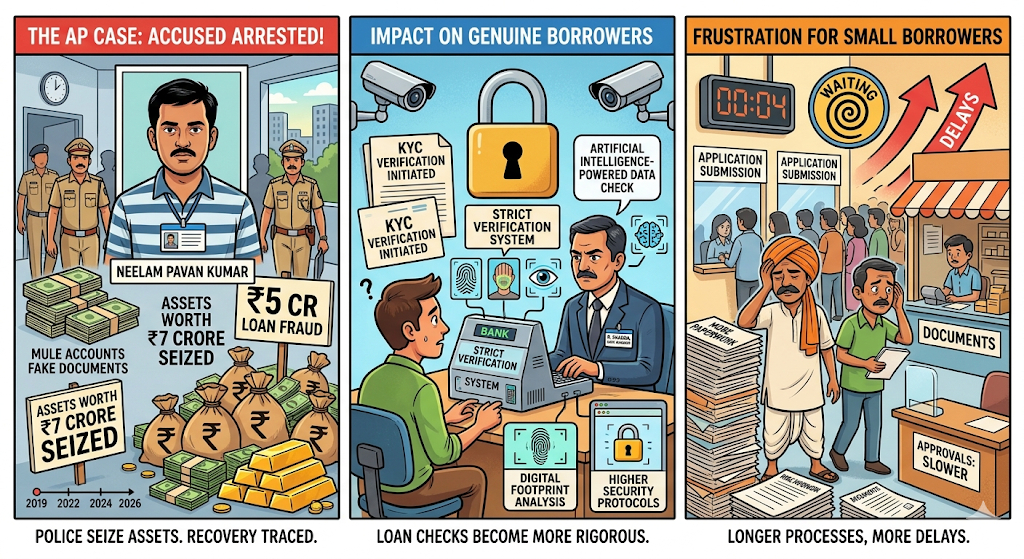
The Andhra Pradesh case is not being treated as a routine loan default. According to The Wakeup Times report dated May 18, 2026, police said the accused, Neelam Pavan Kumar, allegedly opened mule accounts using fake documents and borrowed loans worth about ₹5 crore since 2019. Assets worth ₹7 crore were seized.
In the short term, the seizure may help lenders trace recoverable assets. In the long term, such cases can make loan checks stricter for genuine borrowers. The negative side is simple: if fake accounts enter the banking chain, small borrowers may face longer verification, more paperwork and slower approvals.
The seizure value being higher than the reported loan value has raised interest in the asset trail. However, the accused should be described as “accused” or “allegedly involved” unless a court records guilt.
For ordinary Indians, the first impact may come through tighter KYC checks. Banks and NBFCs may verify PAN, Aadhaar, account ownership, income documents and repayment capacity more closely before approving loans. This can reduce fraud but also slow loan disbursal.
There is a positive side too. Stronger checks can protect borrowers whose identity documents are misused. It can also reduce fraud-linked NPAs, making lenders more confident while offering loans to genuine salaried, MSME and self-employed borrowers.
*T&C Apply
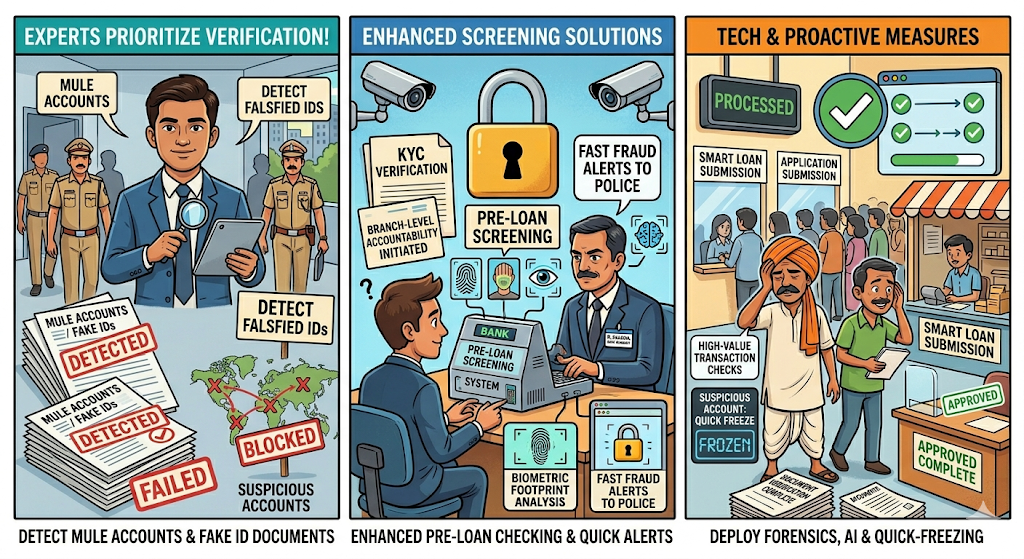
Cyber and banking investigators have repeatedly flagged mule accounts as a key channel for moving fraud money. In a separate ₹1,000 crore case, NDTV reported that CBI found accounts opened using falsified identification documents and fake business verification.
The solution is stronger pre-loan screening, faster fraud alerts between banks and police, and stricter checks on newly opened accounts used for high-value transactions. Lenders also need better document forensics, branch-level accountability and quick freezing of suspicious accounts.
For background on loan recovery and seized collateral, LoansJagat earlier reported how lenders handle seized properties and recovery timelines in stressed loan cases.
The Andhra Pradesh case shows how loan default can turn into a fraud probe when fake documents and mule accounts are alleged.
For borrowers, the warning is direct: keep documents safe, avoid sharing bank accounts, and report misuse quickly.
What can someone do if partners take a business loan in his name and later blame him for the fraud?
First, he should keep every loan paper, bank notice, message, partnership record and payment proof safely. Then he should give a written complaint to the bank, police station and, if the amount is big, the Economic Offences Wing. He can ask the bank for copies of the loan application, KYC papers, guarantor details and sanction file.
If partners or bank staff used his name without proper consent, that must be clearly written in the complaint. A lawyer should also be contacted quickly, mainly if police action or arrest is possible. Bank notices should not be ignored.
How Can Partners Get A Loan For An Existing Business?
For a partnership business, the partners can approach a bank or NBFC with basic business and income papers. Usually, lenders ask for the partnership deed, PAN, GST details, bank statements, ITRs, profit and loss statement, balance sheet and KYC of all partners. The business should show regular sales and a decent repayment record.
Partners should also decide how much loan is needed and who will handle EMIs. Before applying, compare interest rate, charges, tenure and collateral rules. It is better to keep written approval from all partners, so there is no dispute later.









.png&w=3840&q=75)



