
By continuing, you agree to LoansJagat's Credit Report Terms of Use, Terms and Conditions, Privacy Policy, and authorize contact via Call, SMS, Email, or WhatsApp
Disclaimer: The information published on LoansJagat is intended for general informational and educational purposes only and should not be considered financial, legal, or investment advice. Interest rates, loan terms, statistics, and other data may change over time and may vary by lender or source. Please verify the latest information and consult a qualified financial advisor or the respective Bank/NBFC before making any financial decisions.
Subscribe Now
About the author

Arshathul Afia is a journalism graduate and fintech content writer with 4+ years of experience in digital publishing and research-led writing. She has written 200+ articles covering personal finance, lending, banking, digital payments, credit, insurance, and major financial developments in India. At LoansJagat, she focuses on simplifying complex fintech news, RBI updates, loan-related changes, policy developments, and industry trends for everyday readers. Her journalism background helps her approach stories with research, context, and clarity, while her SEO experience ensures content remains discoverable and relevant. She aims to make financial news easier to understand, practical, and useful for readers across India.
Related News
Simplify All Your Loans Into One Affordable EMI

Customers Served

Debt Consolidated

1200+ Reviews

Locations in India
Club all Loans & Credit Card Bills into Single EMI

Quick Apply Loan
Consolidate your debts into one easy EMI.

Takes less than 2 minutes. No paperwork.

10 Lakhs+
Trusted Customers

2000 Cr+
Loans Disbursed

4.7/5
Google Reviews

50+
Banks & NBFCs Offers
Other services mentioned in this article
Lenders are more particular about unsecured gold loans, and borrowers are taking larger loans with more known jewellery.
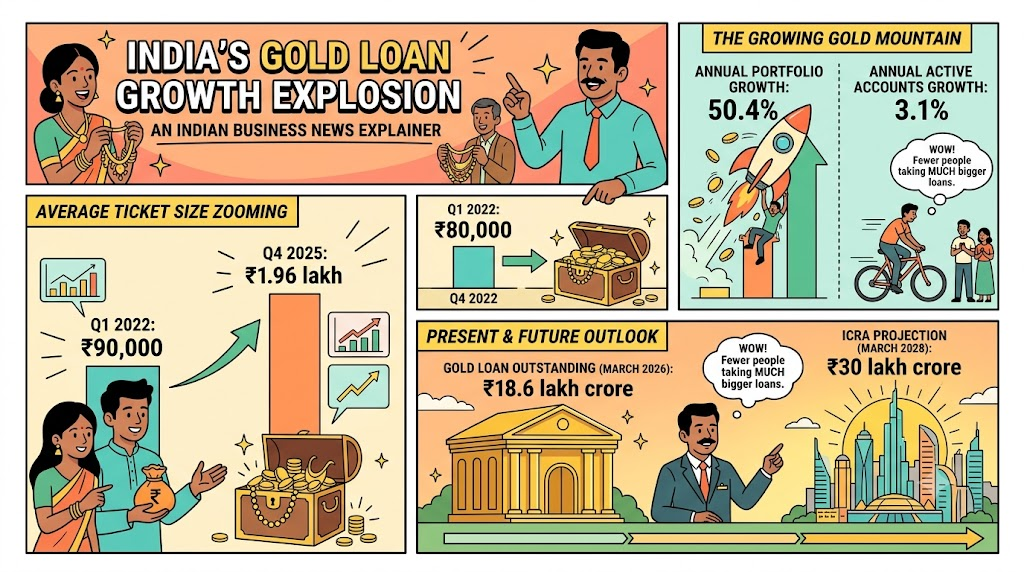
According to the new report titled Gold Loan Landscape Report by TransUnion CIBIL, the gold loan ticket values have increased more than double in India from ₹90,000 during Q1, 2022 to ₹1.96 lakh during Q4, 2025. The origination value increased by 5.1 times compared to 2022 Q1, and the number of loans by 2.3 times. Lenders prefer secured credit, and borrowers are borrowing more from each pledge.
There's a second half to the story in CRIF High Mark's May 2026 report. In March 2026, the outstanding amount of gold loans was at ₹18.6 lakh crore, which rose by 50.4% in 1 year, while the number of active gold loans grew by 3.1% to 899.2 lakh. A family could make more without selling jewelry. But a bigger bump can still exceed your monthly earnings, and failing to pay on time could lead to the eventual auction sale of family antiques.
The initial advantage is access. Even if a self-employed electrician or a Kirana owner is earning regularly, he/she can still face problems with a personal loan application. Gold can make that journey quicker. The lender assesses the value of the jewellery and carries out basic checks and disburses the amount with speed, sometimes even better than an unsecured application. CRIF determined that 32% of origination value was from cities ranked 9-50, and 32% from markets outside the top 100. Smaller cities aren't spared from the rise.
Prior to pledging jewellery for routine expenses, the use of alternatives should be considered. As previously announced, the loan limit for agricultural loans will increase from ₹1.6 lakh to ₹2 lakh per borrower from 1 January 2025 without any collateral from the banks, said a Press Information Bureau release on 14 December 2024. That may be an affordable option for an eligible farmer. The amount should be based on the capacity of a borrower to repay, not the value of their ornaments, for other borrowers.
The increase is a structural change in gold-backed finance, said Bhavesh Jain, MD and CEO of TransUnion CIBIL. A warning was discovered inside the growth at the bureau. Borrowers with gold loan exposure over ₹2.5 lakh had a 1.5% delinquency rate in the 6 months that ended in June 2025, well below the 0.7% rate of those with exposure below ₹2.5 lakh. But there is no such thing as default, but simply bigger exposure; lenders should review overall debt and repayment patterns.
Borrowers need the same caution. A bullet loan may look light at first because principal falls due near the end, but the maturity bill can arrive at the wrong time for a small shop or seasonal worker. Monthly interest, renewal charges and auction notice rules deserve attention before signing. Small firms can examine the Department of Financial Services’ PSB Loans in 59 Minutes page, which reported ₹4.13 lakh crore sanctioned through 21.51 lakh MSME loans as on 7 June 2026. Formal business credit can better suit machinery or expansion.
Gold prices did much of the work. ICRA’s press release dated 29 July 2026 said the organised market stood near ₹18 lakh crore in March 2026 and could cross ₹30 lakh crore by March 2028. Branch additions and jewellery tonnage held by large gold loan NBFCs rose only 3% to 4% between FY22 and FY26, while their loan books expanded by about 24%. Higher value per gram allowed a bigger loan.
CRIF’s ticket bands show the change. The amount funded through loans with an origination value less than ₹1 lakh accounted for 22.9% of the total origination value in Q4 FY24, but the contribution declined to 9.9% by Q4 FY26. Loans above the value of ₹5 lakh were at 41.6% of the origination value. The number of transactions remained with small loans while the amount of money was growing with the bigger ticket.
Main figures are located below. They are from reports released from April to July 2026, with different cut-off dates, and should be read in concert and not as a single set of data.
LoansJagat’s calculation from the CRIF figures gives a useful account-level view. Outstanding per active account works out to roughly ₹1.42 lakh in March 2025 and ₹2.07 lakh in March 2026, an increase of about 46%. This is an inferred average, not a figure printed by CRIF. It explains the wide growth gap.
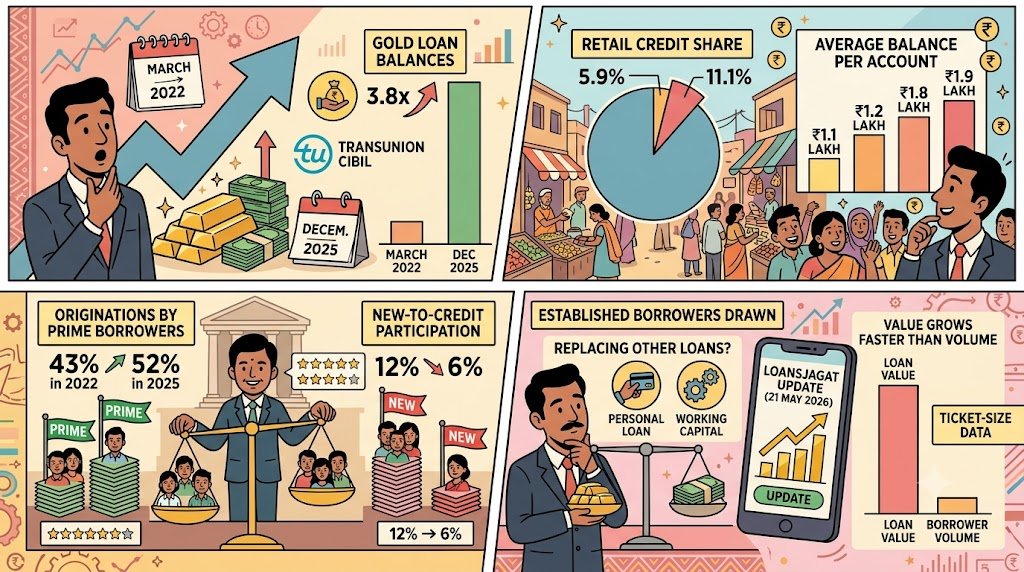
The build-up started well before March 2026. TransUnion CIBIL found that gold loan balances were 3.8 times their March 2022 level by December 2025. Their share of retail credit increased from 5.9% to 11.1%, while average balance per account moved from ₹1.1 lakh to ₹1.9 lakh. Prime and higher-rated borrowers supplied about 52% of 2025 originations, up from 43% in 2022. New-to-credit participation fell from 12% to 6%.
Gold loans are drawing established borrowers too, sometimes replacing a personal loan or working-capital facility. A LoansJagat update published on 21 May 2026 had already shown gold loans leading retail credit growth after the festive quarter. The latest ticket-size data explains how it happened. Loan value rose far faster than borrower volume.
Personal loans did not contract. Their outstanding balance reached ₹16.5 lakh crore in March 2026, up 12.9% from a year earlier. Consumer durable loans grew 20.8%. Credit-card balances were flat year on year, and CRIF described unsecured retail lending as more selective. Lenders were still issuing unsecured loans, though collateral-backed products grew much faster.
The difference appears during approval. A personal loan may come with stricter income checks, a smaller approved amount, or a higher rate. Gold gives the lender a recoverable asset, so the decision can move faster. That convenience carries a direct risk. The lender can auction the jewellery after the required recovery process if repayment fails. A personal loan default harms the credit record, but it does not place inherited bangles in the lender’s vault.
ICRA expects organised gold loans to grow at more than 30% a year during FY27 and FY28, crossing ₹30 lakh crore by March 2028. Its 29 July release placed banks at about 78% of the market in March 2026 and NBFCs at around 22%. R Srinivasan, Sector Head for Financial Sector Ratings at ICRA, said new lenders, acquisitions and wider branch networks support the outlook after recent stress in unsecured lending.
Competition may bring quicker service, but it can also encourage over-reliance on collateral value. ICRA warned that a move from bullet repayments towards regular instalments could raise reported delinquencies in the near term. For households, the safer habit is plain: take the required amount, ask for the full repayment schedule, retain the valuation slip and avoid using repeated top-ups to pay old interest.
Gold Loan Ticket Size Doubles to ₹2 Lakh Amid Unsecured Credit Shift captures a change already visible in lender books. The average ticket rose to ₹1.96 lakh, gold loan outstanding reached ₹18.6 lakh crore, and active accounts moved far more slowly. Higher gold values gave existing borrowers room to take larger sanctions. Lenders also found secured credit easier to support while unsecured approvals became more selective.
The product can help with a medical bill, seasonal business need or short cash gap. Trouble starts when the maximum eligible loan replaces a proper budget. Gold may carry a higher valuation, but repayment still comes from salary, crop income or shop receipts. That part has not changed.
TransUnion CIBIL placed it at ₹1.96 lakh in Q4 2025, against ₹90,000 in Q1 2022.
Higher gold values support larger sanctions against the same jewellery, subject to valuation and borrower checks.
No. Personal loan outstanding grew 12.9% by March 2026, though gold loans expanded much faster.
CIBIL reported more repayment delays among borrowers whose total gold loan exposure went beyond ₹2.5 lakh.
Interest cost, processing fee, repayment date, renewal charge, valuation record, and auction terms should all be reviewed.
A gold loan may suit urgent needs when jewellery is available, while personal loans avoid pledging family assets.










.png&w=3840&q=75)


