
By continuing, you agree to LoansJagat's Credit Report Terms of Use, Terms and Conditions, Privacy Policy, and authorize contact via Call, SMS, Email, or WhatsApp
Disclaimer: The information published on LoansJagat is intended for general informational and educational purposes only and should not be considered financial, legal, or investment advice. Interest rates, loan terms, statistics, and other data may change over time and may vary by lender or source. Please verify the latest information and consult a qualified financial advisor or the respective Bank/NBFC before making any financial decisions.
Subscribe Now
About the author

Arshathul Afia
Arshathul Afia is a journalism graduate and fintech content writer with 4+ years of experience in digital publishing and research-led writing. She has written 200+ articles covering personal finance, lending, banking, digital payments, credit, insurance, and major financial developments in India. At LoansJagat, she focuses on simplifying complex fintech news, RBI updates, loan-related changes, policy developments, and industry trends for everyday readers. Her journalism background helps her approach stories with research, context, and clarity, while her SEO experience ensures content remains discoverable and relevant. She aims to make financial news easier to understand, practical, and useful for readers across India.
Related News
Simplify All Your Loans Into One Affordable EMI

Customers Served

Debt Consolidated

1200+ Reviews

Locations in India
Club all Loans & Credit Card Bills into Single EMI

Quick Apply Loan
Consolidate your debts into one easy EMI.

Takes less than 2 minutes. No paperwork.

10 Lakhs+
Trusted Customers

2000 Cr+
Loans Disbursed

4.7/5
Google Reviews

50+
Banks & NBFCs Offers
Other services mentioned in this article
Businesses seek faster GST refunds and easier tax credit access ahead of the October 8 Council meeting, with working capital and compliance costs in focus.
Key Highlights
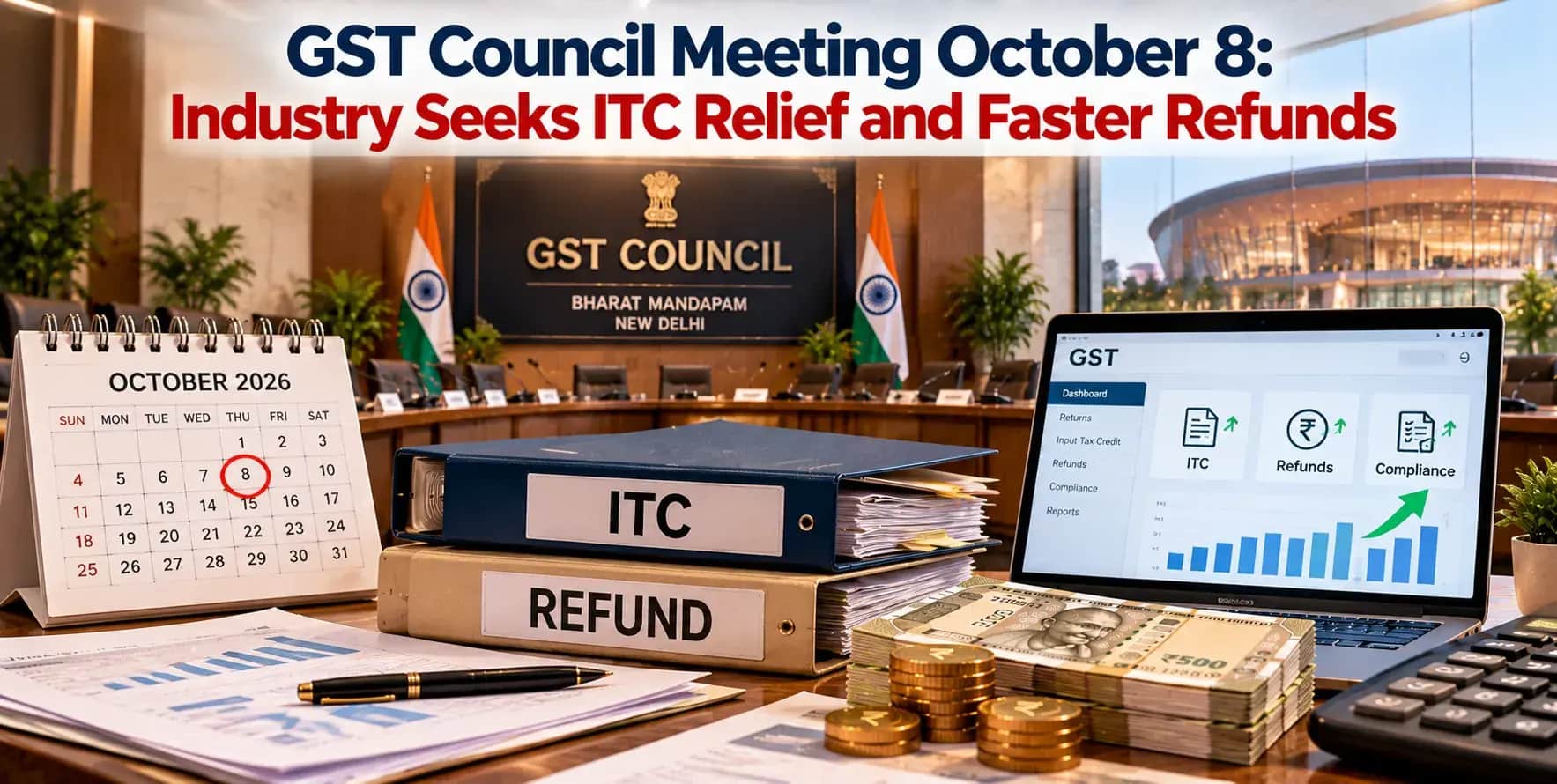
Businesses want relief from unused input tax credit (ITC) and long refund procedures as the GST Council prepares to meet on 8 October 2026. Finance Minister Nirmala Sitharaman will chair the meeting at Bharat Mandapam in New Delhi. A Secretariat memorandum, described in a 5 October 2026 report, moved the meeting from 7 October, citing ‘unavoidable circumstances’.
For businesses, the immediate concern is money already paid as GST but unavailable for operating expenses. Over longer periods, accumulated credit also puts pressure on companies investing in production. Industry representatives are asking for changes to how credit is recovered, alongside simpler compliance. These are demands ahead of the meeting, rather than approved relief.
Manufacturers facing an inverted duty structure pay higher GST on inputs than on finished products. Their credit accumulates because the tax payable on sales does not absorb it. Pharmaceutical and textile manufacturers may also face this problem when GST paid on inputs exceeds the tax payable on finished products. Quicker payment of eligible refunds would return money to businesses sooner.
Our assessment is that refund timing deserves attention alongside borrowing rates. Where a business borrows to cover a cash shortage, an earlier refund could reduce the period for which that borrowing is needed. That is a potential financing benefit, not a forecast of lower loan rates. Exporters tracking GST refund provisions face the same distinction between having credit recorded and receiving usable cash.
Even after a refund is processed, unused credit builds up again where inputs remain taxed at higher rates than finished products. Manoj Mishra, partner at Grant Thornton Bharat, discussed this issue in a report published by The Financial Express on 2 October 2026. He pointed out that faster refunds would not prevent unused credit from accumulating where tax rates remain inverted. He urged the GST Council to address these rate differences and review refund provisions for genuine accumulated credit, including credit linked to input services
Companies expanding their operations may also have unused tax credits tied to machinery and input services. Nimish Bhatia, partner at Price Waterhouse & Co LLP, told Business Standard that businesses were seeking refunds for these credits, along with faster provisional refunds. He also suggested spreading capital goods refunds over five years, with proportionate relief for assets purchased before the proposed changes.
Genuine buyers want greater certainty when a supplier’s compliance failure affects their tax credit. Companies operating across states also want less overlapping scrutiny of similar transactions. These concerns explain why the industry’s requests extend beyond refund speed.
The earlier refund measure addresses eligible claims through a risk-based process. Industry’s wider request concerns credit that continues to accumulate or becomes disputed. Faster processing alone does not resolve every eligibility issue.
The Ministry of Finance published the 56th GST Council recommendations on 3 September 2025, including measures to improve provisional refunds. A subsequent government reply dated 13 February 2026, Annexure III, recorded 90% provisional refunds for low-risk zero-rated supplies, effective from 1 October 2025.
The reply also recorded simplified registration from 1 November 2025, with automated registration within 3 working days for specified applicants. Those measures form the background to the current demands for further relief, rather than new announcements associated with October 8.
The October 8 GST Council meeting comes with industry pressing for recoverable credit to reach businesses sooner. The distinction is practical: processing an eligible refund faster helps cash flow, while resolving credit restrictions addresses why money remains tied up. Both concerns feature in the demands placed before the meeting.
The 57th GST Council meeting is scheduled for 8 October 2026 at Bharat Mandapam, New Delhi, chaired by Finance Minister Nirmala Sitharaman.
ITC allows eligible GST paid on business purchases to be set off against tax payable on sales, subject to applicable conditions.
Delayed refunds leave money unavailable for business expenses. Industry also wants changes addressing credit that accumulates because of tax-rate differences.
Eligible exporters may claim refunds of unused credit on inputs and input services, subject to conditions. Domestic sales are not a universal requirement.
No. Refund eligibility depends on the transaction and the category of credit. An amount appearing in the credit ledger does not automatically qualify for cash repayment.









.png&w=3840&q=75)


