
By continuing, you agree to LoansJagat's Credit Report Terms of Use, Terms and Conditions, Privacy Policy, and authorize contact via Call, SMS, Email, or WhatsApp
Disclaimer: The information published on LoansJagat is intended for general informational and educational purposes only and should not be considered financial, legal, or investment advice. Interest rates, loan terms, statistics, and other data may change over time and may vary by lender or source. Please verify the latest information and consult a qualified financial advisor or the respective Bank/NBFC before making any financial decisions.
Subscribe Now
About the author

Arshathul Afia
Arshathul Afia is a journalism graduate and fintech content writer with 4+ years of experience in digital publishing and research-led writing. She has written 200+ articles covering personal finance, lending, banking, digital payments, credit, insurance, and major financial developments in India. At LoansJagat, she focuses on simplifying complex fintech news, RBI updates, loan-related changes, policy developments, and industry trends for everyday readers. Her journalism background helps her approach stories with research, context, and clarity, while her SEO experience ensures content remains discoverable and relevant. She aims to make financial news easier to understand, practical, and useful for readers across India.
Related News
Simplify All Your Loans Into One Affordable EMI

Customers Served

Debt Consolidated

1200+ Reviews

Locations in India
Club all Loans & Credit Card Bills into Single EMI

Quick Apply Loan
Consolidate your debts into one easy EMI.

Takes less than 2 minutes. No paperwork.

10 Lakhs+
Trusted Customers

2000 Cr+
Loans Disbursed

4.7/5
Google Reviews

50+
Banks & NBFCs Offers
Other services mentioned in this article
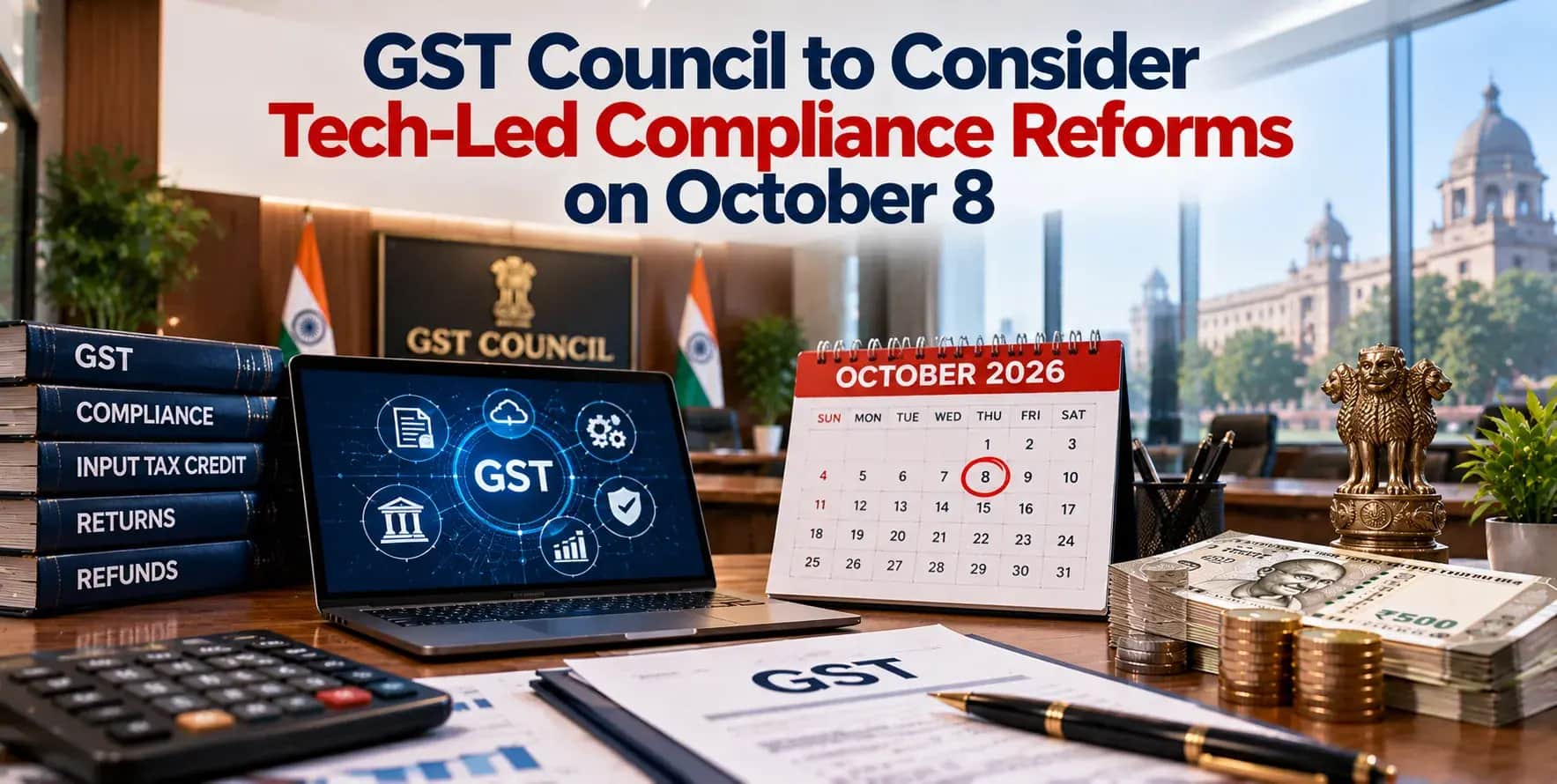
The GST Council will consider process reforms on October 8, with proposals aimed at easing compliance through technology and reducing routine intervention by tax officers.
Key Highlights
Finance Minister Nirmala Sitharaman will chair the 8 October meeting at Bharat Mandapam in New Delhi. The Council Secretariat rescheduled the meeting from 7 October. Discussions are expected to address the time and cost businesses face when completing GST procedures.
Under the proposal, work for which available data is sufficient to process would move through automated systems. Officers would still handle cases that require judgement. For businesses, the proposed shift is intended to reduce avoidable paperwork and processing delays. The enforcement changes being discussed are separate proposals and would not take effect simply because they appear on the Council’s agenda.
GST refunds can arise in different situations, including zero-rated supplies, excess tax payments and accumulated input tax credit under an inverted duty structure. Registration delays create a different problem: the business is still trying to complete its entry into the system. The proposed review covers both stages, alongside return corrections and responses to tax demands.
Refund processing deserves particular attention from businesses that borrow to cover operating expenses. An eligible refund releases the business’s own money; a loan adds a repayment obligation. The practical test is whether processing becomes quicker and more dependable. This is a business-finance perspective, not a forecast of lower loan rates or guaranteed savings.
Speaking in Bengaluru on 16 September 2026, Sitharaman said the next Council meeting would take up process reforms under GST 2.0. Her remarks covered e-invoicing and input tax credit. She explained that the previous meeting had focused on rate rationalisation, while procedural reforms had been left for the next round.
Industry chambers have sought quicker refunds, access to blocked input tax credit and fewer disputes, according to reporting dated 6 October 2026. The requests address problems that continue after businesses record their transactions. A rate cut does not clear money held up in a GST refund or resolve an input tax credit dispute already under review.
Reporting published on 6 October 2026 listed the arrest-power and small-value dispute proposals currently under discussion. The amounts in the table come from that reporting and have not been notified as revised thresholds.
These proposals would change enforcement procedures. They should not be read as a waiver of GST payable or permission to disregard an existing notice.
The 56th GST Council recommendations, released on 3 September 2025, had already proposed automated registration within 3 working days for specified applicants. Risk-based provisional refunds were also part of that package. The October discussions therefore build on earlier procedural changes.
The government’s ‘Nine Years of GST’ backgrounder, published on 30 June 2026, describes real-time invoice-data capture through GSTN and e-invoicing, as well as pre-filled returns and simplified reconciliation. It also records the use of artificial intelligence and analytics to identify risk indicators. The stated aim is targeted scrutiny of higher-risk taxpayers, with fewer procedural burdens for compliant businesses.
Even after Council approval, businesses cannot apply the proposed change straight away.They will need to wait for the relevant notifications, amendments or other implementation measures confirming when and how the change will apply. Until then, the existing GST procedure remains applicable.
The 57th GST Council meeting will be held on 8 October 2026 at Bharat Mandapam in New Delhi. It was originally scheduled for 7 October.
Routine processing would use transaction data already available in the GST system. Cases that require an officer’s judgement would continue to be handled manually.
The removal of arrest powers is a reported proposal for discussion. It should not be described as an implemented change.
The government’s 30 June 2026 backgrounder describes registration within 3 working days for low-risk applicants under an existing scheme. That timeline should not be applied to every application.
The reported agenda concerns GST administration, not loan pricing. Our assessment is that faster eligible refunds could help cash availability, but that is different from reducing an EMI.









.png&w=3840&q=75)


