By continuing, you agree to LoansJagat's Credit Report Terms of Use, Terms and Conditions, Privacy Policy, and authorize contact via Call, SMS, Email, or WhatsApp
Disclaimer: The information published on LoansJagat is intended for general informational and educational purposes only and should not be considered financial, legal, or investment advice. Interest rates, loan terms, statistics, and other data may change over time and may vary by lender or source. Please verify the latest information and consult a qualified financial advisor or the respective Bank/NBFC before making any financial decisions.
Subscribe Now
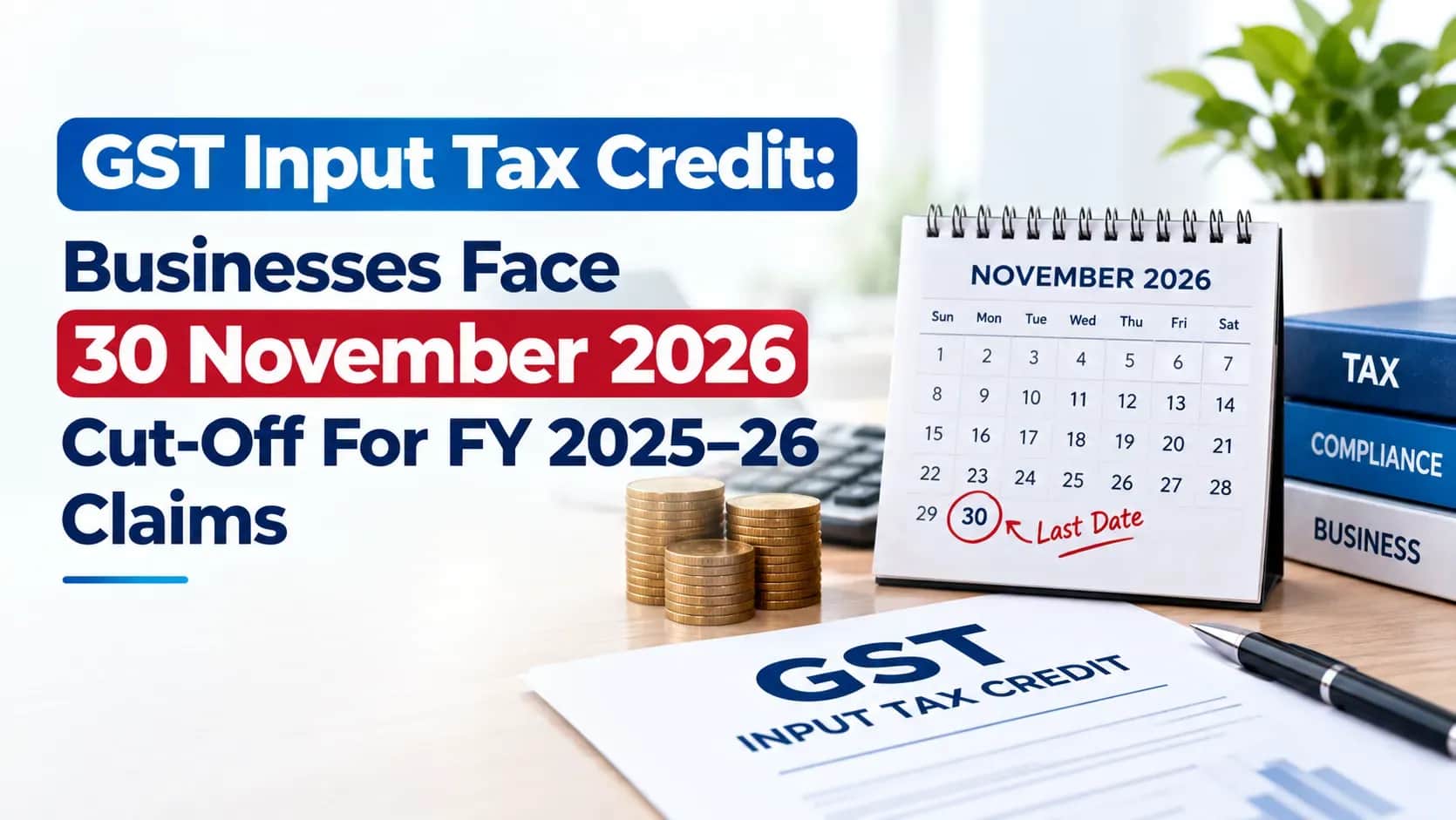
The window to file the relevant annual return to preserve eligible GST credit for FY 2025-26 may close earlier than 30 November 2026, thus exposing businesses to the risk of losing eligible GST credit if they file too late.
Key Highlights
The eligible FY 2025–26 invoices and debit notes are eligible for claims, with a claim deadline specified under Section 16(4). For GST-registered businesses, the deadline is 30 November 2026 or the filing date of the annual return, whichever is earlier. This is not a new restriction that was announced for October 2026, but a rule that already existed.
Firms may pay more tax in cash because they cannot claim eligible credits. If a business receives supplier invoices while repaying loans, it may struggle to pay supplier bills. But missing GST-borne purchases may lead to blocked expenses. Accounts should identify eligible amounts, determine missing data, and submit a claim through the relevant return within the specified time frame.
Manufacturers can claim eligible GST on production inputs, and service providers can claim GST credit on business expenses, such as professional services. The statutory conditions remain in force. An immediate financial impact is seen on registered businesses that have eligible purchases pending review.
To explain the purchase-tax offset, we cover the concept of input tax credit. From a cash-flow perspective, losing eligible credit can reduce the funds available for operating costs or debt repayment. This will not affect a loan's interest rate or instalment. It changes how much cash they can pay with. A firm considering more debt should therefore carefully determine whether it has a funding need or is simply claiming unclaimed tax credits it will receive anyway.
According to the guidance provided in the GST portal, GSTR-2B will be compared with taxpayers' records, and they should not file duplicate or reverse claims. If the supplier-reported data is not provided or is incorrect, the recipient may perform a reconciliation and discuss with the supplier whether the data needs to be corrected. Assigning an unresolved invoice to each person helps prevent either issue from going unchecked. This will create a usable record instead of leaving unexplained differences between the business accounts and GST portal figures as unresolved credit.
The Central Board of Indirect Taxes and Customs received trade and industry representation on time-barred credit in Circular No. 237/31/2024-GST dated 15th October 2024. Its answer provided details of relief for particular older cases. That reported worry is not a new extension for FY 2025-26.
According to Section 16, it is necessary to file the prescribed documents, receive supplies and meet reporting and payment of tax requirements, and also file returns. Section 17 is for credit for personal or exempt use and blocked costs. Substituting an eligibility review with an invoice with the business GSTIN, therefore, is not possible. These are some of the differences between routine purchases and claims that need further investigation.
These differences are not based on an accounts spreadsheet description, but on the CGST Act. A staff-welfare heading can have a mixture of expenses which have a variety of credit outcomes.
The relevant amendments took effect on 1 October 2022, with a notification dated 28 September 2022 issued by the Central Tax (No. 18/2022-Central Tax) Office. It superseded the previous September return-related limit, but maintained the condition that an earlier annual return will open the window sooner.
Compliance with the final credit-cut-off cannot be interpreted as "permission" to delay compliance with the routine. Nor does a November-period return filed after November cure the lateness of the claim.
In 2024, retrospective relief was extended to specified claims relating to FY 2017-18 through FY 2020-21, provided the relevant returns had been filed by 30 November 2021. The CBIC clarified the procedure for the authorities to deal with qualifying cases. This does not excuse pending claims for now in hope of a later concession.
Any business should pinpoint the missing invoices and follow up with suppliers before the deadline approaches. The upside is that the good credit isn't created out of nowhere; it's "good" credit. That process can help borrowers save cash used for living expenses now, without adjusting the loan terms.
Yes, provided it is eligible and within the statutory time limit. The claim period may be shortened based on the date of the relevant annual return.
Does GST On A Purchase Result In Input Tax Credit?
No. Legal conditions must be fulfilled and blocked-credit provisions remain. An invoice or payment alone doesn't establish eligibility.
Yes. Section 16(4) uses the earlier of the statutory November cut-off and the relevant annual return filing date. Pending claims need review before annual filing.
If the recipient does not pay the supplier the value of the supply along with tax within 180 days, an amount equal to the ITC availed is payable/reversed along with applicable interest. The rules stipulate that re-availment is subject to payment.
The deadline concerns eligible credit claims by GST-registered businesses. An ordinary consumer cannot claim business ITC merely because a shop issues a bill showing GST.
About the author

Arshathul Afia
Arshathul Afia is a journalism graduate and fintech content writer with 4+ years of experience in digital publishing and research-led writing. She has written 200+ articles covering personal finance, lending, banking, digital payments, credit, insurance, and major financial developments in India. At LoansJagat, she focuses on simplifying complex fintech news, RBI updates, loan-related changes, policy developments, and industry trends for everyday readers. Her journalism background helps her approach stories with research, context, and clarity, while her SEO experience ensures content remains discoverable and relevant. She aims to make financial news easier to understand, practical, and useful for readers across India.
Related News
Simplify All Your Loans Into One Affordable EMI

Customers Served

Debt Consolidated

1200+ Reviews

Locations in India
Club all Loans & Credit Card Bills into Single EMI

Quick Apply Loan
Consolidate your debts into one easy EMI.

Takes less than 2 minutes. No paperwork.

10 Lakhs+
Trusted Customers

2000 Cr+
Loans Disbursed

4.7/5
Google Reviews

50+
Banks & NBFCs Offers
Other services mentioned in this article








.png&w=3840&q=75)


