By continuing, you agree to LoansJagat's Credit Report Terms of Use, Terms and Conditions, Privacy Policy, and authorize contact via Call, SMS, Email, or WhatsApp
Disclaimer: The information published on LoansJagat is intended for general informational and educational purposes only and should not be considered financial, legal, or investment advice. Interest rates, loan terms, statistics, and other data may change over time and may vary by lender or source. Please verify the latest information and consult a qualified financial advisor or the respective Bank/NBFC before making any financial decisions.
Subscribe Now
About the author

Arshathul Afia is a journalism graduate and fintech content writer with 4+ years of experience in digital publishing and research-led writing. She has written 200+ articles covering personal finance, lending, banking, digital payments, credit, insurance, and major financial developments in India. At LoansJagat, she focuses on simplifying complex fintech news, RBI updates, loan-related changes, policy developments, and industry trends for everyday readers. Her journalism background helps her approach stories with research, context, and clarity, while her SEO experience ensures content remains discoverable and relevant. She aims to make financial news easier to understand, practical, and useful for readers across India.
Related News
Simplify All Your Loans Into One Affordable EMI

Customers Served

Debt Consolidated

1200+ Reviews

Locations in India
Club all Loans & Credit Card Bills into Single EMI

Quick Apply Loan
Consolidate your debts into one easy EMI.

Takes less than 2 minutes. No paperwork.

10 Lakhs+
Trusted Customers

2000 Cr+
Loans Disbursed

4.7/5
Google Reviews

50+
Banks & NBFCs Offers
Other services mentioned in this article
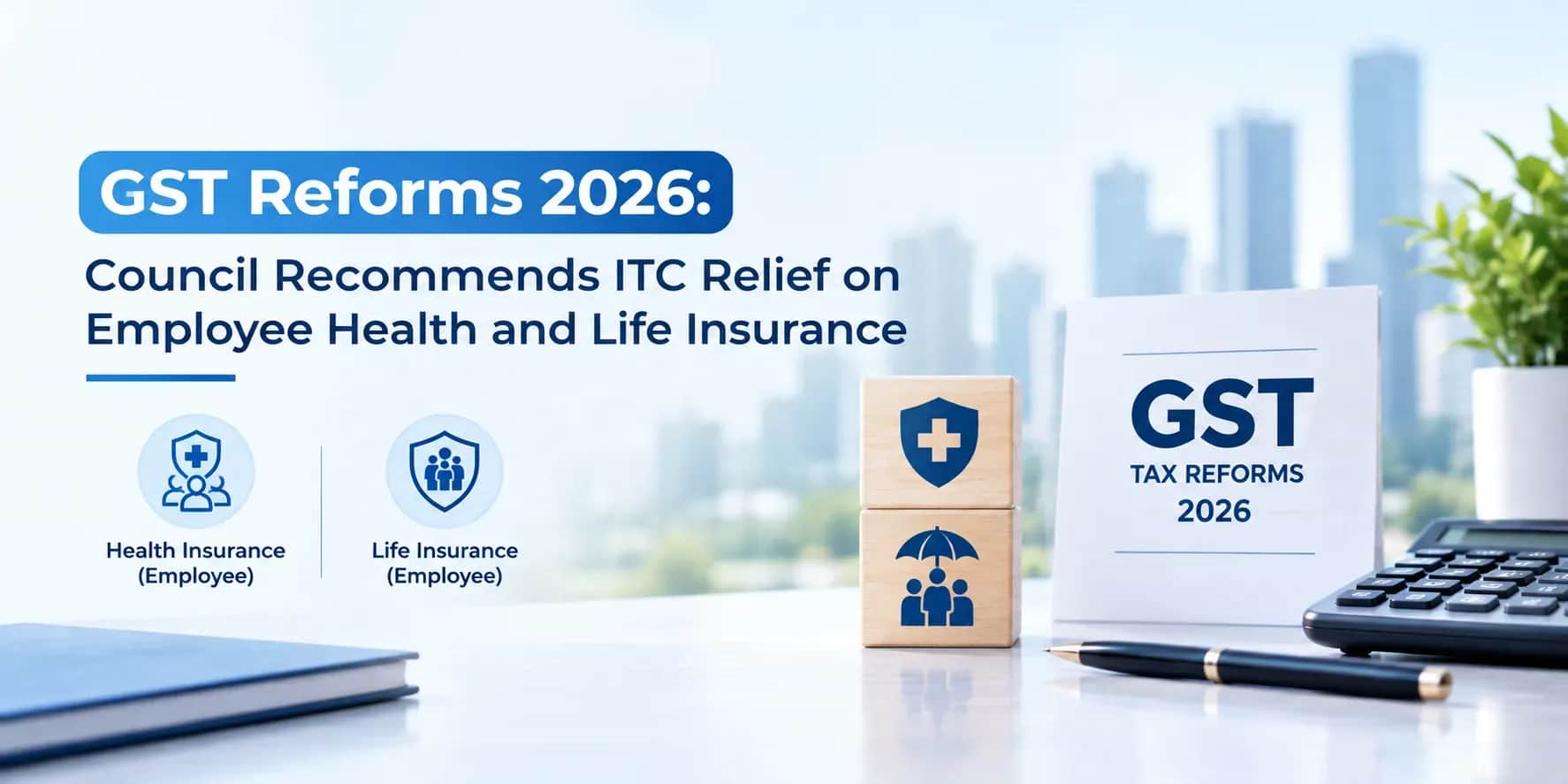
Employers could recover GST paid on employee health and life insurance under proposed reforms, but wider tax credit access still requires changes to the law.
Key Highlights
The GST Council, chaired by Finance Minister Nirmala Sitharaman, recommended removing input tax credit restrictions on health and life insurance at its 57th meeting in New Delhi. The Ministry of Finance’s release dated 8 October 2026, Release ID 2320934, records the proposed amendment to Section 17(5) of the CGST Act, 2017.
For employers, the proposal addresses tax that adds to staff insurance costs when credit is blocked. Insurers expect savings to support broader coverage. Employees’ gains would depend on company decisions, while premiums covering family members could raise disputes over credit eligibility.
Employers pay GST as part of the group insurance bill. Where ITC is unavailable, the tax remains an expense. Allowing eligible businesses to use that credit against their GST liability would reduce the effective cost of providing insurance. MD and CEO of Galaxy Health Insurance, G. Srinivasan, said that the relief could help employers to make employee benefits more flexible with broader protection based on how the savings are utilised.
The reading is that employee benefits and employer savings need to be assessed separately. Recoverable GST reduces a business expense. An employee gains additional protection only when the employer changes the cover provided. In our tax and personal finance coverage, that distinction is central to assessing this proposal. An employer’s tax saving should not be counted as extra money available in an employee’s household budget.
Krishnamoorthy Rao, MD and CEO of Generali Central Insurance, said the proposal could make group health insurance more economically viable and encourage wider employer-sponsored coverage. His comments, reported on 9 October 2026, also addressed insurers’ pricing decisions. He urged the industry to turn the improved economics into sustainable growth, rather than lose the benefit through further premium competition.
Family coverage creates a separate complication. Amit Baid, Head of Tax at BTG Advaya, warned that limiting credit to employees alone could lead to disputes over splitting premiums where group policies also insure dependants. His concern puts the treatment of family cover at the heart of implementation. For such employers, the amount of usable credit would depend on which portion of the premium qualifies.
Individual life and health insurance became GST-exempt on 22 September 2025. Individual family floater health plans were included, but employer-sponsored group policies remained taxable.
The Ministry of Finance clarified in its FAQs published on 16 September 2025 that the GST exemption covers individual life and health insurance policies, including family coverage, but excludes group insurance. The latest proposal concerns the recovery of tax paid by eligible employers.
A group policy can therefore remain taxable while its eligible business purchaser claims ITC. The proposed relief concerns the employer’s tax position, rather than removing GST from the insurer’s invoice.
Existing law already permits credit in specified circumstances. An employer legally obliged to provide the relevant benefit may qualify, subject to applicable conditions.
The Central Board of Indirect Taxes and Customs has confirmed this in Circular No. 172/04/2022-GST, dated 06 July, 2022. This circular mentioned that statutory obligation exception is available in Section 17(5)(b). Describing the earlier rules as a complete prohibition would therefore overlook employers already covered by that exception.
The GST Council has recommended wider insurance ITC access. Its official release states that implementing amendments, notifications and circulars will give the recommendations legal effect. For employees, any improvement in benefits will depend on how employers use the resulting savings.
On 8 October 2026, the Council recommended amending Section 17(5) to remove ITC restrictions on health and life insurance. Legal implementation is required.
The exemption effective from 22 September 2025 covers individual policies. Employer group policies remain taxable. The latest proposal concerns access to tax credit on eligible premiums.
No. The policy’s group classification determines its treatment. Employer-sponsored group health and group life insurance continue attracting 18% GST.
G Srinivasan linked wider protection to employers’ use of savings. The proposal does not itself increase an employee’s insured amount.
No. Existing exceptions include benefits an employer must provide under law, as confirmed in CBIC Circular No. 172/04/2022-GST.