By continuing, you agree to LoansJagat's Credit Report Terms of Use, Terms and Conditions, Privacy Policy, and authorize contact via Call, SMS, Email, or WhatsApp
Disclaimer: The information published on LoansJagat is intended for general informational and educational purposes only and should not be considered financial, legal, or investment advice. Interest rates, loan terms, statistics, and other data may change over time and may vary by lender or source. Please verify the latest information and consult a qualified financial advisor or the respective Bank/NBFC before making any financial decisions.
Subscribe Now
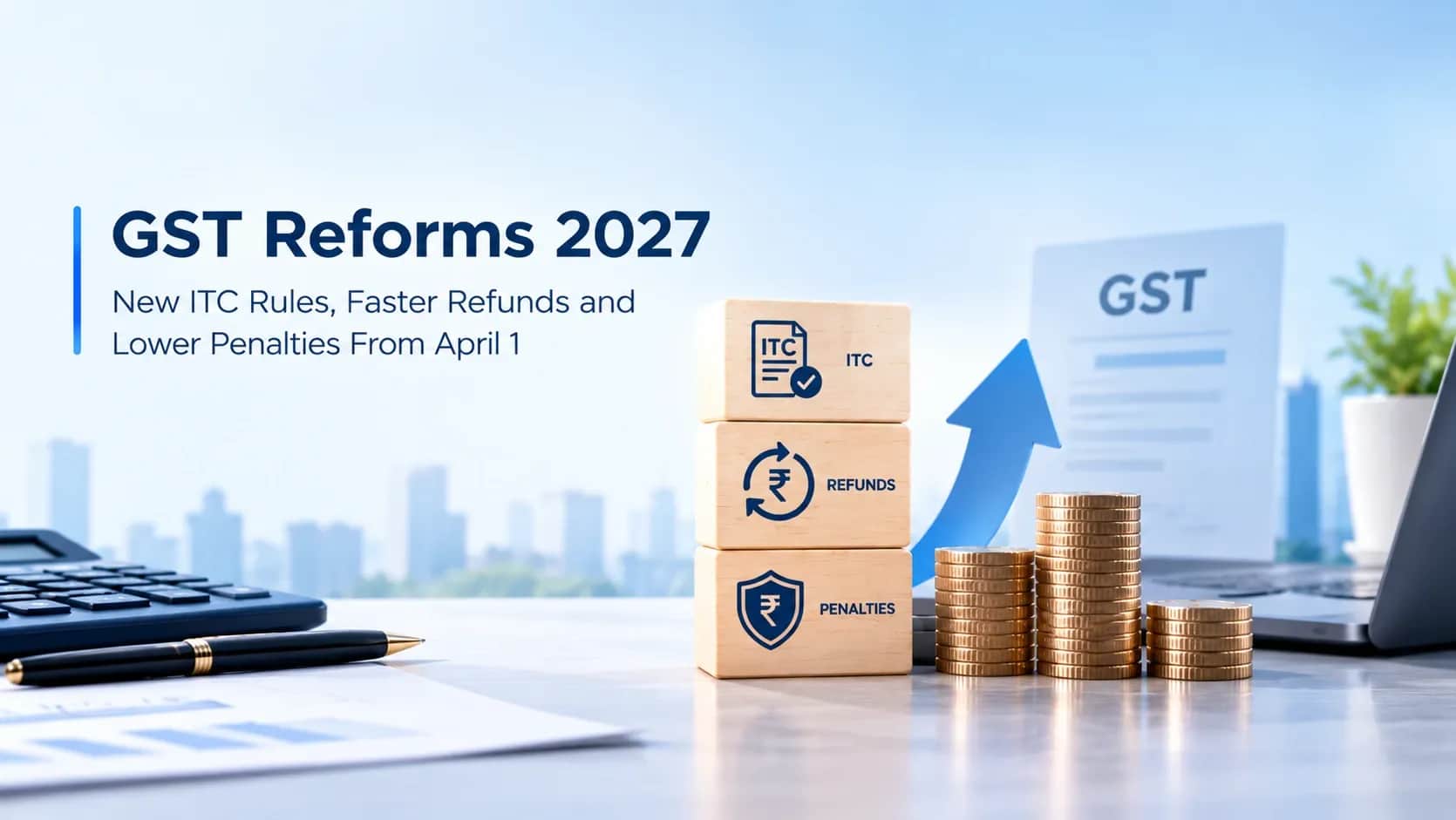
Businesses could benefit from lower penalties, wider input tax credit refunds and automated GST refund processing. The proposed reforms have different implementation timelines, with some compliance changes planned for April 2027.
Key Highlights
The government’s GST announcement of 8 October 2026 requires legal amendments before implementation. Meeting in New Delhi that day under Union Finance Minister Nirmala Sitharaman’s chairmanship, the Council recommended changes to registration and input tax credit (ITC), alongside refunds and litigation. Its 57th meeting also produced a proposal to remove arrest powers under Section 69 of the CGST Act, 2017.
Exporters and manufacturers awaiting tax refunds would receive funds sooner. Invoice errors or discrepancies in returns, however, could delay claims. No further broad cut in GST rates forms part of these proposals, which address tax administration.
Small online sellers could find interstate registration easier. Under proposed Rule 14B, eligible sellers may declare an e-commerce operator’s warehouse as their principal place of business in another state. The facility covers sellers intending to pass on ITC not exceeding ₹2.5 lakh monthly, excluding specified stock transfers.
Return filing would also change. The Council recommended improvements to GSTR-1, GSTR-1A, GSTR-3B and the Invoice Management System. Businesses would receive facilities to correct tax liabilities and ITC discrepancies. The proposed mechanism, planned for the April 2027 return period, aims to reduce notices arising from mismatched tax returns.
Tax experts have welcomed the proposed refund automation. Pratik Jain, Partner at Price Waterhouse & Co LLP, linked the proposed 90% provisional refunds to businesses being able to put released funds back into operations. L Badri Narayanan, Chairman of ASSOCHAM’s National Council on Indirect Taxes, described wider inverted-duty refunds as a significant change in comments reported on 9 October 2026.
Our assessment is that faster refunds will be most useful when businesses maintain accurate purchase records. A mismatch between invoices and GSTR-2B may still create difficulties during verification. Our input tax credit guide explains how eligible purchase taxes are adjusted against GST liabilities.
For businesses facing an inverted duty structure, the Council recommended including eligible input-service credits availed from 1 November 2026 in refund calculations.
Capital-goods credits availed from 1 April 2027 would also qualify for specified zero-rated and inverted-duty refunds. Instead of considering the entire credit immediately, the calculation would spread it over 60 months.
The proposed amendments to Section 17(5) could relax input tax credit restrictions for specified supplies and expenses, including outdoor catering, health and life insurance, and telecommunications towers. These changes would apply only after the required legal amendments take effect.
A higher GST rate on input services alone does not qualify a business for an inverted-duty refund. Eligibility depends on comparing tax rates on goods inputs and outward supplies, as confirmed in the government’s clarification dated 9 October 2026.
Eligible excess electronic cash ledger balances would receive automated refund sanctions. For zero-rated supplies and inverted-duty claims, provisional refunds would depend on system-based risk assessment.
The Council’s official recommendations issued on 8 October 2026 set out the proposed changes.
Under the proposal, applicants would receive a refund acknowledgement or deficiency memo within 10 days. If the officer takes no action, the application would be deemed acknowledged. The deadline does not require payment within that period. A later phase would introduce full automated sanction for eligible zero-rated claims once verification is complete and outstanding dues have been adjusted.
Removing Section 69 would withdraw the specified GST arrest powers. Prosecution for qualifying offences would continue under the amended framework.
The Council also recommended a ₹10,000 minimum tax-demand threshold for issuing show-cause notices. Pending notices and appeals below this amount would receive relief under the proposed provisions.
Payment timing would determine access to the proposed 5% penalty in eligible non-fraud cases. Taxpayers would need to pay both tax and interest within the applicable period following the adjudication order: 30 days for Section 73 cases or 60 days for Section 74A cases.
Most rate revisions agreed at the previous GST Council meeting on 3 September 2025 took effect on 22 September 2025. That meeting focused on tax rates.
The 8 October 2026 meeting turned towards the procedures businesses follow after registration, particularly return corrections, ITC refunds and tax disputes.
For manufacturers awaiting ITC refunds, the proposed changes would allow more eligible credits to enter refund calculations. Businesses involved in smaller tax disputes could also benefit from revised penalties and notice thresholds.
However, the recommendations do not replace existing GST law immediately. Their implementation depends on the necessary amendments and notifications.
Revised return reconciliation is proposed from the April 2027 return period. Other changes require separate legal implementation.
Eligible zero-rated and inverted-duty claims could receive 90% provisional sanction following automated risk assessment.
The Council proposed reducing the maximum general penalty under Section 125 from ₹25,000 to ₹10,000, subject to amendment.
The proposed capital-goods refund provision covers eligible ITC availed from 1 April 2027. Earlier credits are not covered by this particular proposal.
Not solely for that reason. Eligibility depends on the comparison between GST rates on goods inputs and outward supplies.
About the author

Arshathul Afia is a journalism graduate and fintech content writer with 4+ years of experience in digital publishing and research-led writing. She has written 200+ articles covering personal finance, lending, banking, digital payments, credit, insurance, and major financial developments in India. At LoansJagat, she focuses on simplifying complex fintech news, RBI updates, loan-related changes, policy developments, and industry trends for everyday readers. Her journalism background helps her approach stories with research, context, and clarity, while her SEO experience ensures content remains discoverable and relevant. She aims to make financial news easier to understand, practical, and useful for readers across India.
Related News
Simplify All Your Loans Into One Affordable EMI

Customers Served

Debt Consolidated

1200+ Reviews

Locations in India
Club all Loans & Credit Card Bills into Single EMI

Quick Apply Loan
Consolidate your debts into one easy EMI.

Takes less than 2 minutes. No paperwork.

10 Lakhs+
Trusted Customers

2000 Cr+
Loans Disbursed

4.7/5
Google Reviews

50+
Banks & NBFCs Offers
Other services mentioned in this article