
Disclaimer: The information published on LoansJagat is intended for general informational and educational purposes only and should not be considered financial, legal, or investment advice. Interest rates, loan terms, statistics, and other data may change over time and may vary by lender or source. Please verify the latest information and consult a qualified financial advisor or the respective Bank/NBFC before making any financial decisions.
Subscribe Now
About the author

Arshathul Afia is a journalism graduate and fintech content writer with 4+ years of experience in digital publishing and research-led writing. She has written 200+ articles covering personal finance, lending, banking, digital payments, credit, insurance, and major financial developments in India. At LoansJagat, she focuses on simplifying complex fintech news, RBI updates, loan-related changes, policy developments, and industry trends for everyday readers. Her journalism background helps her approach stories with research, context, and clarity, while her SEO experience ensures content remains discoverable and relevant. She aims to make financial news easier to understand, practical, and useful for readers across India.
Related News
Simplify All Your Loans Into One Affordable EMI

Customers Served

Debt Consolidated

1200+ Reviews

Locations in India
Club all Loans & Credit Card Bills into Single EMI

Quick Apply Loan
Consolidate your debts into one easy EMI.

Takes less than 2 minutes. No paperwork.

10 Lakhs+
Trusted Customers

2000 Cr+
Loans Disbursed

4.7/5
Google Reviews

50+
Banks & NBFCs Offers
Other services mentioned in this article
The GST Council’s refund proposals cover input services and capital goods, with separate dates and conditions for each.
Key Highlights
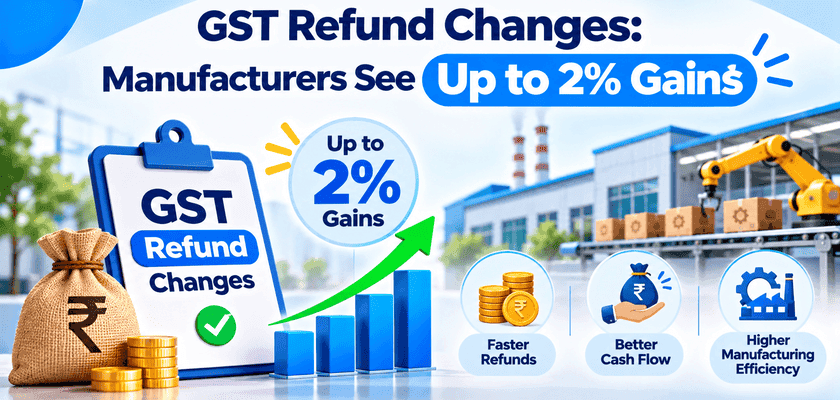
Changes to GST input tax credit (ITC) refunds have released cash for businesses, with gains reaching 2% in certain manufacturing sectors, the Times of India reported on November 10. The resulting cost benefit has not been passed on to consumers, the report said.
The changes address money held in accumulated tax credits. Businesses pay GST on purchases, but some cannot fully use that credit against the tax due on their sales. Refund eligibility and processing speed determine when those amounts become available again.
ITC allows eligible GST paid on business purchases to be set off against output tax liability. A business may nevertheless accumulate unused credit when its inputs attract a higher tax rate than its outward supplies, a situation described as an inverted duty structure.
The report also cited rental-related ITC refunds for service businesses. Tax experts told the newspaper that rent can account for up to 10–15% of costs at IT and consulting firms.
Refunding eligible accumulated credit returns money that would otherwise remain in the tax account. However, the rules distinguish between credit on goods, input services and capital goods. A balance in the electronic credit ledger does not automatically qualify for a cash refund.
At its 57th meeting on October 8, 2026, chaired by Finance Minister Nirmala Sitharaman, the GST Council recommended widening the refund calculation.
For inverted-duty cases, the proposal includes eligible credit on input services and capital goods. Capital-goods credit would also be included in refunds relating to zero-rated supplies made without payment of tax.
The Finance Ministry’s October 9 FAQs explain that the capital-goods calculation would take one-sixtieth of the eligible credit for each month.
The proposed expansion does not remove the underlying eligibility test for an inverted-duty refund.
The ministry illustrated this with a manufacturer buying inputs taxed at 18% and selling output taxed at 5%. Because the input-goods rate exceeds the output rate, eligible input-service credit would enter the expanded refund calculation.
The result differs where both input goods and output supplies attract 5%, even if services purchased by the business attract 18%. Higher tax on services alone does not establish an inverted duty structure.
Alongside wider credit coverage, the Council recommended processing reforms based on system risk assessments.
Under the proposed first phase, the acknowledgement or deficiency-memo deadline would fall from 15 days to 10 days. If the officer takes neither action within that period, the system would acknowledge the application.
Acknowledged low-risk claims involving zero-rated supplies or inverted duty structures would receive automated provisional sanction for 90% of the amount claimed. A later phase envisages automated final refunds for low-risk zero-rated claims.
The official announcement describes these as recommendations requiring relevant notifications, circulars or legislative amendments to take legal effect.
The Times of India reported that several prices had returned to earlier levels despite GST cuts from 28% to 18%, or from 12% or 18% to 5%. Businesses cited higher costs.
Saurabh Agarwal, Tax Partner at EY India, told the newspaper that reducing manufacturing’s tax and working-capital burden was significant, alongside how much benefit eventually reached consumers.
Some manufacturers have gained extra cash from the GST refund changes, but the reported savings have not reached consumers. Businesses also face different refund conditions for input services and capital goods. The Council has proposed separate dates for these credits, and the relevant legal amendments and notifications will determine how those proposals take effect.
The Times of India reported a potential cash-flow benefit of up to ₹2 for every ₹100 in sales in certain manufacturing sectors. The estimated benefit varies by sector.
The Council recommended including eligible input-service credit availed on or after November 1, 2026, in inverted-duty refund calculations. A higher service tax rate alone does not establish eligibility for refunds.
Under the Council’s proposal, eligible capital-goods credit availed from April 1, 2027, would enter refund calculations over 60 months. The entire credit would not be refunded in the first month.
Yes, eligible exporters of services may claim refunds of unutilised ITC through RFD-01, subject to applicable conditions. Domestic billing is not a prerequisite merely because all outward supplies are zero-rated.
A registered works contractor may claim eligible ITC on materials used for taxable contracts, subject to GST conditions. Construction for one’s own account and other blocked credits face separate restrictions.
Start your journey today
Apply Now*T&C apply











