

By continuing, you agree to LoansJagat's Credit Report Terms of Use, Terms and Conditions, Privacy Policy, and authorize contact via Call, SMS, Email, or WhatsApp
Disclaimer: The information published on LoansJagat is intended for general informational and educational purposes only and should not be considered financial, legal, or investment advice. Interest rates, loan terms, statistics, and other data may change over time and may vary by lender or source. Please verify the latest information and consult a qualified financial advisor or the respective Bank/NBFC before making any financial decisions.
Subscribe Now
About the author

Arshathul Afia
Arshathul Afia is a journalism graduate and fintech content writer with 4+ years of experience in digital publishing and research-led writing. She has written 200+ articles covering personal finance, lending, banking, digital payments, credit, insurance, and major financial developments in India. At LoansJagat, she focuses on simplifying complex fintech news, RBI updates, loan-related changes, policy developments, and industry trends for everyday readers. Her journalism background helps her approach stories with research, context, and clarity, while her SEO experience ensures content remains discoverable and relevant. She aims to make financial news easier to understand, practical, and useful for readers across India.
Related News
Simplify All Your Loans Into One Affordable EMI

Customers Served

Debt Consolidated

1200+ Reviews

Locations in India
Club all Loans & Credit Card Bills into Single EMI

Quick Apply Loan
Consolidate your debts into one easy EMI.

Takes less than 2 minutes. No paperwork.

10 Lakhs+
Trusted Customers

2000 Cr+
Loans Disbursed

4.7/5
Google Reviews

50+
Banks & NBFCs Offers
HDFC Bank’s latest MCLR reduction may trim borrowing costs for eligible customers, but the benefit will arrive only when each loan reaches its reset date.
HDFC Bank has reduced its Marginal Cost of Funds-Based Lending Rates across India, according to the bank’s official interest-rate page carrying rates effective September 7, 2026. The lender cut its 7 published tenures by 5 to 10 basis points. Existing customers with MCLR-linked floating loans may receive a lower rate after their contractual reset, which can reduce the EMI or bring the closing date forward.
Relief will be modest in the short run. A 5-bps cut equals 0.05 percentage point, while 10 bps equals 0.10 percentage point. Fixed-rate borrowers, customers on a repo-linked benchmark and MCLR borrowers waiting for a future reset will see no immediate change.
The latest revision lowered HDFC Bank’s MCLR range to 7.90% to 8.60%, from 8.00% to 8.65% in August.
HDFC Bank’s official figures are listed below. The August comparison was also reported by Business Standard on September 8, 2026. The table stays close to the lender’s published data and does not treat MCLR as the final rate paid by every customer.
“Up to 10 bps” needs careful reading. A loan tied to the 1-year MCLR receives a 5-bps benchmark cut because that rate moved from 8.40% to 8.35%. Only accounts tied to the overnight, 1-month, 3-month or 2-year MCLR can receive the full 10-bps reduction. The agreement decides which row applies.
MCLR is an internal reference rate. The bank usually adds a spread based on the product and sanction terms. A loan linked to the 1-year MCLR plus a 0.65 percentage-point spread, for example, would carry a final rate of 9.00%.
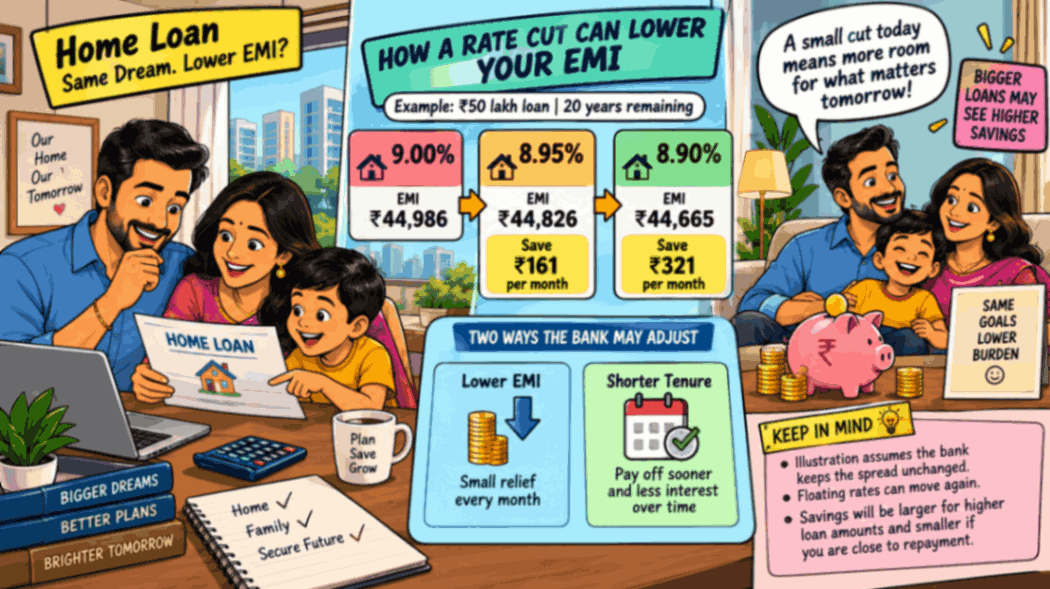
Say ₹50 lakh is still unpaid and the borrower has another 20 years to go. At 9.00%, about ₹44,986 leaves the account every month. Once the rate moves to 8.95%, the debit comes down to nearly ₹44,826, provided the bank does not alter the tenure. The borrower keeps around ₹161. A small amount, yes, but it no longer goes towards the EMI.
A 10-bps reduction takes the illustrative rate to 8.90% and the EMI to nearly ₹44,665. The monthly saving rises to about ₹321. Those amounts will not transform a family budget, but the cut still reduces borrowing cost. Customers with a larger unpaid balance may see a bigger rupee change; those close to repayment may notice very little.
The lender can instead keep the EMI unchanged and shorten the tenure, depending on the contract. This can reduce more interest over time, though it releases no monthly cash. A household facing tight expenses may prefer the smaller EMI.
The illustration assumes that the spread stays unchanged after reset. Floating rates may move again.
Every MCLR-linked loan follows a reset schedule written into the agreement. A customer with an annual reset in January may have to wait until January even though HDFC Bank changed its published rates in September. The old rate generally runs until that date. That lag often causes confusion when a borrower reads about a cut but sees the same debit in the next bank statement.
Newer retail loans may use an external benchmark instead of MCLR. Such accounts do not move because HDFC Bank changed an internal benchmark. A LoansJagat comparison published on April 22, 2026 explains how MCLR and external benchmark-linked loans respond at different speeds. Its borrower-focused view fits the present update: the benchmark name and reset cycle decide when any benefit appears.
The loan document should settle the issue. Borrowers can search for “benchmark”, “spread” and “next reset date”. Accounts carrying a base rate, Benchmark Prime Lending Rate or fixed rate do not directly change under this announcement.
HDFC Bank had already reduced selected MCLR rates by up to 5 bps from August 7, 2026. That move brought the range to 8.00% to 8.65%. September is broader because each published tenure moved down, though the size varies across the table.
The months before August did not follow one direction. HDFC Bank raised selected maturities in June and adjusted rates again in July. September’s cut should not be projected through the full life of a 15-year or 20-year loan.
The Press Information Bureau had discussed faster transmission of rate reductions in an August 23, 2019 policy brief. It recorded banks’ plans to pass reductions through MCLR and introduce external benchmark-linked retail products. The earlier policy push also helps explain why borrowers at the same bank can now have different benchmark arrangements.
HDFC Bank has posted the new rates but has not issued a detailed public explanation for the September action. Financial Express reported on September 8, 2026, that a senior bank official expected lenders to pursue credit more aggressively. The official also indicated that surplus funds in the banking system could keep downward pressure on lending rates.
For households, the stronger finding comes from the repayment calculation rather than the headline. The 1-year MCLR, often relevant to older retail contracts, fell by 5 bps, not the maximum 10 bps. On the ₹50 lakh example used above, that means about ₹161 a month if the lender cuts the EMI. The figure is useful, but small. Processing fees can easily outweigh it if a customer rushes into a balance transfer.
Borrower-finance analysts suggest comparing the revised EMI, closing date and total remaining interest. Customers can also ask whether HDFC Bank will reduce the tenure while preserving the EMI.

First, the borrower should download the latest loan statement and identify the benchmark. Next comes the reset date. If the account uses MCLR and the scheduled reset has arrived, the customer can request a fresh repayment schedule showing the rate, spread, EMI and tenure after revision.
A balance transfer deserves a full cost check. The new lender may charge processing, legal and valuation fees. A 5-bps or 10-bps difference alone may not justify moving a long-running loan.
If the bank does not explain a post-reset discrepancy, the customer should raise a written service request and retain the acknowledgement. An unresolved consumer-service complaint can also be recorded through the Department of Consumer Affairs’ National Consumer Helpline. The portal allows document uploads, which can help preserve the statement, sanction letter and correspondence in one complaint record.
HDFC Bank’s September MCLR cut offers limited but genuine relief to eligible borrowers. The reduction covers every published tenure, yet the full 10-bps benefit does not apply to all loans. Many older retail accounts may receive only the 5-bps cut attached to the 1-year rate.
The next step belongs in the loan statement, not in the headline. Borrowers should verify the benchmark and reset date, then ask for calculations covering both a lower EMI and a shorter tenure. That review shows the real savings and prevents an expensive switch made for a very small rate difference.
HDFC Bank’s 1-year MCLR is 8.35% from September 7, 2026, down from 8.40% in August. A customer’s final loan rate may be higher because the bank adds the spread stated in the loan agreement.
The change reaches an eligible loan on its contractual reset date. A borrower with a later monthly, quarterly, half-yearly or annual reset may continue paying the existing rate until that scheduled review.
On an illustrative ₹50 lakh balance with 20 years left, a rate change from 9.00% to 8.90% lowers the EMI by about ₹321 when the tenure remains fixed. The actual saving will differ from account to account.
No. The home loan must be linked to the affected MCLR tenure, and its reset date must arrive. The lender may reduce the EMI, shorten the tenure or apply the treatment allowed under the contract.
Not on that number alone. The borrower should compare the new benchmark, spread, reset frequency, processing fee and total remaining interest. Staying with the current loan may cost less after all charges are counted.









.png&w=3840&q=75)


