
Disclaimer: The information published on LoansJagat is intended for general informational and educational purposes only and should not be considered financial, legal, or investment advice. Interest rates, loan terms, statistics, and other data may change over time and may vary by lender or source. Please verify the latest information and consult a qualified financial advisor or the respective Bank/NBFC before making any financial decisions.
Subscribe Now
About the author

Arshathul Afia is a journalism graduate and fintech content writer with 4+ years of experience in digital publishing and research-led writing. She has written 200+ articles covering personal finance, lending, banking, digital payments, credit, insurance, and major financial developments in India. At LoansJagat, she focuses on simplifying complex fintech news, RBI updates, loan-related changes, policy developments, and industry trends for everyday readers. Her journalism background helps her approach stories with research, context, and clarity, while her SEO experience ensures content remains discoverable and relevant. She aims to make financial news easier to understand, practical, and useful for readers across India.
Related News
Simplify All Your Loans Into One Affordable EMI

Customers Served

Debt Consolidated

1200+ Reviews

Locations in India
Club all Loans & Credit Card Bills into Single EMI

Quick Apply Loan
Consolidate your debts into one easy EMI.

Takes less than 2 minutes. No paperwork.

10 Lakhs+
Trusted Customers

2000 Cr+
Loans Disbursed

4.7/5
Google Reviews

50+
Banks & NBFCs Offers
Other services mentioned in this article
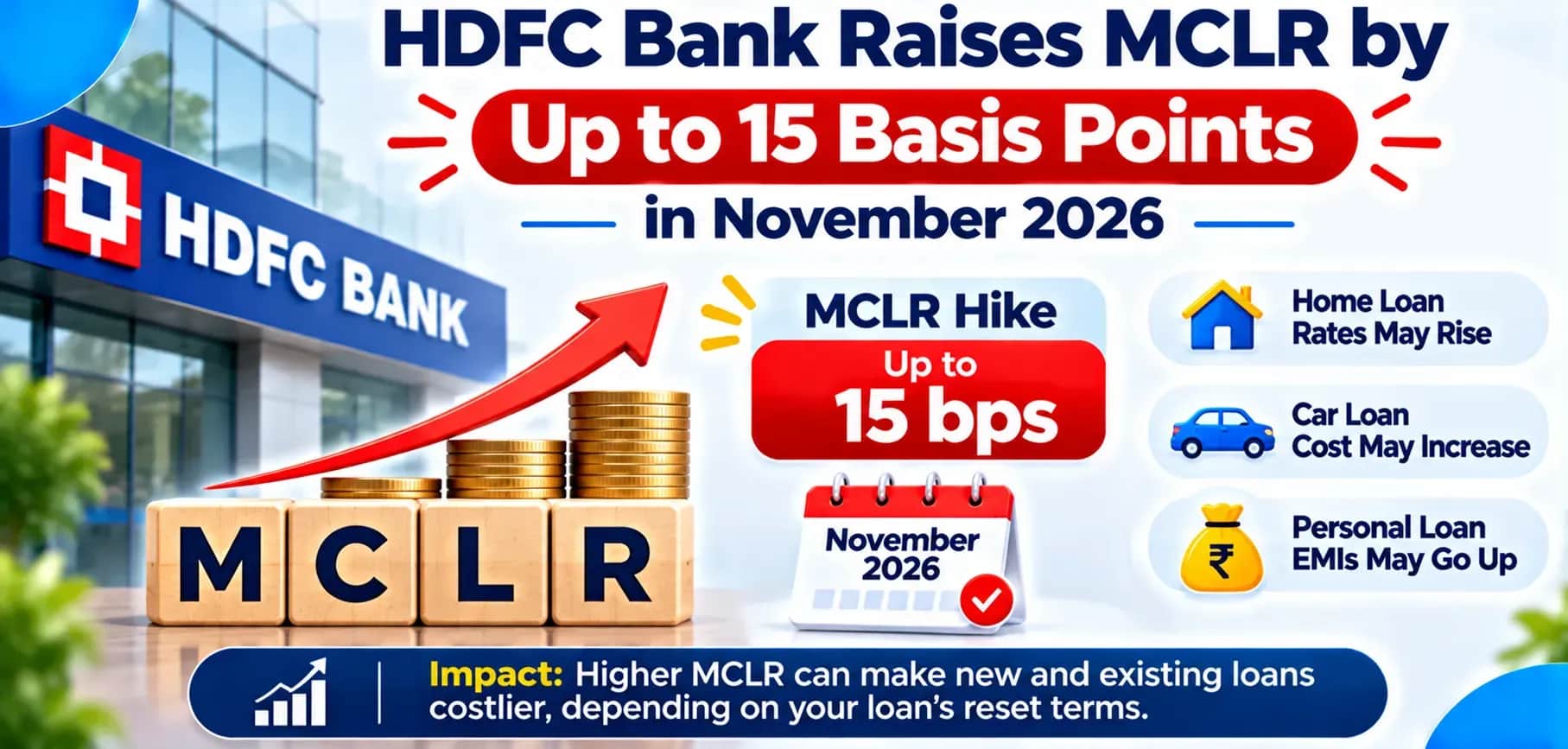
HDFC Bank raised its lending benchmarks by 5 to 15 basis points from 7 November 2026, potentially increasing borrowing costs when MCLR-linked loans next reset.
HDFC Bank raised its Marginal Cost of Funds-based Lending Rate (MCLR) across all 7 tenures from 7 November 2026. The 1-year benchmark moved from 8.30% to 8.45%. Some borrowers with floating-rate home, auto and personal loans may pay more in interest if their agreements link the loan to one of the benchmarks that rose.
The date to check on an existing loan is its next interest rate reset. A borrower whose rate was reset before 7 November could still be paying interest based on an earlier benchmark. If the next reset falls in a later month, the applicable MCLR will be the one in force at that point. The November schedule shows where the benchmarks stand now.
October’s schedule had brought cuts of 5 to 15 basis points across the published tenures. The November revision moved all 7 rates higher. The 1-month rate rose by 10 basis points to 7.85%, where it now sits alongside the overnight rate. A basis point is one-hundredth of a percentage point, so a move from 8.30% to 8.45% is a rise of 15 basis points.
Borrowers can use the tenure specified in their agreement to find the applicable benchmark in the table. For an account linked to the 1-year MCLR, the relevant November benchmark is 8.45%. The interest rate actually charged on that account also reflects the spread, or margin, specified in the loan terms.
The increase applies to the MCLR benchmark used to price eligible loans. The loan agreement identifies that benchmark, so two borrowers with the same type of loan may be affected differently. An older floating-rate home loan may still track MCLR. A home loan tied to the policy repo rate or another external benchmark follows the rate specified in its own agreement. Fixed-rate loans continue at the contracted rate for the duration of the fixed-rate period.
Banks have been required to link new floating-rate retail loans, including housing and auto loans, to an external benchmark since 1 October 2019. Existing MCLR-linked borrowers could continue under their earlier terms. The benchmark named in the agreement is therefore the most direct way to check whether the November revision applies to a particular account.
Yes. If the rate rises and the monthly instalment stays the same, more of each payment goes towards interest. The principal then takes longer to repay. If the remaining tenure is kept the same, the monthly instalment generally has to rise. The repayment schedule may also reflect a combination of a higher EMI and a longer tenure.
The change in rupees depends on the outstanding balance, the remaining repayment period and the interest rate applied at the reset. The October-to-November comparison shows how the benchmark moved. A borrower’s last reset may have used a rate from an earlier month, so the change in the rate charged on that account can differ from the movement shown in the table.
The agreement sets out the benchmark and the reset schedule. The latest statement shows the current interest rate and outstanding principal. After a reset, the revised repayment schedule shows the new EMI or the number of instalments left. Checking the number of payments remaining is particularly useful if the monthly debit still looks the same.
HDFC Bank’s November revision took the 1-year MCLR to 8.45% and the 3-year rate to 8.70%. Borrowers with an MCLR-linked loan can check the reset date in their agreement and use the revised repayment schedule to see how the change affects their monthly payment and expected closure date.
Yes. The bank raised all 7 published MCLR rates from 7 November 2026. The overnight rate recorded the smallest increase at 5 basis points.
The 1-year MCLR is 8.45%, up from 8.30% in October. The loan’s contracted spread also affects the rate charged to the borrower.
A repo-linked loan follows the policy repo rate and the terms in its agreement. The November MCLR hike applies to a separate lending benchmark.
The monthly amount depends on the repayment terms and how the reset is applied. Some borrowers may instead see more instalments added to the schedule.
Borrowers can check the reset clause in the loan agreement and look for the next reset date on their loan statement or rate revision notice.
Start your journey today
Apply Now*T&C apply











